Publish the PMO Inner-Circle Access Ledger
If the Prime Minister’s real decision pipeline is smaller than cabinet, caucus and normal public-service channels, Canadians deserve public guardrails.
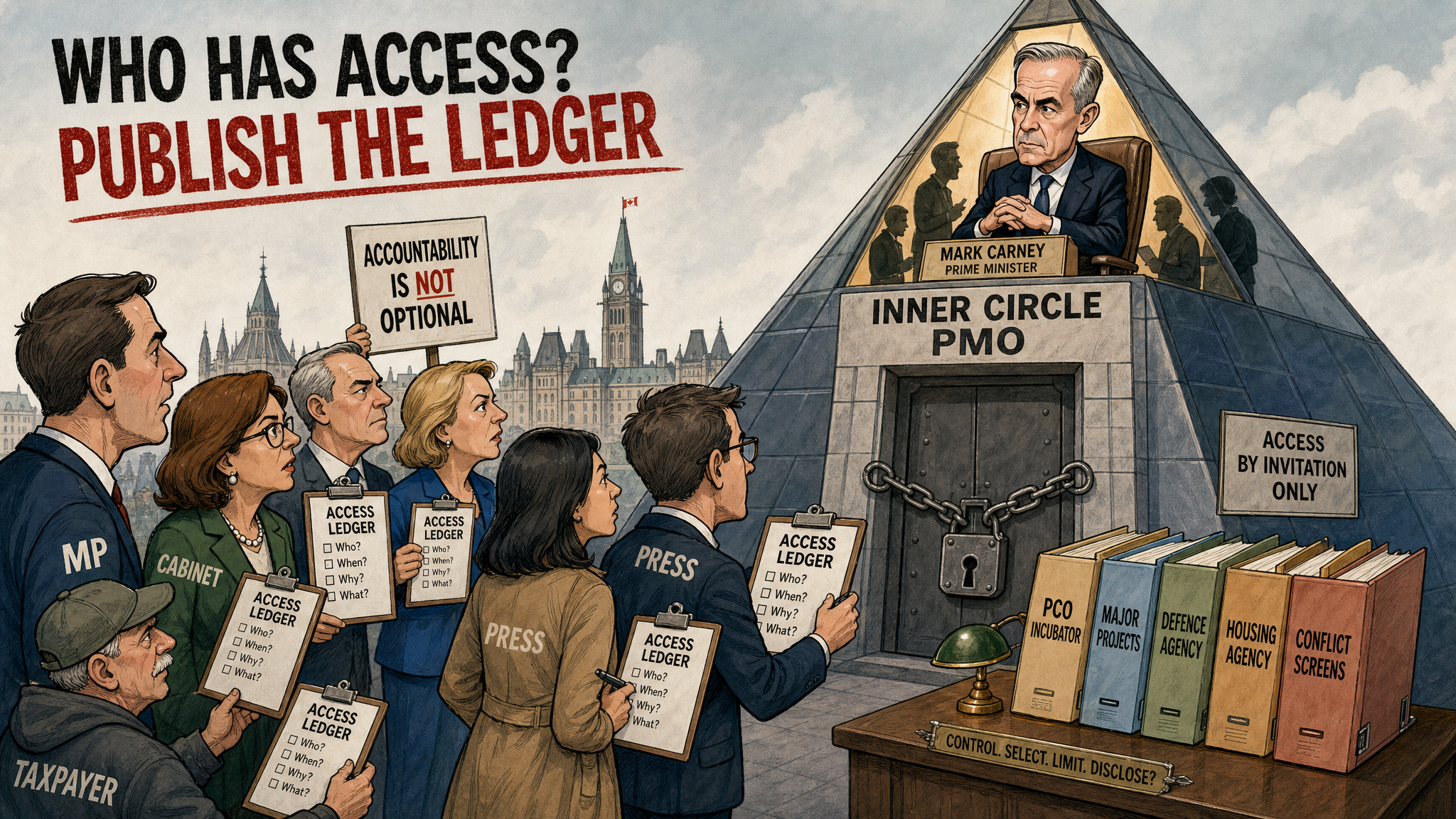
Justin Ling’s Toronto Star column should make every accountability conservative ask a simple question: if the Prime Minister’s real decision pipeline is this small, where is the public access ledger?
Ling’s reporting, based on conversations with people in and around the Carney government, describes a Prime Minister who runs Ottawa like an executive pyramid. Carney is clearly at the top. The circle below him is smaller than a traditional government. Ling reports that prominent Liberals put Carney’s inner circle in the single digits, and that nobody seemed entirely sure who belonged on the full list of confidants. That is not automatically scandalous. Prime ministers need trusted advisers. But trust inside government does not cancel transparency outside it.
The column names formal players: chief of staff Marc-André Blanchard, principal secretary Scott Gilmore, chief operating officer Maia Johnson, deputy chief of staff and chief economist Tim Krupa, Quebec adviser Andrée-Lyne Hallé, and outside counsel including Gerry Butts, Bruce Anderson and Jean Chrétien. It also reports that Carney’s personal Rolodex includes “very rich and powerful people,” with Michael Bloomberg cited as one example, and that Carney leans heavily on Privy Council Clerk Michael Sabia.
The official record confirms why this matters. The Government Electronic Directory lists the Prime Minister’s Office chief-of-staff branch and its senior roles. PMO announcements show Carney putting new machinery around major files: Doug Guzman at the Defence Investment Agency, Ana Bailão at Build Canada Homes, and Dawn Farrell at the Major Projects Office. Ling’s column adds the governance concern: Carney and Sabia are using the Privy Council Office like an “incubator” for new agencies and offices, while cabinet and Parliament are less central than Canadians may assume.
That structure may move faster. It may even deliver some good results. But speed is not a substitute for democratic visibility. When big decisions involve defence procurement, housing finance, national-interest projects, industrial policy, tariffs, infrastructure, AI or foreign investment, Canadians deserve to know whether advice came through accountable public channels or through informal access to the Prime Minister’s small circle.
The fix is not complicated. Publish a PMO access ledger. List senior political advisers and non-sensitive informal advisers who regularly shape government decisions. Disclose mandates, meeting categories, outside roles, lobbying registrations, conflict screens, recusals and the files on which advice was provided. For outside advisers, publish whether they were paid, whether they represented clients with federal interests, and whether cabinet or public-service officials received the same briefing.
No one is asking Ottawa to publish national-security secrets or private family conversations. The line is influence over public power. If a small group is shaping agencies with billions in procurement and policy authority, then Canadians should see the guardrails.
Carney sells competence as his brand. Competence without transparency becomes court government. Publish the inner-circle access ledger before the new executive state becomes too powerful to audit.
- Toronto Star via Internationly mirror: Justin Ling: Who does Mark Carney really listen to? I asked the insiders
- National Newswatch: Listing for Ling’s Toronto Star column
- Government Electronic Directory Services: Prime Minister’s Office — Office of the Chief of Staff
- Prime Minister of Canada: Launch of the Major Projects Office
- Prime Minister of Canada: Launch of Build Canada Homes
- Prime Minister of Canada: Creation of the Defence Investment Agency
This article distinguishes formal public roles from reported informal influence. The accountability demand is disclosure of governance guardrails, not disclosure of sensitive national-security advice or private family conversations.