The “Whole Truth” Needs Speech-Law Guardrails
Truth matters. So do the legal boundaries when Ottawa considers turning historical disputes into criminal prosecutions.
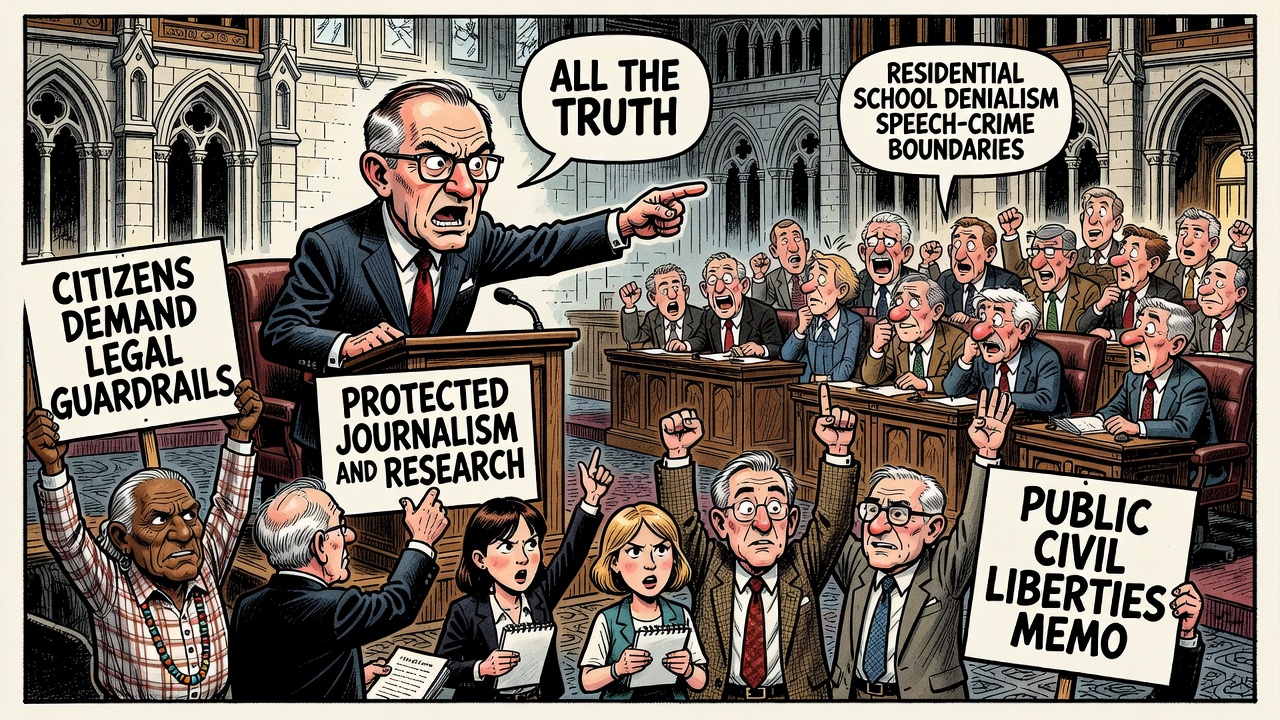
Prime Minister Mark Carney used his September 30 National Day for Truth and Reconciliation remarks to say truth is the foundation of justice and that Canada must face its “whole truth.” That is a serious statement about a serious history. It should not become a blank cheque for vague criminal law.
Residential schools were real. The damage was real. Carney’s official statement says more than 150,000 First Nations, Inuit and Métis children were sent to the schools, and that more than 6,600 Survivors and witnesses came forward to the Truth and Reconciliation Commission. A responsible free-speech argument does not require denying any of that.
The live accountability question is narrower: will Carney’s Liberals adopt NDP MP Leah Gazan’s Bill C-254, or a government version of it, and where exactly would the criminal boundary sit? Parliament’s own bill page says C-254 is a private member’s bill to amend the Criminal Code on the “promotion of hatred against Indigenous peoples.” The bill text would create an offence for wilfully promoting hatred by condoning, denying, downplaying or justifying the Indian residential school system, or by misrepresenting facts relating to it, outside private conversation.
That wording demands caution. “Wilfully promotes hatred” is a high threshold. But terms like “downplaying” and “misrepresenting facts” can become elastic when politics, journalism, archival research and protest collide. A historian arguing over numbers, a journalist testing a public claim, a survivor with a dissenting memory, or a citizen asking what evidence proves a specific allegation should not need a criminal lawyer before speaking.
Ottawa has already expanded hate-crime law this year. Justice Canada says Bill C-9, the Combatting Hate Act, received royal assent on June 18, 2026, and added a hate-crime offence, a Criminal Code definition of hatred, access-to-place protections and a new offence for public display of certain terrorism or hate symbols. That is not a small legal backdrop. Before layering on a new denialism offence, cabinet should explain why existing law is insufficient.
Gazan’s September 28 statement says she offered her bill to the Liberals as a government bill and argues this is about incitement of hate, not freedom of speech. Fine: publish the memo that proves it. Canadians should see the Charter analysis, consultation record, examples of conduct that would be prosecuted, examples of lawful debate, Attorney General consent standards, complaint-screening rules, and explicit protections for journalism, research, education, religious discussion, good-faith public-interest debate and Indigenous voices that do not fit a government script.
Conservatives should not defend cruelty toward Survivors. They should defend precision in criminal law. If Carney believes truth is the foundation of justice, he should also accept that justice needs guardrails. The state must punish threats and incitement. It must not appoint itself the final editor of history.
- Prime Minister of Canada: Prime Minister Carney delivers remarks on the National Day for Truth and Reconciliation — September 30, 2026
- Prime Minister of Canada: Statement by Prime Minister Carney on the National Day for Truth and Reconciliation — September 30, 2026
- Parliament of Canada: Bill C-254, An Act to amend the Criminal Code (promotion of hatred against Indigenous peoples)
- Parliament of Canada: Text of Bill C-254, First Reading
- Justice Canada: Combatting Hate Act backgrounder
- Leah Gazan: Statement on the denialist attack at Tk’emlúps te Secwépemc First Nation — September 28, 2026
- Juno News: ‘All the truth’? Carney goes silent on ‘unmarked graves’ in reconciliation speech — October 1, 2026
This article rejects harassment or hatred toward Survivors and Indigenous communities. It argues that any new Criminal Code offence must be narrowly drafted, publicly justified and protected against political misuse.