$40B Reconciliation Spending Needs Receipts
Ottawa can respect Indigenous self-government while still publishing the federal reconciliation ledger taxpayers and communities deserve.
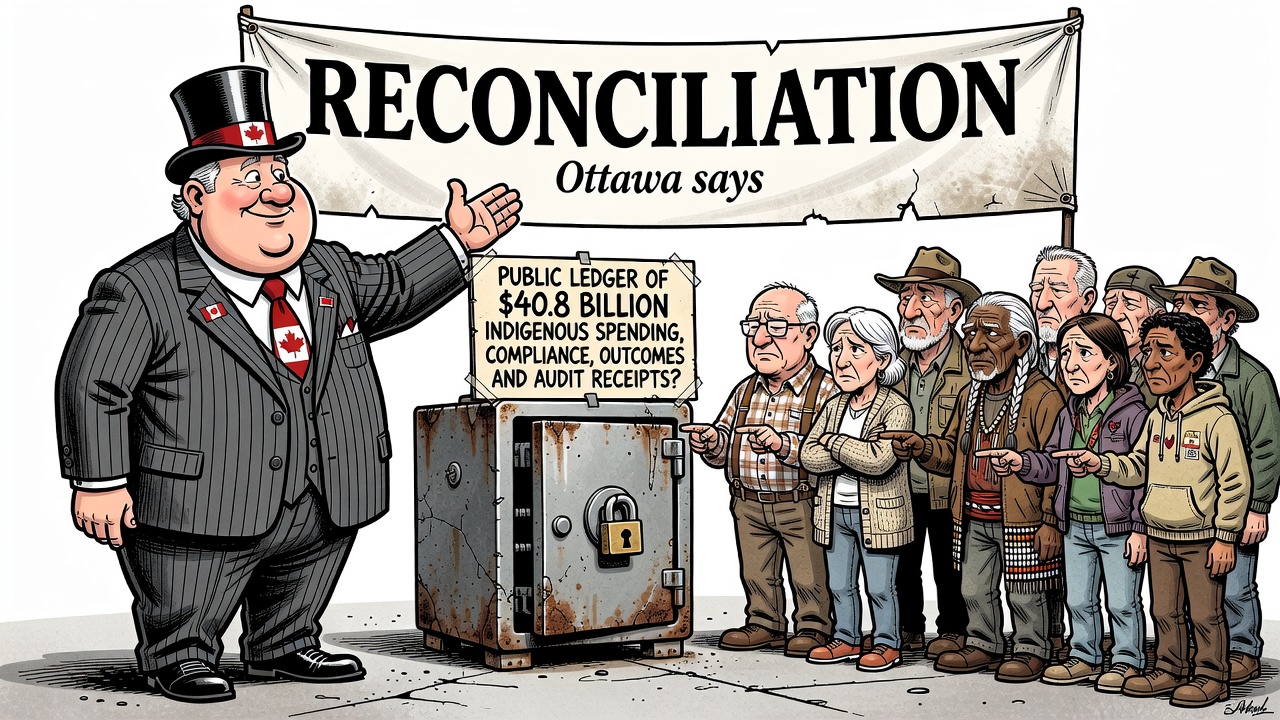
Prime Minister Mark Carney used the National Day for Truth and Reconciliation to say Canadians must face “all the truth.” Fine. Then Ottawa should apply the same standard to its own reconciliation spending: show the public the money, the outcomes, the audits and the reporting gaps.
This is not an argument against reconciliation, self-government or better services in First Nations, Inuit and Métis communities. It is the opposite. Reconciliation funded with public dollars cannot survive on slogans. It needs confidence from citizens, taxpayers and the communities the programs are meant to serve.
The scale is no longer small. A Fraser Institute release says inflation-adjusted federal Indigenous spending rose from $10.3 billion in 2014-15 to $40.8 billion in 2024-25, excluding substantial lawsuit and settlement spending. Indigenous Services Canada’s own 2025 annual report says the New Fiscal Relationship 10-Year Grant now provides more than $1.6 billion annually in flexible funding to 160 First Nations, with 99 new expressions of interest.
Flexible funding can be legitimate. Local control can work better than Ottawa micromanagement. But flexibility is not a substitute for public accountability. When billions move through federal departments, transfer agreements and long-term grants, Canadians deserve a clear ledger showing what was spent, where it went, what outcomes improved, what backlogs remain, and what controls protect the money from failure, favouritism or waste.
The reporting side is exactly where the problem becomes politically uncomfortable. Juno News highlighted renewed scrutiny over financial disclosure and cited a public claim that only 41% of First Nations posted financial reports in 2024-25. Indigenous Services Canada’s March 2024 committee material explains Ottawa’s position: the government suspended enforcement of the First Nations Financial Transparency Act in 2015 after hearing that the law conflicted with self-determination and First Nations’ primary accountability to their citizens.
That rationale deserves to be heard. It still does not answer the federal question. If Ottawa believes the old Act was paternalistic or inconsistent with modern partnership, then it should publish the replacement accountability system. Where is the mutual-accountability framework? Where is the First Nations auditor general or audit function Ottawa said it was working toward? Which reports are public, which are community-only, which are filed to Ottawa, and which are missing altogether?
A conservative accountability test is simple: respect Indigenous governments, but do not let federal ministers hide behind them. Ottawa should publish a department-wide reconciliation receipt ledger covering spending by stream, annual outcomes, reporting compliance, audit status, enforcement or non-enforcement decisions, grant recipients, administrative costs, and unresolved data gaps. It should separate money that reaches communities from money consumed by bureaucracy, consultants, litigation and program overhead.
Carney says truth is the foundation of justice. Then the truth about $40.8 billion in annual spending should not require access-to-information battles, partisan leaks or think-tank reconstruction. If the money is working, the receipts will prove it. If it is not, the people most harmed by Ottawa’s opacity will be the very communities reconciliation is supposed to serve.
- Juno News: ‘All the truth’? Carney goes silent on ‘unmarked graves’ in reconciliation speech — October 1, 2026
- CNW / Fraser Institute: Federal Indigenous spending reached $40.8 billion in 2024/25 — September 25, 2026
- Todayville / Fraser Institute: Over half of Canadian First Nations no longer comply with the Financial Transparency Act
- Indigenous Services Canada: Annual Report to Parliament 2025
- Indigenous Services Canada: Standing Committee appearance materials: FNFTA section — March 20, 2024
This article does not allege wrongdoing by any Indigenous government or recipient. It argues that federal ministers should publish clear public receipts for federal reconciliation spending and accountability systems.