The Losses-of-Public-Money Recovery Ledger
Ottawa reports losses and recoveries every year. Publish the department-by-department recovery plan, not just the damage totals.
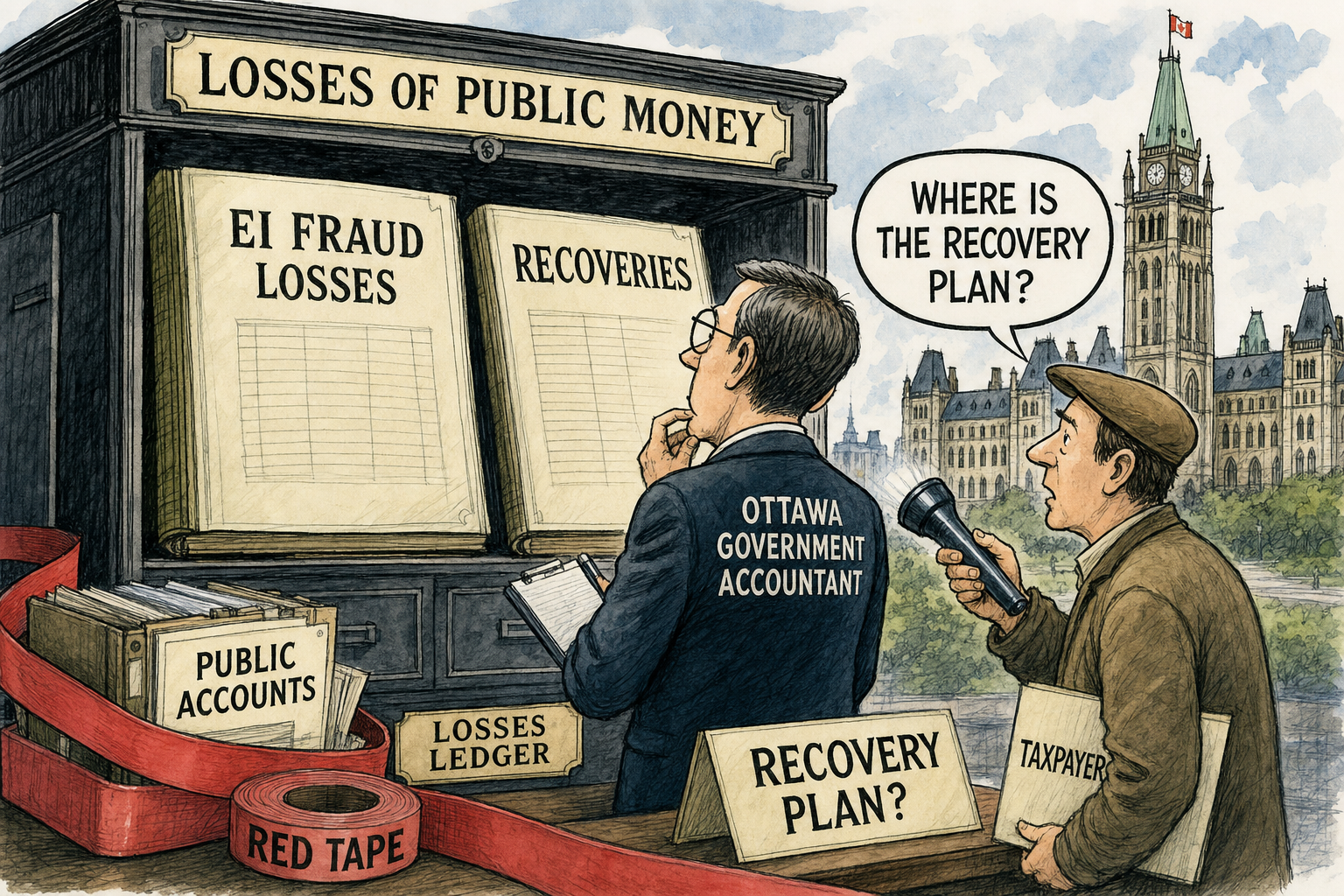
Ottawa does publish a losses ledger. The problem is that the ledger too often stops where accountability should begin: at the gap between money lost and money recovered.
OttawaSpends, an independent search project built from official Government of Canada open data, says its database is imported weekly and was current to October 3, 2026. Its home page reports $970.6 billion in published spending across 1,313,418 records, 60 departments and agencies, and 200 recipient countries. Its “losses of public money” page pulls the Public Accounts losses into a searchable list.
The results deserve a hard question from Parliament. For 2024-2025, OttawaSpends lists a Department of Employment and Social Development entry for a “Fraudulent claim for Employment Insurance Benefit” with $614,035,665 in losses and $212,275,277 recovered. That leaves a displayed gap of $401,760,388. On the same page, a 2024-2025 Parks Canada Agency entry for damage to building or other real property, classified as accidental loss, destruction or damage, shows $346,074,538 in losses and $681,621 recovered.
Those numbers should not be waved around as proof that every unrecovered dollar is gone forever. Public Accounts tables include amounts not expected to be recovered and amounts expected to be recovered in later years. But that is exactly why the Liberal government should publish a plain-language recovery plan beside every major loss entry: what happened, who is accountable, what has been recovered, what is still being pursued, what has been written off, and what control failed.
The official Public Accounts of Canada 2025 page confirms the reporting framework. It includes separate tables for losses of public money due to offences, illegal acts or accidents, accidental losses of public property, and updates to cases reported in previous years. For example, the 2024-2025 table for Employment and Social Development records $279,151,875 in losses for fraudulent Employment Insurance benefit claims and $59,501,238 recovered in 2024-2025. The accidental public-property table records Parks Canada damage to building or other real property at $285,116,959, with $586,581 recovered in 2024-2025.
That is not enough for taxpayers. A table is a disclosure, not a management answer. If Ottawa can publish the loss, it can publish the recovery owner, deadline, enforcement status, write-off authority and prevention fix. If a department repeatedly reports large fraud-loss entries, the responsible minister should table a program-integrity scorecard with case volumes, recovery rates, prosecutions or penalties, and the reason any balance is judged unrecoverable.
Conservative accountability does not mean pretending every complex file has a simple villain. It means refusing to let large losses become routine accounting footnotes. Canadians fund the programs. Canadians deserve the recovery ledger.
- OttawaSpends: Where federal money goes
- OttawaSpends: Losses of public money
- Public Accounts of Canada 2025: Public Accounts index
- Public Accounts of Canada 2025, Volume III: Losses of public money and property
OttawaSpends is used here as a searchable presentation layer for official Government of Canada data. The official Public Accounts page is cited for the underlying federal reporting framework and table components.