Buy Canadian Means Show LNG Canada’s Supplier Ledger
Do not cancel LNG. Do not hide the supplier, waiver and security-risk receipts either.
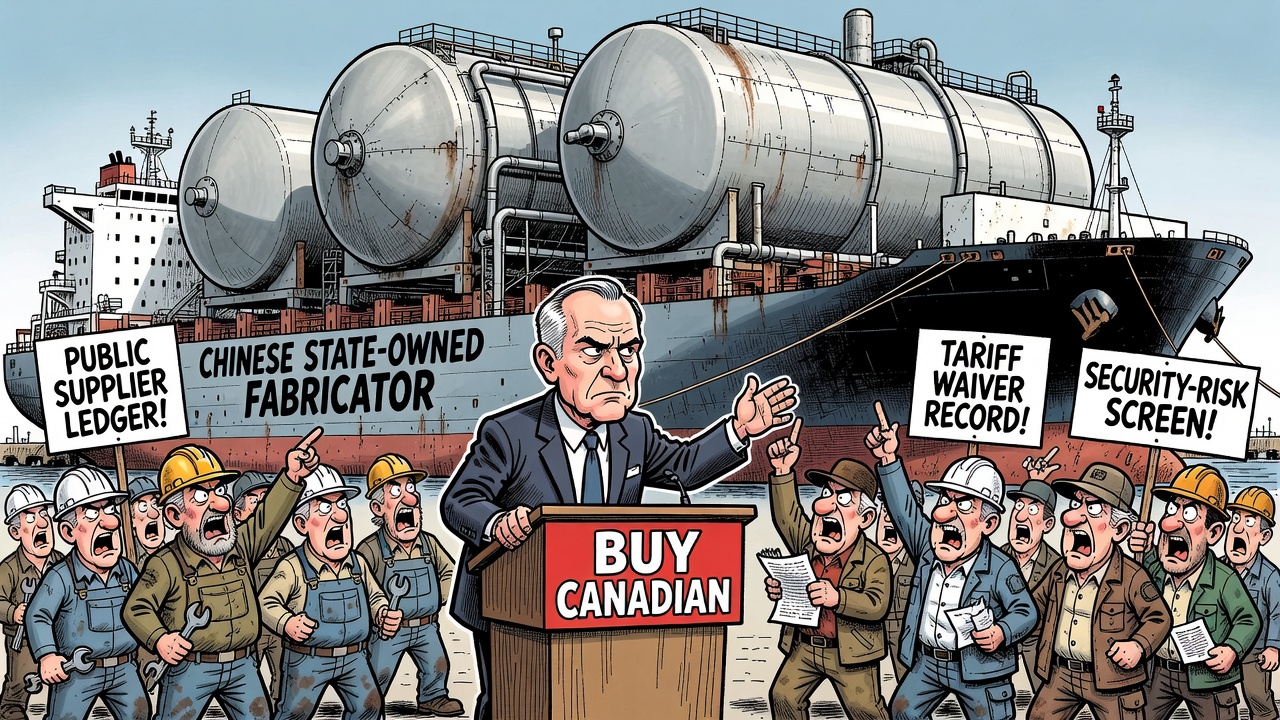
LNG Canada Phase 2 can be good news for Canadian workers, Indigenous partners and energy exports. That is exactly why the public should not have to accept a slogan in place of a ledger.
On September 29, the Prime Minister’s Office celebrated LNG Canada’s final investment decision as a $33-billion private-sector expansion in Kitimat, supported through the federal Major Projects Office. Ottawa said the project would double terminal capacity to 28 million tonnes a year, create more than 4,000 direct construction jobs and make LNG Canada the second-largest facility of its kind in the world.
Then came the uncomfortable follow-up. CBC reported on October 2 that LNG Canada will again use Chinese steel and components for specialized module fabrication, including more work from China Offshore Oil Engineering Co. Ltd. The company told CBC the issue is not preference but capacity: it says no Canadian fabrication yard can manufacture and deliver the additional modules required for Phase 2 at this scale and complexity.
That may be true. But if it is true, it proves the accountability point. A government cannot sell major projects as the centrepiece of a “Buy Canadian” policy, take a victory lap when the investment lands, and then shrug when the most politically sensitive sourcing question appears. If Canadian yards cannot build these modules, Canadians deserve to know when Ottawa knew, what domestic-capacity plan exists, and whether any federal support was conditioned on Canadian content elsewhere in the project.
The ownership structure also demands daylight. PMO lists LNG Canada’s partners as Shell Canada at 40 per cent, PETRONAS at 25 per cent, PetroChina at 15 per cent, Mitsubishi at 15 per cent and KOGAS at 5 per cent. Foreign participation does not automatically make a project bad. But a Chinese state-owned shareholder, Chinese state-linked fabrication, port infrastructure and a federal fast-track office are enough to require a clear public risk screen.
The right conservative answer is not anti-development theatre. Build the project. Sell Canadian gas to Asia. Create jobs. But publish the supplier ledger: what is being bought in Canada, what is being fabricated offshore, which firms are doing the work, what tariff or remission treatment applies, whether any national-security review was conducted, and what Ottawa is doing so the next megaproject does not need the same answer.
Carney wants Canadians to believe the new major-project machine will rebuild national strength. National strength is not just ribbon cuttings. It is steel capacity, transparent procurement, enforceable Canadian-content rules and security discipline. If “Buy Canadian” is more than branding, the LNG Canada file is where Ottawa can prove it.
- Prime Minister of Canada: Prime Minister Carney welcomes LNG Canada Phase 2
- CBC News: LNG Canada to use Chinese steel on $33B expansion project in Kitimat, B.C.
- Yahoo News mirror: CBC report on LNG Canada’s Chinese steel plan
- Western Standard: Buy Canadian pledge faces scrutiny over LNG Canada plans
This article supports responsible LNG development while arguing that federal Buy Canadian claims, Major Projects Office support and China-linked sourcing decisions should be documented in a public ledger.