India Diplomacy Needs a Canadian Safety Ledger
Diplomacy is not a safety metric. If Canada-India security cooperation has improved, Ottawa should publish the receipts Canadians can verify.
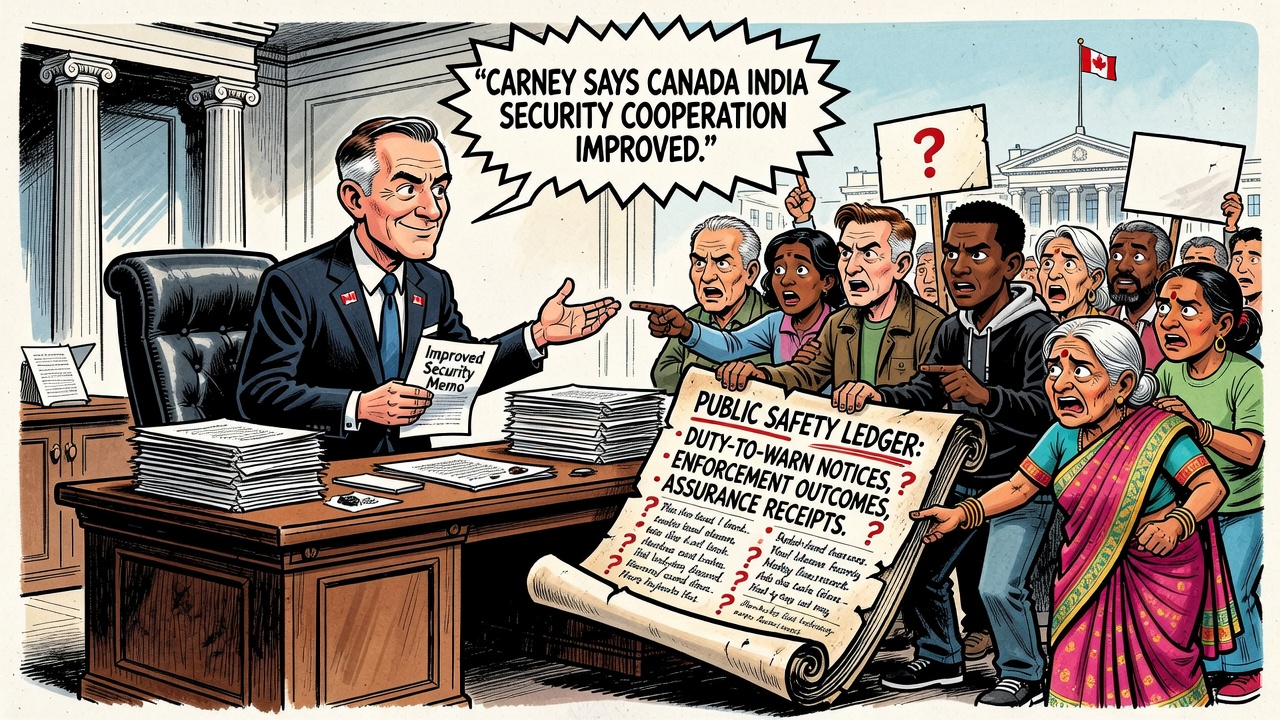
Prime Minister Mark Carney wants Canadians to believe the Canada-India relationship can be rebuilt without sacrificing public safety at home. That may be possible. But it cannot be proven by warm diplomatic language, trade ambitions or private assurances from New Delhi. It requires public, non-operational receipts.
Recent reporting says Carney told New York Times interviewers there was evidence that renewed engagement with India had improved security cooperation, while declining to guarantee that India-linked crimes would not recur in Canada. That is a realistic answer in one sense: no prime minister can guarantee the future. But after what Canadians were told by police in 2024, “trust us, cooperation is better” is not enough.
The RCMP’s October 14, 2024 statement was not vague. The national police said it had evidence connected to agents of the Government of India involving homicides and violent acts, the use of organized crime against South Asian communities, coercion and democratic-process interference. The RCMP also said more than a dozen credible and imminent threats to life had triggered duty-to-warn notices, particularly affecting members of the South Asian community and the pro-Khalistan movement.
That is the baseline Carney inherited. CSIS has also continued to identify transnational repression as a real threat in Canada, warning that foreign states can use intimidation, coercion and violence to silence communities here. If Ottawa now says the security channel with India is healthier, Canadians deserve to know what changed without exposing investigations, sources or victims.
A conservative accountability approach would not ask police to publish case files. It would ask the government to publish a safety ledger: the number of duty-to-warn notices by quarter, the number of diaspora safety briefings held, the dates ministers were briefed, enforcement outcomes that can be disclosed, charges or disruptions already public, categories of assurances sought from India, and whether any promised cooperation has been independently verified by Canadian agencies.
That ledger should also state the threshold for normalization. Are high-level visits, trade talks and security dialogues contingent on measurable reductions in threats? What happens if another credible threat is traced to foreign-state direction? Who tells affected communities first? Who reports to Parliament?
Canada can pursue diplomacy with India. It can cooperate on trade, migration, counterterrorism and regional security. But Canadian citizenship must come first. Diaspora communities should not be treated as background noise in a reset built for cabinet photo ops and export headlines.
If Carney wants credit for calmer relations, he can publish calm evidence: warnings down, investigations moving, communities briefed, assurances documented and consequences ready. Until then, improved cooperation is a claim — not a safety record.
- RCMP: RCMP statement on violent criminal activity occurring in Canada with connections to agents of the Government of India — October 14, 2024
- National Post via Unpublished: Carney says he cannot guarantee India will no longer be involved in crimes in Canada — September 28, 2026
- Juno News: Carney won’t guarantee end to India-linked crimes in Canada — September 29, 2026
- CSIS: Operations and analysis — CSIS Public Report 2025
- Prime Minister of Canada: Prime Minister Carney meets with Prime Minister of India Narendra Modi — March 2, 2026
This article argues for public reporting on safety metrics. It does not allege that any person not charged with an offence committed a crime.