October 3 Foreign-Influence Registry Deadline Needs a Public Ledger
A registry is not accountability if Canadians only see what Ottawa has already validated. The real test is the backlog, the delays and the enforcement record.
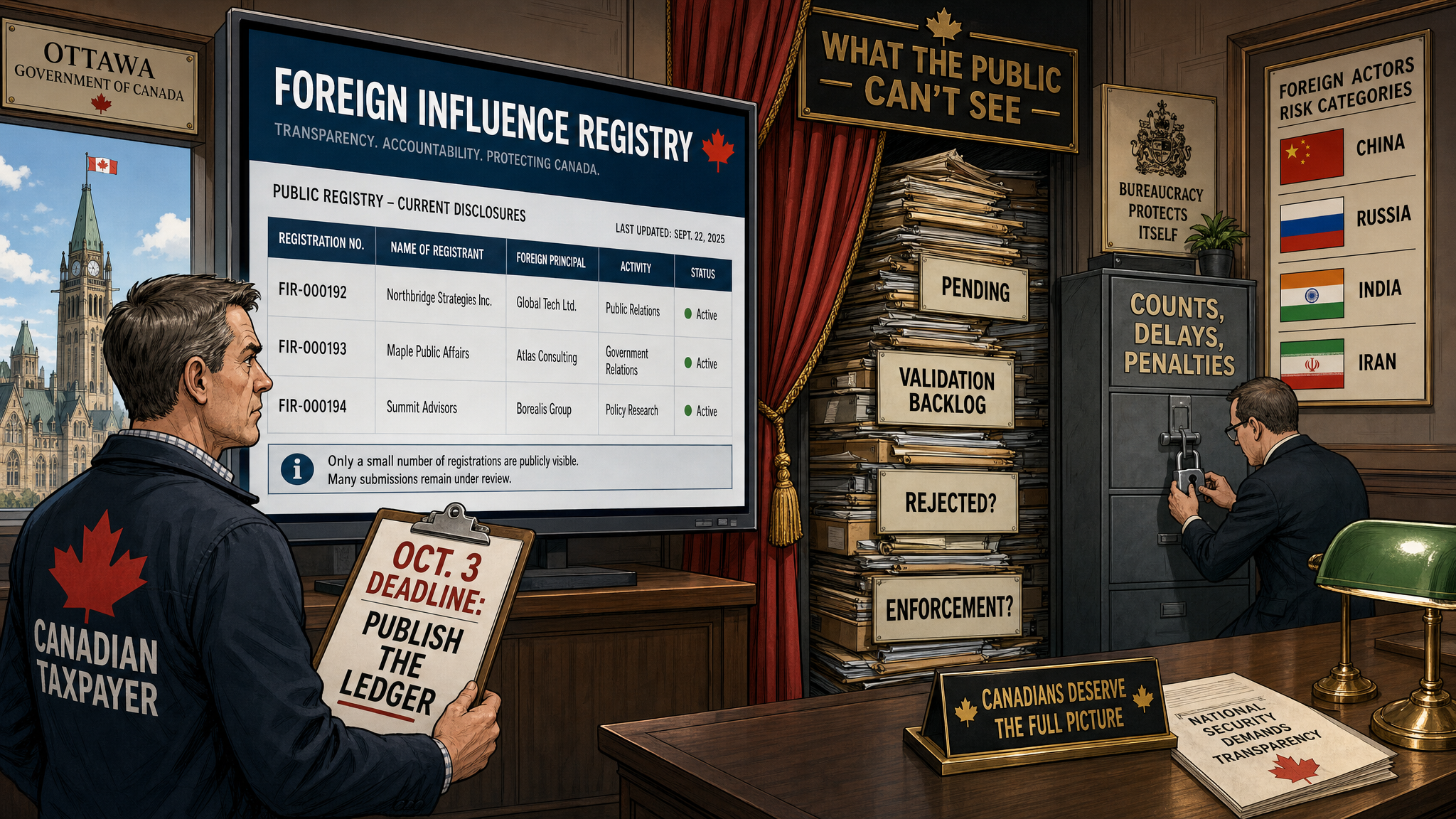
Canada’s foreign-influence registry finally exists. That is the good news. The accountability test arrives on October 3, 2026, when arrangements that existed before the August 4 launch hit their transition deadline. After that date, the Liberal government should not be allowed to point at a website and declare the foreign-interference file handled.
Public Safety Canada announced on August 4 that the Foreign Influence Transparency and Accountability Act and its regulations had come into force, formally creating a public registry overseen by independent Commissioner Anton Boegman. The rules require people or organizations with covered arrangements involving a foreign principal to register within 14 days; pre-existing arrangements have until October 3 to submit.
The registry page itself says registrations began August 4 and that information appears publicly only after it is reviewed and validated. That matters. A visible registry entry is not the same thing as the universe of filings received. Canadians cannot judge whether the system is working unless they know how many filings are pending, corrected, rejected, withdrawn, delayed, removed, restored or investigated.
This is not a theoretical concern. On June 18, Global News reported that Canada still did not have an operational public database six months after draft rules, while civil-society and diaspora groups were pressing Ottawa to finish the work. The registry’s eventual launch does not erase the delay; it makes measurement of the delay more important.
Nor should anyone oversell what the registry can do. CIGI senior fellow Wesley Wark argued on October 1 that the program is country-agnostic, broad enough to risk chilling legitimate advocacy, and not a substitute for CSIS, RCMP and other national-security work against covert interference. That critique cuts both ways. If the registry is broad, Ottawa must show it is not burying innocent civic activity in bureaucracy. If the registry is limited, Ottawa must show it is not pretending transparency paperwork will expose hostile-state operations by itself.
The conservative accountability answer is straightforward: publish the transition ledger. Within days of the October 3 deadline, Canadians should see total filings received, validations completed, median validation time, pending inventory, rejected or corrected registrations, country and foreign-principal categories, activity types, technical incidents, investigations opened, penalties considered, penalties issued, law-enforcement referrals and any public-interest removals from the registry.
That ledger should also explain how the office is handling risk from China, Russia, India, Iran and other hostile or high-risk actors without turning ordinary diaspora advocacy, diplomatic contact or public-policy debate into a compliance trap. Transparency must target influence, not chill citizenship.
A foreign-influence registry can help Canadians see who is trying to shape public decisions. But a black box with a search bar is still a black box. If Ottawa wants credit for transparency, it can start by publishing the backlog, validation and enforcement receipts.
- Public Safety Canada: Government of Canada establishes foreign influence registry — August 4, 2026
- Office of the Foreign Influence Commissioner: Registration and compliance
- Office of the Foreign Influence Commissioner: Statement from Commissioner Boegman on the foreign influence registry — September 16, 2026
- Office of the Foreign Influence Commissioner: Registry of foreign influence activities
- Global News: Canada still doesn’t have a foreign influence registry, and advocates are worried — June 18, 2026
- Centre for International Governance Innovation: If This New Federal Program “Won’t Solve Foreign Interference in Canada,” Then What Will It Do? — October 1, 2026
This article argues for public reporting on the registry’s operation. It does not allege that any listed registrant has engaged in illegal activity.