Alto’s $113B Watchdog Estimate Needs a Cost-Creep Ledger
A high-speed rail line may sound visionary. A $23-billion gap between Ottawa’s upper estimate and the budget watchdog’s upper estimate sounds like a taxpayer warning light.
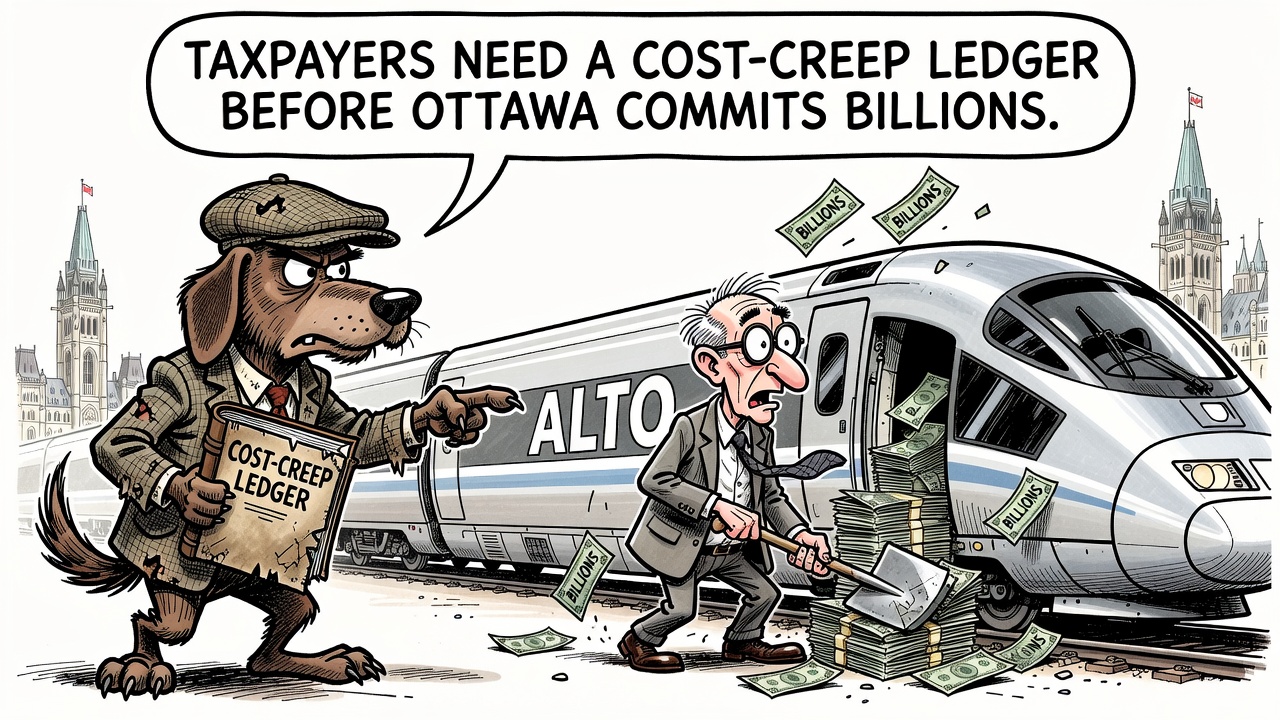
The Parliamentary Budget Officer has put a hard number beside Ottawa’s Alto high-speed rail dream. In an October 1 report on the proposed Toronto–Québec City corridor, the PBO estimated the baseline route, excluding a possible Kingston amendment, could cost between $75 billion and $113 billion to construct. Ottawa’s public working estimate has been $60 billion to $90 billion.
That does not prove Alto should be cancelled tomorrow. It does prove that “nation-building” is not a budget. If the top of the independent watchdog’s range is $23 billion above the top of Ottawa’s headline range, taxpayers deserve a public cost bridge before the project becomes too politically large to stop.
Alto itself says its $60-billion to $90-billion figure is a preliminary planning assumption, not a project budget, and that costs will be refined through development and pre-construction. Fair enough. Then publish the assumptions. Show Canadians what is included, what is excluded, what is contingency, what is financing cost, what is operating risk, and what is simply unknown.
The PBO’s risk list is not abstract. Tunnels and elevated structures are major cost drivers. The report estimates each additional kilometre of tunnel could add about $169 million, while each additional kilometre of elevated structure could add about $153 million. It also points to Montreal tunnelling, Canadian Shield engineering, land acquisition, permitting, litigation, design changes and project-management weakness as real escalation risks.
Those are exactly the places where Liberal megaproject politics usually goes soft: announce the upside, defer the route pain, and let future taxpayers discover the overruns. The PBO even notes that every later construction-start year is associated with roughly $1.5 billion in added cost. Delay is not free; neither is haste if it bulldozes due diligence.
Nor can Ottawa hide behind the stimulus line. The PBO estimates the initial Ottawa–Montréal construction segment could lift real GDP by about $1.8 billion in 2029 and $2.0 billion by 2033, with employment gains rising from roughly 4,300 to 9,000. But those are level effects during construction, not a blank cheque, and the report does not yet answer whether ridership will sustain operations. A second PBO report is supposed to tackle that question.
So the conservative accountability test is simple: before a final investment decision, publish an Alto cost-creep ledger. It should compare Ottawa/Alto’s $60-billion-to-$90-billion assumptions with the PBO’s $75-billion-to-$113-billion estimate, disclose route risks, land and expropriation exposure, tunnel and elevated-structure assumptions, procurement terms with Cadence, private-risk transfer, ridership and fare assumptions, operating subsidies, and the point at which cabinet must pause or cancel the project.
If Alto is truly affordable, the ledger will help prove it. If it is not, Canadians should find out before the bill reaches $113 billion.
- Parliamentary Budget Officer: Canada’s Eastern Corridor High-Speed Rail: A Cost Analysis using Global Data — October 1, 2026
- Parliamentary Budget Officer: PBO report assesses costs and economic impacts of Alto’s Eastern Corridor high-speed rail project — October 1, 2026
- CityNews / The Canadian Press: Budget watchdog says Alto rail construction could cost more than Ottawa predicts — October 1, 2026
- Alto: Your questions about Alto: cost, timeline and public feedback — March 6, 2026
This article does not argue against passenger rail improvements. It argues that a taxpayer-backed megaproject requires public assumptions, risk transfer and cancellation thresholds before a final investment decision.