Pacific Link Needs Receipts Before Taxpayers Own the Risk
Carney can argue for pipelines and still owe Canadians the cap table, debt treatment, permit list and consent record before the public carries the risk.
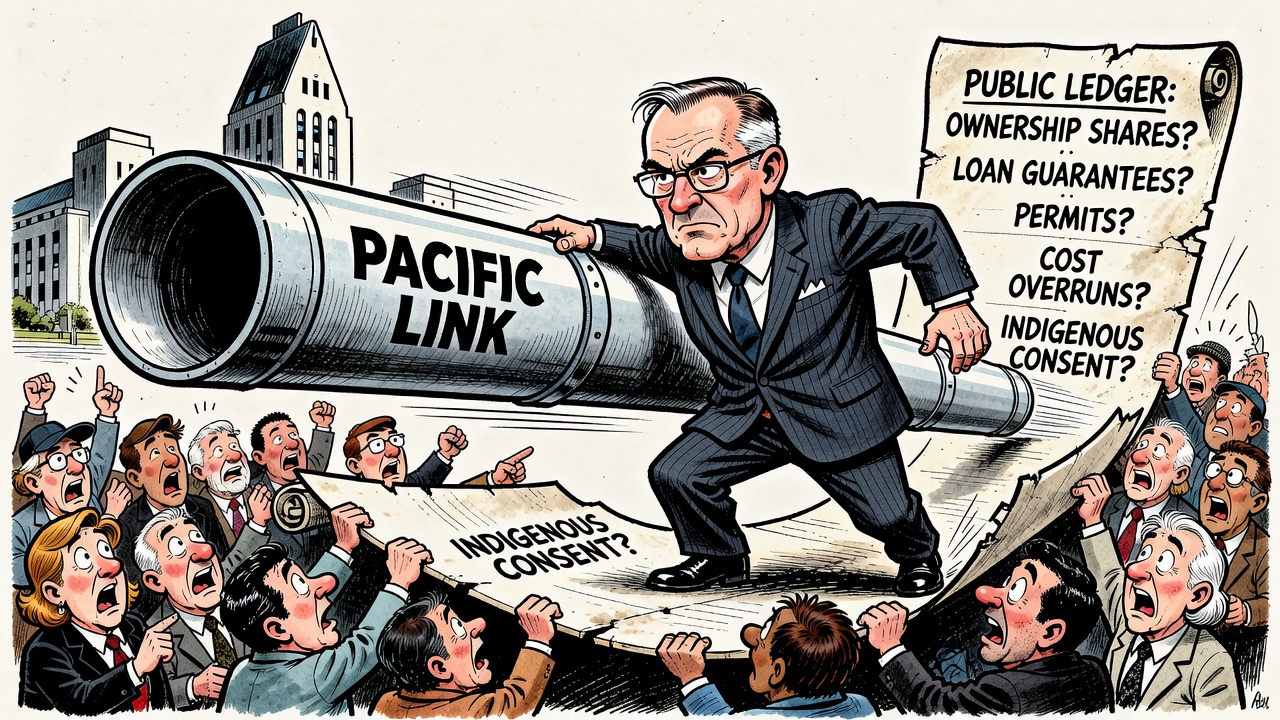
Prime Minister Mark Carney has now put a name and a fast-track label on Ottawa’s West Coast oil-pipeline push. On October 1, the PMO announced that the West Coast Oil Pipeline, now called Pacific Link, is officially listed as a project of national interest under the Building Canada Act.
There is a serious conservative case for getting Canadian energy to tidewater and reducing dependence on the U.S. market. But “nation-building” cannot become a magic phrase that turns public debt, regulatory shortcuts and unresolved consultation into background noise. If taxpayers are being asked to stand behind Pacific Link, taxpayers deserve the receipts before the deal hardens.
The government says Canada and Alberta will share equal ownership, Indigenous communities will be offered at least 10 percent ownership financed through loan-guarantee programs, Pembina Pipeline will participate as a private-sector investor, and Trans Mountain Corporation will lead development. That is not a normal private pipeline announcement. It is a public balance-sheet question.
So publish the cap table. Publish which dollars are equity, which are debt, which are guarantees, and which liabilities would sit with Ottawa, Alberta, Trans Mountain or private investors. Publish the cost-overrun rules before costs overrun. Canadians remember Trans Mountain: optimistic politics at the start, taxpayer exposure later.
The permitting track needs the same sunlight. PMO says the Major Projects Office, supported by the Canada Energy Regulator, will run the federal review and develop conditions by September 1, 2027. Global News reported that the decision moves the project into the new fast-track system and that a conditions document is expected after regulatory review and public hearings.
That may create investor certainty, but it also concentrates power. Ottawa should release a plain-language ledger showing which permits, authorizations, hearings, environmental conditions and court-tested duties are being consolidated, accelerated or replaced. A deadline is not accountability unless the public can see what is being compressed.
The consent record matters too. The Athabasca Chipewyan First Nation said the announcement does not mean the pipeline will be built, does not resolve environmental concerns, and does not constitute ACFN’s consent. UBCIC said consultation is incomplete and warned that First Nations title and rights cannot be set aside for a political timeline. Those are not anti-development footnotes; they are legal and democratic warning lights.
Carney’s own numbers make the transparency test larger. The PMO says Pacific Link could move an additional one million barrels per day to Asian markets, create 140,000 jobs, generate more than $20 billion in GDP per year, and produce $100 billion in government revenue by 2060. If Ottawa can publish promotional upside that precise, it can publish downside exposure with the same precision.
Build if it is lawful, economic and consented to. But do not ask Canadians to applaud a cabinet fast-track while the risk ledger stays locked. Before Pacific Link becomes another taxpayer-backed megaproject, publish the ownership, debt, guarantee, permit, consultation and cost-overrun receipts.
- Prime Minister’s Office: Prime Minister Carney lists the West Coast Oil Pipeline, now known as Pacific Link, as a project of national interest — October 1, 2026
- Global News: Pacific Link pipeline to the West Coast officially designated a “national interest” project — October 1, 2026
- Athabasca Chipewyan First Nation: Statement to ACFN Members on the Proposed Pacific Link Pipeline — October 1, 2026
- Union of B.C. Indian Chiefs: UBCIC Rejects “National Interest” Designation for Pacific Link Pipeline — October 1, 2026
- Wilderness Committee: Canada’s most expensive extinction attempt now has a name: “Pacific Link Pipeline” — October 1, 2026
This article supports lawful Canadian energy development while arguing that public ownership, loan guarantees and fast-track powers require public receipts before taxpayers carry the risk.