No Immigration Increase Before the Control Receipts
Carney is talking about a controlled immigration increase before Canadians have the control receipts. Publish the ledger first.
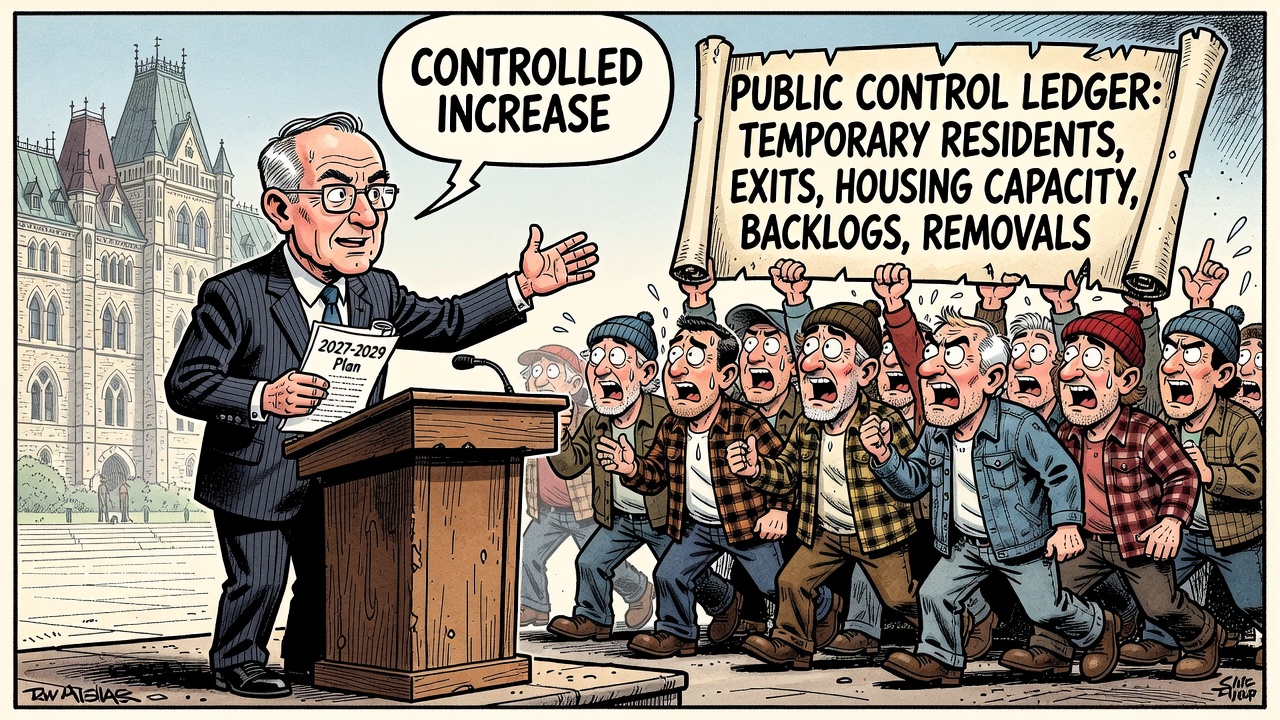
Prime Minister Mark Carney has shifted the immigration debate from restraint to timing. The Canadian Press reported September 29 that Carney told the New York Times the question is when Canada resumes a “controlled increase” in population, after saying the immigration system is back under control.
That is exactly the kind of phrase Ottawa likes: reassuring enough for voters who are worried about housing and services, flexible enough for lobbyists who want more labour supply, and vague enough to avoid hard numbers until after the headline has passed. Conservatives should answer with a simple rule: no increase before receipts.
The next immigration levels plan for 2027 to 2029 is due around November 1. The current federal plan already targets 380,000 permanent residents a year from 2026 through 2028. It also commits Ottawa to reducing the temporary population to less than five percent of Canada’s total population by the end of 2027, while setting temporary worker and student arrival targets of 385,000 in 2026 and 370,000 in 2027 and 2028.
Those targets are not the same as proof of control. IRCC’s own committee material listed more than 2.09 million applications in its inventories in May, with roughly 1.15 million inside service standards and the rest outside them or otherwise not meeting the standard. CityNews also reported that Statistics Canada estimated non-permanent residents at 6.7 percent of the population as of July 1, above Ottawa’s five percent ceiling for the end of next year.
There is another transparency problem. The current plan includes one-time measures to transition about 115,000 protected persons and up to 33,000 temporary workers to permanent residence over two years, on top of the broader permanent-resident targets. Those may be defensible choices, but they should not be invisible to Canadians trying to understand the true intake number.
The C.D. Howe Institute’s Immigration Targets Council is not calling for a pause in immigration. It recommends 380,000 permanent residents in 2027, then 350,000 in 2028 and 340,000 in 2029. More importantly, it says all permanent-resident admissions should be counted in one published target instead of added through side doors outside the announced total.
That is the accountability test Carney should meet before any “controlled increase.” Publish a control ledger with the temporary-resident stock versus the five percent target, permit expiries, confirmed exits, overstays, asylum and protected-person inventories, removals, backlog by stream, special pathways outside the headline target, and housing and health-care capacity assumptions by province.
Canada can support legal immigration and still reject government-by-slogan. If the system is under control, Ottawa should be able to show the controls. If it cannot, the answer to an increase is no.
- CityNews / The Canadian Press: PM looks at when to boost immigration as government gets system “under control” — September 29, 2026
- Immigration, Refugees and Citizenship Canada: Supplementary Information for the 2026–2028 Immigration Levels Plan
- Immigration, Refugees and Citizenship Canada: IRCC applications at a glance: inventories and backlogs — May 28, 2026
- C.D. Howe Institute: Canada Needs Clear, Predictable Immigration Targets
This article supports lawful immigration while arguing that Ottawa should publish measurable control evidence before increasing population-growth targets.