Release the CRTC Independence Records
Who controls an arm’s-length regulator when a decision becomes politically inconvenient? Publish the legal memo and communications ledger.
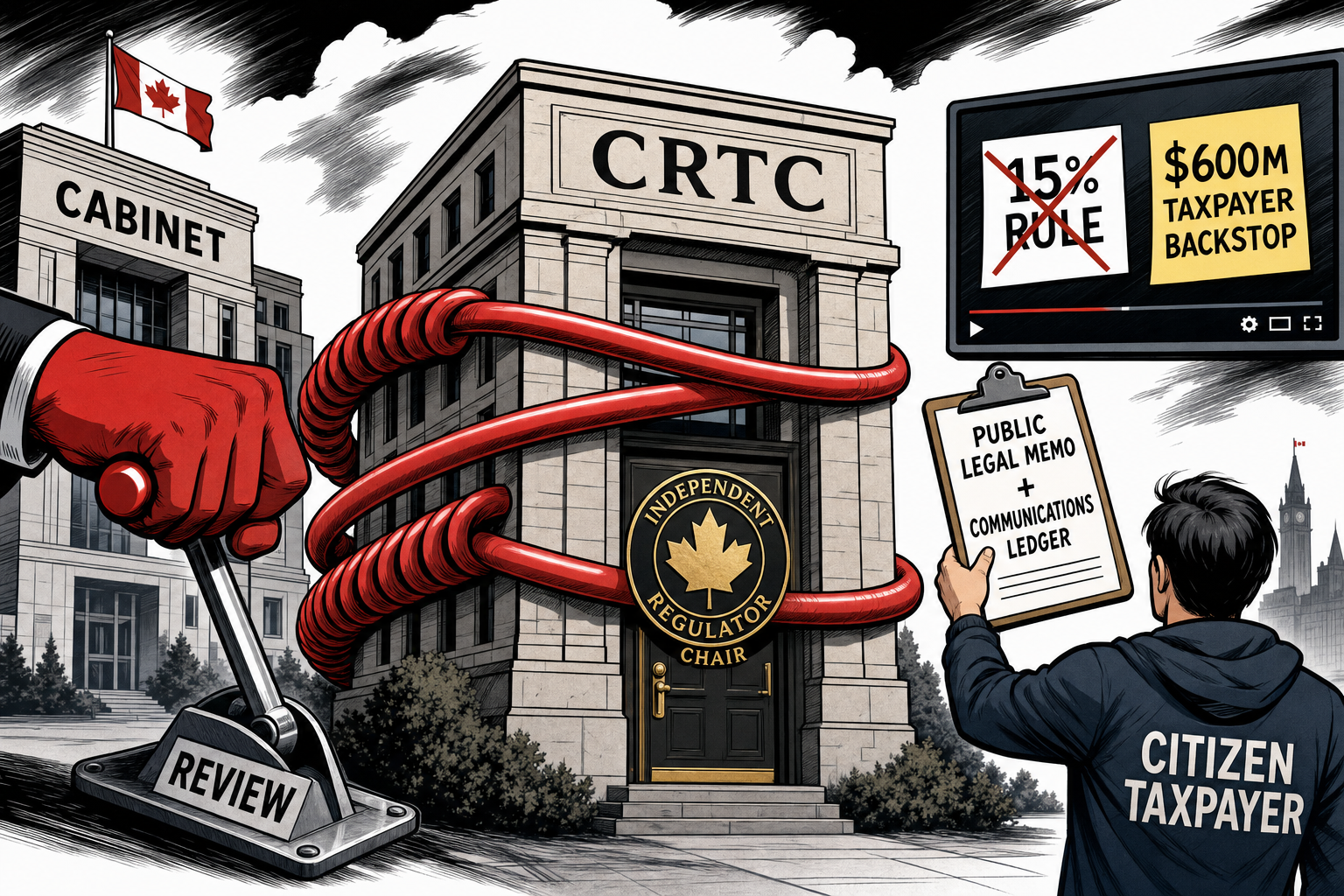
Ottawa’s streaming retreat has moved from a cost argument to a rule-of-law argument. The question now is not simply whether the CRTC’s Online Streaming Act framework was expensive, unpopular or badly designed. The question is who controls an arm’s-length regulator when a decision becomes politically inconvenient.
The Wire Report reported September 28 that communications veteran John P. Roman filed a Part 1 application asking the CRTC to address whether Ottawa’s request for a review of mandatory Canadian-content payments for online streamers amounts to political interference. Roman’s argument, as reported, is narrow and serious: the Broadcasting Act allows cabinet to issue broad policy directions, and to seek reviews of certain licence decisions, but it does not give the government express authority to direct a review of the CRTC’s recent non-licence contribution decisions.
That matters because the CRTC’s May 21 decision was not a stray press release. The regulator said it had held broad consultations, received more than 600 submissions, heard from nearly 150 groups, and then set updated contribution rules for broadcasters with more than $25 million in annual Canadian broadcasting revenues. Traditional broadcasters would contribute 25 percent; online broadcasters would contribute 15 percent, including the existing five percent base contribution.
Then the politics changed. On June 3, Global News and The Canadian Press reported that Ottawa was directing the CRTC to back down and review the streamer-spending rules, citing consumer cost concerns, while promising $600 million annually for the sector. The same report noted the legal complication: under the Broadcasting Act, cabinet does not have authority to overturn a specific decision on streamer contributions, and must instead direct the CRTC on broad implementation.
Canadian Heritage’s own Online Streaming Act page says the Act received Royal Assent on April 27, 2023, and that the government issued policy directions to the CRTC, which is responsible for implementing the Act. The CRTC’s own release describes the commission as an independent quasi-judicial tribunal that makes decisions based on the public record.
That is why the Carney government owes Canadians more than affordability slogans. If cabinet believes it had lawful authority to ask the CRTC to reopen or pause the May decision, publish the Justice and Canadian Heritage legal memo. If the government communicated with the CRTC, publish the call logs, emails, meeting notes and draft policy-direction timeline. If consultations or implementation steps were delayed because ministers announced a different preferred outcome, say so plainly.
Conservatives should not need to defend the CRTC’s 15 percent rule to defend institutional independence. A regulator can make a bad decision and still deserve a lawful correction process. A government can oppose a rule and still be required to respect the statutory lines Parliament wrote.
The Liberal pattern is the problem: build a regulatory machine, let it impose costs, panic when voters notice, then move the bill to taxpayers while hiding the legal receipts. Release the legal memo and the communications ledger. Canadians deserve to know whether the CRTC is independent, or merely part of a “federal family” that obeys when cabinet calls.
- The Wire Report: Liberals accused of violating CRTC independence in regulatory challenge — September 28, 2026
- CRTC / Government of Canada: CRTC takes action to support the creation and discoverability of Canadian and Indigenous content — May 21, 2026
- Global News / The Canadian Press: Ottawa orders CRTC review of streamer spending rules, citing consumer cost — June 3, 2026
- Canadian Heritage: Online Streaming Act
- CRTC: Broadcasting Regulatory Policy CRTC 2026-96 — May 21, 2026
This article distinguishes Roman’s reported legal challenge from established public records and argues for disclosure of the legal authority and communications record behind Ottawa’s CRTC review request.