Canadian Heritage’s Local-News Directory Needs a Funding-and-Intervention Ledger
Ottawa can map news deserts. It cannot keep the budget, criteria, funding links and policy-intervention triggers in the dark.
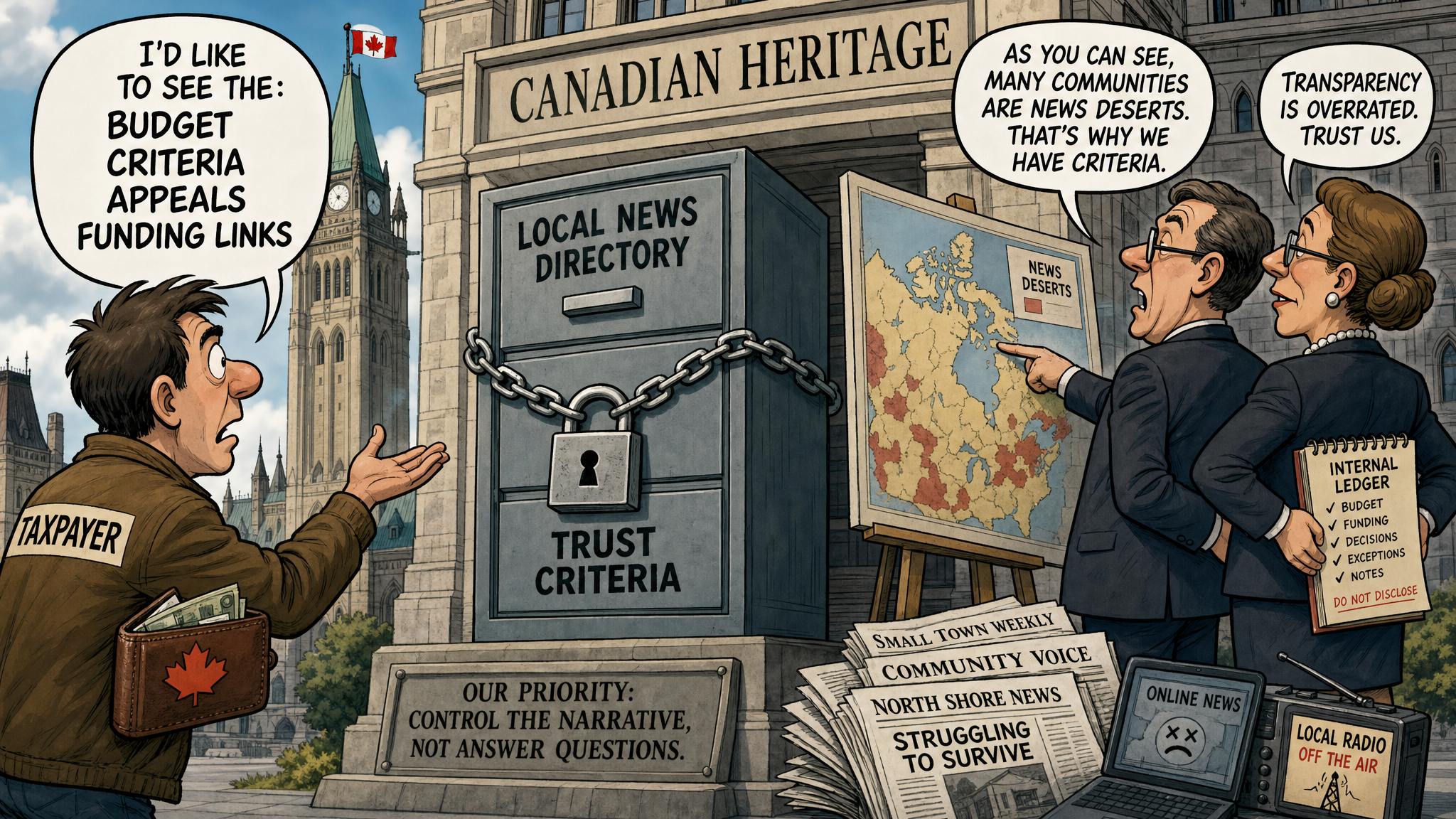
A federal map of Canada’s local-news gaps could be useful. A government-influenced directory that points citizens toward news they can “trust,” while the same government funds journalism programs and uses the data to target policy interventions, requires a public ledger before it becomes another quiet lever over the press.
Canadian Press reported that Canadian Heritage engaged independent industry experts to build a local news directory: a multi-phase, multi-year project meant to measure “news deserts” and “news poverty.” The same report said departmental records framed the data as a way for government to better target policy efforts. The proof-of-concept stage cost $110,000, with later phases expected to map Ontario and Quebec and then expand nationally by 2028.
That is exactly where transparency has to begin. If the project is merely a neutral map, publish the contract, total budget, work plan, data fields, researchers, funding partners and update schedule. If the project will guide Canadian Heritage “policy and program decisions,” publish the intervention rules too: what threshold triggers government action, who recommends it, which minister signs off, and how Parliament can audit the results.
The concern is not that local journalism does not matter. It does. Communities need reporters at council meetings, courtrooms, school boards and emergency briefings. The concern is that Ottawa is already an active market participant. Canadian Press noted that the Local Journalism Initiative is slated to contribute $128.8 million toward local journalism by March 2027. The Canada Revenue Agency says a qualifying journalism organization must first be designated as a qualified Canadian journalism organization, and its labour-tax-credit guidance sets the temporary rate at 35 per cent through 2026, with qualifying labour expenditures capped at $85,000 per eligible newsroom employee.
Those labels and programs are not abstract. They shape who receives payroll support, which outlets can survive, and which voices get treated as institutionally legitimate. Rebel News, citing ATIP records and Blacklock’s reporting, said released memos described the directory as helping people find local news they can trust, while the full project budget was redacted. Second Reading’s useful caveat is also the safest way to frame this: “trustworthy” may be partly a characterization, not a formal program label. Fine. Then prove it with the records.
A conservative accountability standard is simple: government should not secretly blend press mapping, subsidy eligibility, public-broadcaster partnerships, platform policy and intervention planning. Publish whether QCJO or subsidy status affects inclusion. Publish any excluded-outlet list, scoring rules, correction process and appeal rights. Publish whether Statistics Canada, the CRTC, CBC/Radio-Canada or other funded entities will finance or use the later phases. Publish privacy safeguards and any AI-verification rules.
Ottawa can help Canadians identify local-news gaps without ranking acceptable journalism behind closed doors. If the directory is neutral, the ledger will strengthen it. If it becomes a taxpayer-funded trust seal attached to future subsidies, access or regulation, Canadians deserve to know before the government’s map becomes the government’s media gate.
- InfoNews / Canadian Press: Ottawa commissions project to track news deserts in Canada
- Rebel News: Liberal government spends $100K compiling directory of media Canadians can trust
- Second Reading: Canadian Heritage paid $110,000 for the first phase of a directory of local news outlets
- Macdonald-Laurier Institute / The Hub: Local journalism is going extinct in Canada—so what’s the solution?
- Canada Revenue Agency: Canadian Journalism Labour Tax Credit
- Canada Revenue Agency: Qualified Canadian journalism organization
This article argues for disclosure around a government-funded local-news directory and related journalism-support policy. It does not allege unlawful conduct by named researchers, journalists, public servants or outlets.