Passport Speed Is Not Enough: Publish the Accuracy Ledger
A faster passport counter still needs public proof that accuracy controls are working.
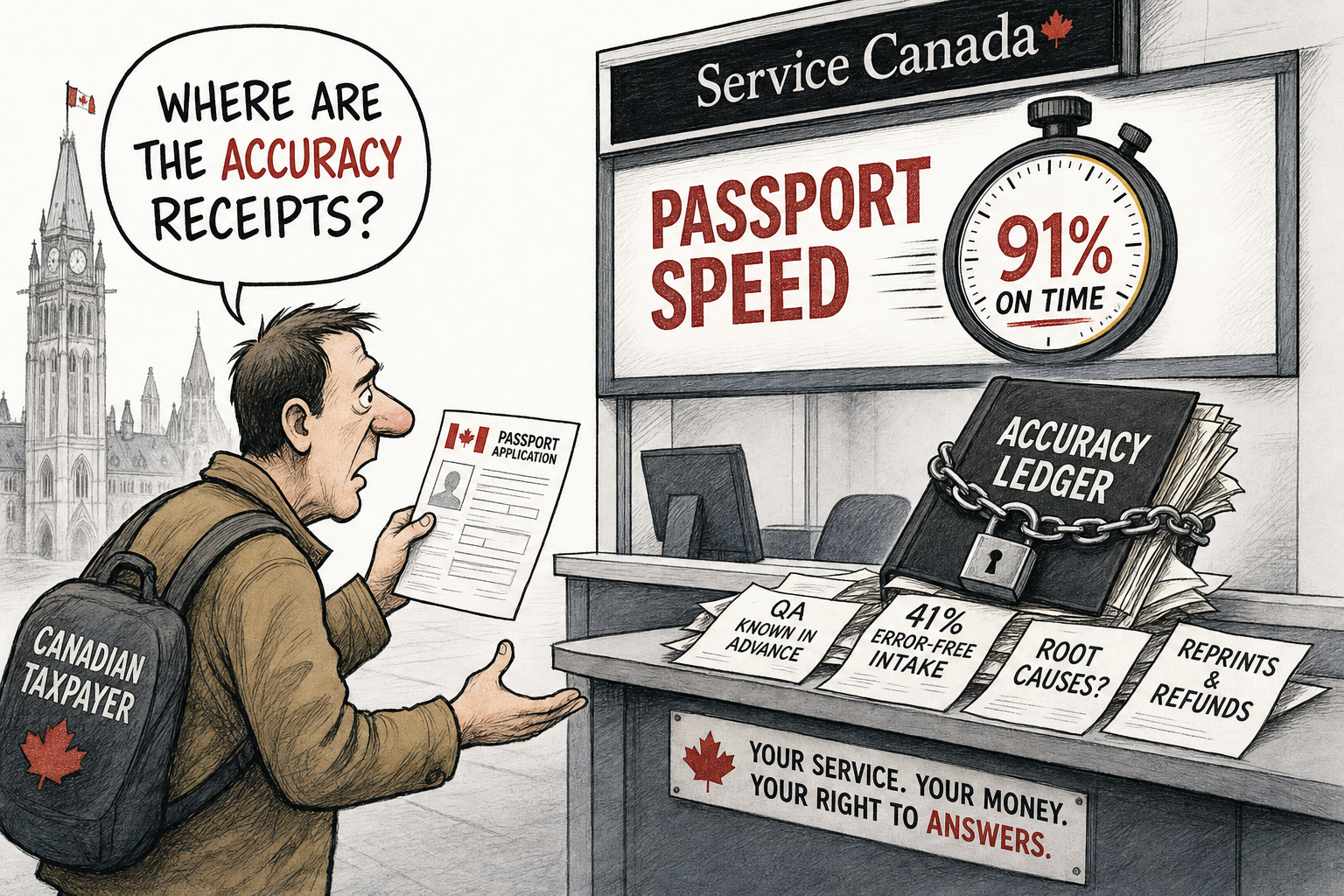
A new federal audit gives Ottawa one piece of good news on passports: speed has recovered. It also exposes the part of government service delivery that politicians would rather keep out of the headline — whether the work is accurate, measured honestly and fixed when errors repeat.
Employment and Social Development Canada’s Audit of Passport Service Delivery, dated September 25, says the Passport Program is overseen by Immigration, Refugees and Citizenship Canada and delivered by Service Canada. It says about 4.9 million passports were issued in 2024-25, up 11 per cent from the year before. This is not a small back-office file. It is a core identity and travel service that millions of Canadians pay for and rely on.
The audit reports that the program aims to process 90 per cent of applications on time. It met that mark in 2025-26, reaching 91 per cent, after falling to 81 per cent in 2024-25. That improvement matters. Canadians remember passport chaos, lineups and uncertainty. A faster system is better than a slower one.
But speed is not the same thing as competence. The audit found weaknesses in the Quality Assurance Program. Managers know which files are selected for quality review before assignment, and passport officers also know in advance when their file has been selected. The audit says those practices can affect assignments and reduce the reliability of the results. In plain English: if people know which files are being checked before the work is judged, Canadians should not be asked to treat the score as complete proof of quality.
The accuracy indicators are even more concerning. The audit says early results from the in-person Intake Quality Assurance Program showed only 41 per cent of reviewed applications were error-free. It also says passport processing quality fell below the 90 per cent target in 2023-24 and 2025-26. Final passport quality is reported above 99 per cent, but the audit notes that fixing mistakes late creates extra work and cost.
That is exactly where conservative accountability starts: not with a press release about hitting the speed target, but with the receipts for errors, rework and prevention. Taxpayers should know how many files fail intake review, what error categories repeat, how many passports require reprinting, what late corrections cost, which offices or channels need support, and what deadlines Service Canada and IRCC have accepted for fixing the control gaps.
The Carney government does not need to publish Canadians’ personal passport information to be transparent. It can publish a non-personal accuracy dashboard: quarterly QA pass rates, intake error categories, reprint volumes, refund costs, regional variance, root-cause findings, training fixes and implementation dates for the audit recommendations.
A passport is not a favour from government. It is a paid public service tied to citizenship, travel, work and family obligations. If Ottawa wants credit for faster passports, it should also publish the accuracy ledger. Canadians deserve a system that is not merely quick at the counter, but reliable behind it.
- Employment and Social Development Canada: Audit of Passport Service Delivery
This article relies on the September 25, 2026 federal audit. It does not use personal passport data and does not allege misconduct by individual officers.