July’s Fiscal Monitor Needs a Debt-Charge Ledger
A smaller four-month deficit is not the same thing as spending control.
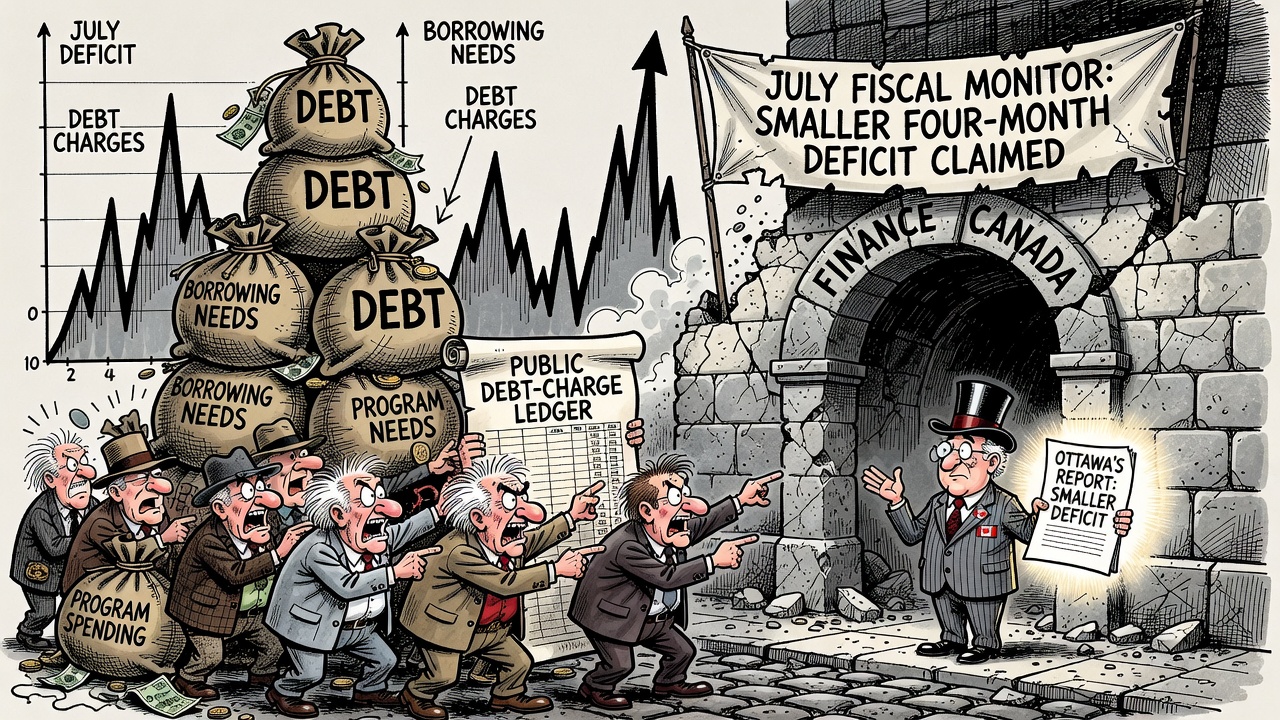
Finance Canada’s July Fiscal Monitor gives the Liberal government a convenient headline: Ottawa posted a $5.1 billion deficit for April to July 2026-27, compared with $7.8 billion over the same four months last year. That improvement is real. It is also not the whole story.
Look at July by itself. The monthly deficit was $4.8 billion, versus $1.5 billion in July 2025. Revenues barely moved, up only $0.2 billion, or 0.5 per cent. Program expenses excluding net actuarial losses, however, rose $2.8 billion, or 7.3 per cent, and public debt charges rose $0.5 billion, or 11.3 per cent. That is not a victory lap; it is a warning light.
The year-to-date numbers tell the same accountability story. Revenues for April to July increased $12.0 billion, helped by personal income tax, GST and other revenue. But program expenses still climbed $7.7 billion, or 5.1 per cent, mainly from direct program expenses and transfers to persons. Public debt charges rose $1.4 billion to almost $20.0 billion in just four months.
Ottawa’s line will be that the deficit is smaller than last year’s. A conservative accountability standard asks a better question: did government spending become disciplined, or did taxpayers simply send in more money while the cost base kept rising?
The debt-charge line deserves special scrutiny. Finance says the increase largely reflects higher effective interest rates on a larger stock of marketable bonds, plus inflation adjustments on Real Return Bonds, partly offset by lower treasury-bill rates. In plain English: past borrowing is still sending invoices, and the invoice is growing.
Statistics Canada’s second-quarter government finance release adds context. It reported federal net debt of $1,051.2 billion, up $56.4 billion from a year earlier, while federal expenses grew faster than revenue in the quarter. Those are not partisan talking points. They are government numbers.
Carney’s Liberals should publish a monthly debt-charge ledger before claiming fiscal progress. Canadians deserve the program lines behind the $7.7 billion expense increase, the borrowing instruments behind the $1.4 billion debt-charge increase, the role of personnel costs and defence spending, and the effect of July’s deterioration on any promised operating-budget balance.
A smaller four-month deficit driven by stronger revenue is better than a larger one. But it is not proof of restraint. The proof is a ledger showing what was cut, what grew, what was borrowed, and who signed off. If Ottawa wants credit for prudence, it should be willing to show the receipts monthly, not after the next budget spin cycle.
- Department of Finance Canada: The Fiscal Monitor — July 2026
- CityNews / The Canadian Press: Federal government posts $5.1-billion deficit for April-to-July period
- Statistics Canada: Government finance statistics, second quarter 2026
This article relies on Finance Canada’s monthly Fiscal Monitor and Statistics Canada’s government finance statistics. Monthly fiscal results can be affected by timing within the fiscal year.