Ottawa Needs a Chinese-Drone Security Ledger
The question is not whether every drone is spying. The question is why Ottawa still makes Canadians guess about inventories, restrictions and risk controls.
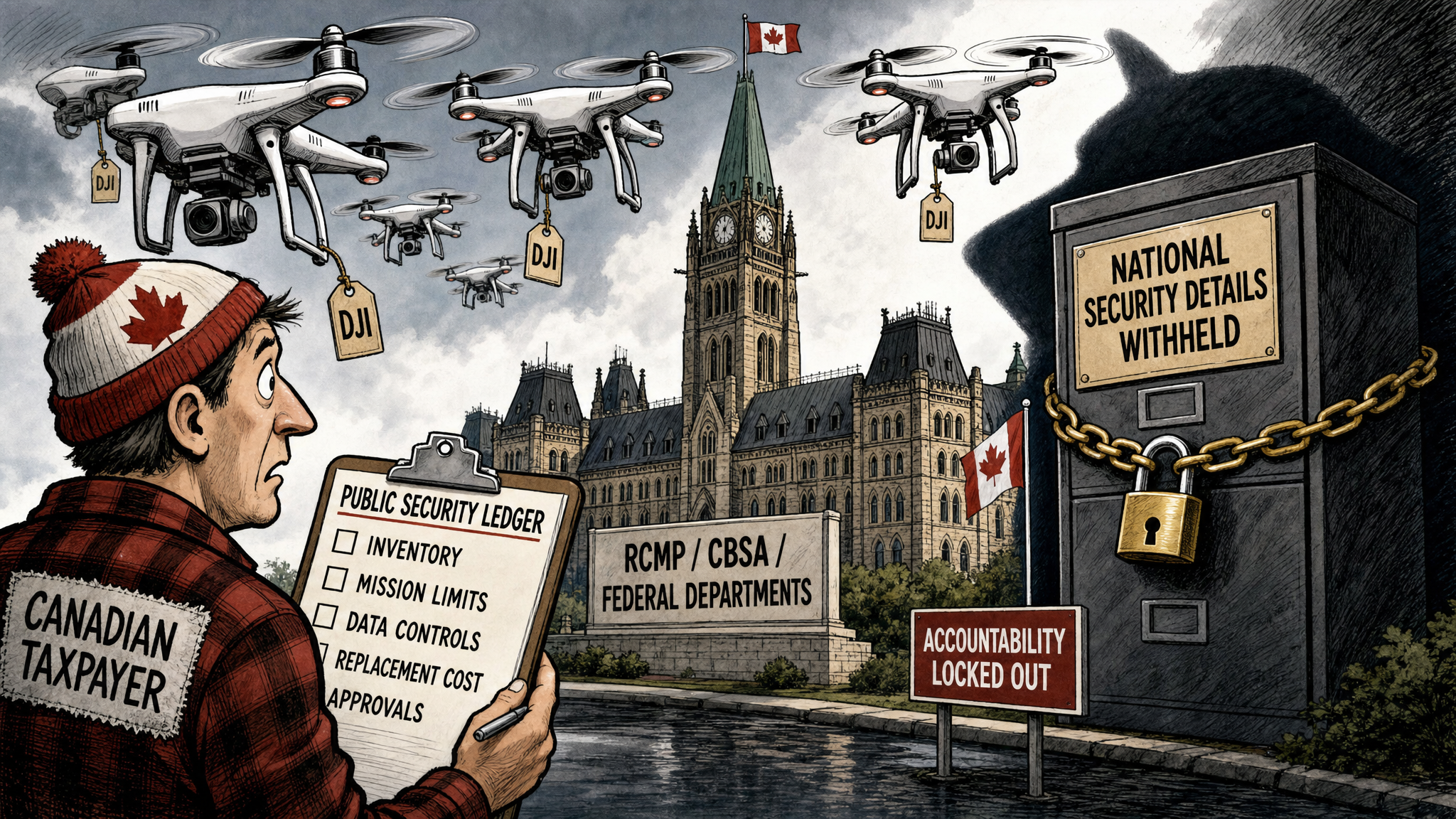
Ottawa’s Chinese-drone problem is now a receipts problem.
A parliamentary written question asked departments to disclose drones manufactured in China, their uses, security assessments and controls to keep information away from government or government-connected entities in China. Reporting on the response says Chinese-made drones are not sitting in one obscure warehouse. They are spread across federal government, including law-enforcement and border agencies.
Juno News reported that the RCMP owned 1,027 Chinese-manufactured drones as of May 29, including 999 DJI units, while noting that the tally excludes micro-drones not tracked in a centralized database. Rebel News reported that both the RCMP and the Canada Border Services Agency acknowledged Chinese-made drones, with the Mounties withholding operational details on national-security grounds. The Epoch Times reported that federal documents show at least 1,600 Chinese-manufactured drones across more than 20 federal departments and agencies.
Those facts do not prove espionage. Conservatives should not need to overstate the case. The accountability case is stronger and cleaner: if Ottawa believes these systems are safe enough for public agencies, it should publish the ledger that proves it.
The RCMP’s own public posture, as reported, is that Chinese-origin drones are restricted away from national-security cases and some sensitive operations, and must use local data or offline storage controls. CBSA was reported to own six DJI drones and to describe safeguards including no data cards, no network connections and live-feed-only collection. Those may be real controls. But controls that matter should be inspectable in summary form, especially when the same reporting says National Defence and CSIS declined to disclose full information on security grounds.
National security cannot become a magic phrase that hides every procurement decision after the fact. Canadians can understand that some mission details must remain classified. They can also understand the difference between operational secrecy and basic accountability: how many devices, which manufacturer and model, which agencies, what permitted uses, what prohibited uses, what cyber assessment, what data-handling rule, what exception approval and what replacement timeline.
This is exactly where the Carney government should be forced to produce an agency-by-agency Chinese-drone security ledger. Put the sensitive tactical details behind a classified annex if necessary. Publish the public version. If drones are limited to search-and-rescue, training, traffic reconstruction, roof inspections or communications video, say so. If any agency uses them near borders, critical infrastructure, defence sites or joint operations with allies, disclose the policy restrictions and approval trail.
The demand is simple: no panic, no coverup, no “trust us.” Publish the inventory, the restrictions, the assessments, the data controls, the replacement cost and the official who approved continued use. If the risk is managed, Ottawa should be able to show the management.
- House of Commons: Q-1241 on drones manufactured in China owned by government departments and agencies
- Rebel News: RCMP, CBSA using Chinese-made drones as Mounties withhold details on national-security grounds
- Juno News: RCMP owns 1,027 Chinese drones despite security risks
- The Epoch Times: Documents reveal Canadian government using more than 1,500 drones built in China
This article argues for public procurement and security transparency. It does not allege that any specific federal drone transmitted data to a foreign government.