Carney’s Buy Canadian Fine Print Needs an Exemption Ledger
A slogan is not a supply-chain policy. If Ottawa can waive Buy Canadian when the price gap hits 25%, Canadians deserve to see every waiver.
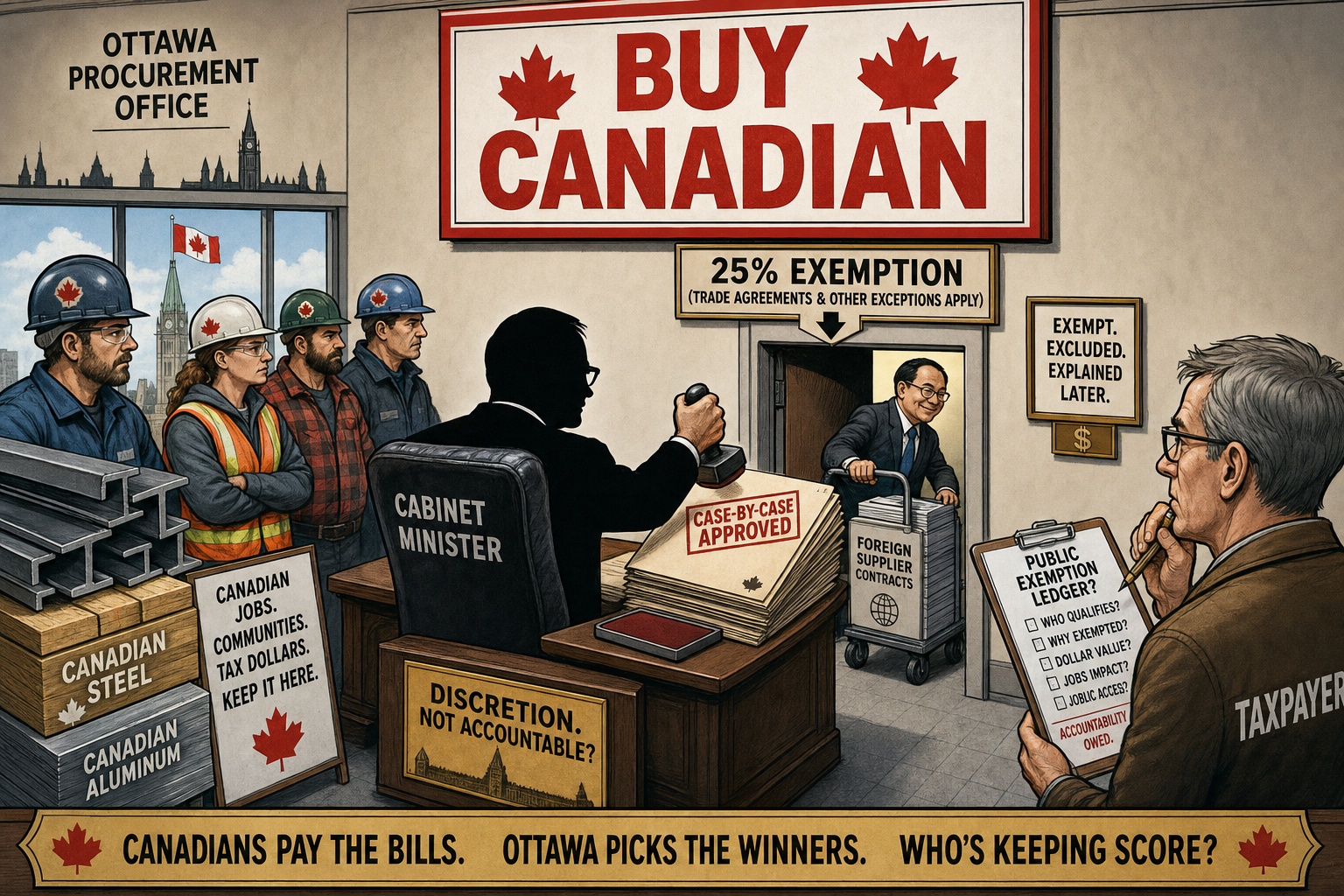
Carney’s Buy Canadian policy now has a simple accountability problem: the fine print matters as much as the podium line.
Rebel News reported that a parliamentary response to Conservative MP Rachael Thomas points to an exemption process under Ottawa’s Buy Canadian rules when applying the policy is expected to raise costs by 25% or more. That is not a rumour. The CanadaBuys policy for strategic federal procurements says the rules apply to strategic competitive procurements meeting the threshold, now $5 million and up as of June 15, 2026, and it lists case-by-case exceptions where strictly necessary. One exception is “best value” when applying the policy is expected to cost 25% or more above current market rates.
That may be defensible in some cases. Taxpayers should not be forced to pay any price for a maple-leaf label if the domestic supply is unavailable, unsuitable or wildly overpriced. But that is exactly why an exemption ledger is necessary. Without public reporting, Canadians cannot tell whether “Buy Canadian” is binding procurement discipline or campaign branding with a ministerial escape hatch.
The companion materials policy is just as important. For defence goods and construction procurements valued at $25 million or more, CanadaBuys says Canadian steel, wood products and aluminum rules can also be excluded case by case. Its best-value exception applies where Canadian materials are expected to increase overall costs by at least 25% over non-Canadian materials, with the cost differential supported by documented market analysis. The policy also says exceptions require ministerial approval.
Ottawa’s own budget update makes the stakes clear. The Spring Economic Update says the federal government buys about $37 billion in goods and services each year, and that by mid-April 2026 the Buy Canadian policy had applied to about $3.6 billion in solicitations and $527.9 million in awarded contracts. PSPC briefing material says the department awarded $55.6 billion in contracts in 2024-25, with about $50.9 billion to suppliers operating in Canada, while April-to-December 2025 contracts and amendments to suppliers outside Canada totalled about $2.3 billion.
Those numbers are too large for trust-us procurement. Every exemption should be recorded in a public table: department, contract value, commodity, foreign supplier, Canadian comparator, market analysis, percentage cost gap, reason invoked, approving minister and whether the contract affected defence, construction, health, infrastructure or technology. If national-security details must be protected, publish the non-sensitive summary and table the classified annex with the proper committee.
The conservative accountability position is straightforward: buy Canadian where the policy says buy Canadian, and prove every exception. A 25% threshold may prevent waste. Hidden exemptions create a different waste — the waste of public trust.
- Rebel News: Carney’s “Buy Canadian” policy lets departments seek an exemption when Canadian sourcing costs 25% more
- CanadaBuys: Policy on Prioritizing Canadian Suppliers and Canadian Content in Strategic Federal Procurements
- CanadaBuys: Strategic procurement threshold lowered to $5 million
- CanadaBuys: Policy on Prioritizing Canadian Materials in Federal Procurements
- Government of Canada: Spring Economic Update 2026, Chapter 1
- Public Services and Procurement Canada: OGGO briefing material, February 10, 2026
This article argues for public exemption reporting. It does not claim every exemption is improper; it argues that taxpayers should be able to inspect the non-sensitive receipts.