Carney’s Budget Anchor Runs Through Labels the PBO Calls Contradictory
The PBO says Ottawa’s fiscal anchor needs more than a slogan. It needs a public labels ledger Canadians can test.
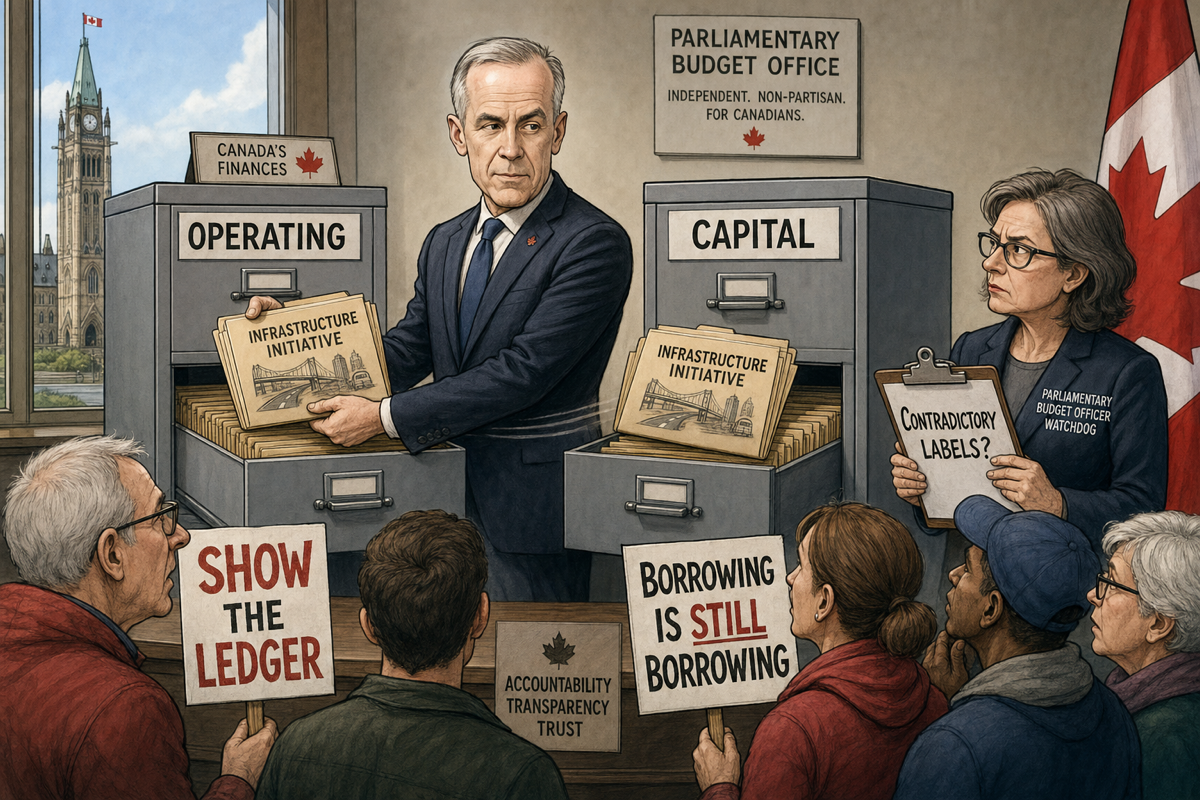
Prime Minister Mark Carney’s operating-budget anchor is being sold as discipline. The Parliamentary Budget Officer’s September 24 report shows why Parliament should demand the labels behind the claim.
Budget 2025 created two fiscal anchors: balance operating spending with revenues by 2028-29, and keep the deficit-to-GDP ratio declining. That sounds simple until Ottawa decides what counts as “operating” and what counts as “capital.” The PBO says the split can provide transparency, but only if the methodology is formal, consistent and testable.
That is the problem. The watchdog found attributions that “appear contradictory.” Its examples are not obscure bookkeeping trivia. Film tax credits are treated as capital, while journalism tax credits are not. Agricultural Clean Technology is treated as capital, while Agricultural Climate Solutions is operating, even though both support investment at the farm level. Similar purposes, different labels, different fiscal optics.
For taxpayers, the accountability issue is obvious: if a government can move spending into the capital column without a clear public rulebook, the operating-balance promise becomes harder to verify. Borrowing does not disappear because Ottawa changes the category name. A dollar financed by debt is still a dollar Canadians must service.
The timing makes this more serious. The PBO projects the government will miss the 2028-29 operating-balance target by one year and reach balance in 2029-30. Canadian Press reporting noted that Carney said on September 15 that Ottawa was on track to balance the operating budget in 2027-28, a year ahead of schedule. Those two claims cannot both be accepted on trust. The public needs the bridge between them.
A conservative accountability standard is not complicated. Publish a full operating-capital labels ledger: every program, tax credit, grant, loan guarantee and fund; its classification; the written reason for that classification; the dollar value; the borrowing impact; and every change made since Budget 2025. If a program was reclassified, identify who approved it and why.
Ottawa should also publish the reconciliation from the PBO’s 2029-30 projection to the Prime Minister’s 2027-28 claim. If the difference is real savings, show the savings. If it is new revenue, show the revenue. If it is classification, show the classification. Canadians do not need a slogan. They need the spreadsheet.
Capital spending can be legitimate. Roads, ports, defence equipment and productivity infrastructure can strengthen the country when projects are selected honestly and delivered competently. But fiscal credibility requires more than moving files from one cabinet to another. It requires Parliament and taxpayers being able to reproduce the math.
Carney wants credit for a cleaner fiscal anchor. The PBO has supplied the test: prove the labels are consistent before asking Canadians to applaud the balance.
- Parliamentary Budget Officer: The Government’s Operating Budget Fiscal Anchor
- CityNews / The Canadian Press: Definitions in Ottawa’s budget framework are inconsistent: fiscal watchdog
- iPolitics / The Canadian Press: Fiscal transparency
- CKPG Today / The Canadian Press: Definitions in Ottawa’s budget framework are inconsistent: fiscal watchdog
This article uses the PBO’s September 24 report and Canadian Press coverage to distinguish the government’s fiscal-balance claim from the classification records needed to test it.