Carney’s Ethics Compliance Is Complete. The Conflict Screen Still Needs a Public Ledger.
Compliance complete is not transparency complete. Canadians should be able to audit the screen around the Prime Minister’s private-sector interests.
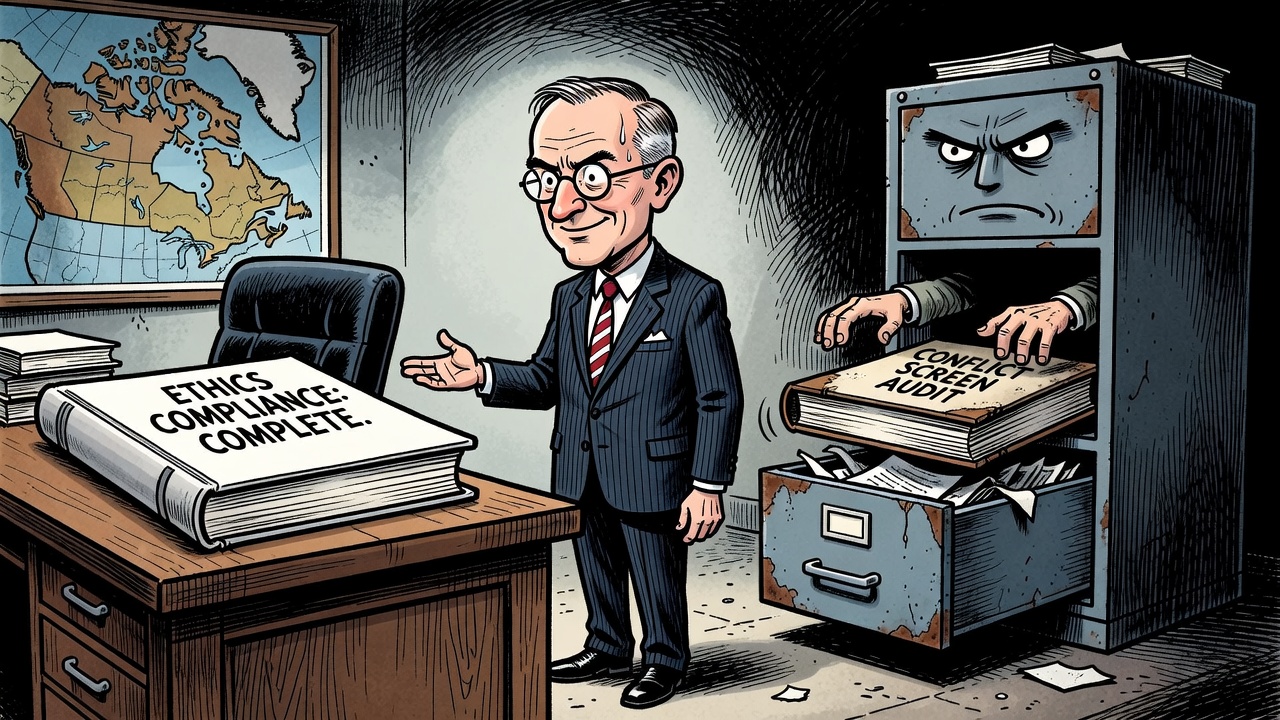
Ethics Canada’s public registry now shows “Initial Compliance Completed” for Mark Carney as Prime Minister of Canada. It also shows initial compliance completed for Carney as the Member of Parliament for Nepean. That is a legal milestone. It is not the same thing as public accountability.
The problem is not that the registry exists. The problem is what Canadians still cannot see. Privy Council Office briefing material says the Conflict of Interest and Ethics Commissioner and Carney agreed to a conflict screen designed to prevent opportunities to further Carney’s interests, or improperly further the interests of Brookfield Asset Management, Brookfield Corporation, Stripe Inc., and companies owned or controlled by them that Carney is aware of. The same material says the relevant companies are listed in an annex. Voters do not get a practical screened-matters ledger from that sentence.
For a prime minister who built his political brand on competence and trust, that is not good enough. Carney’s defenders can fairly say the ethics system has rules, a commissioner and a public registry. Conservatives should answer: rules are only as strong as the audit trail. A screen that works in private may satisfy a statutory process, but citizens still deserve enough information to know when the Prime Minister is recused, who makes the decision instead, what department is involved and whether the matter touched a listed interest.
This does not require publishing trade secrets, personal financial minutiae or cabinet confidences. It requires a public ledger with basic fields: matter title, date range, department, affected entity or sector, reason for the screen, alternate decision-maker, final authority and any lawful basis for redaction. If a file involves Brookfield, Stripe or an affiliated company, Canadians should not have to guess. If a file does not, the ledger can say so.
Ottawa asks taxpayers to trust it on infrastructure, climate finance, AI, housing capital and industrial policy — exactly the terrain where a former global finance executive’s past roles can create public concern even when no rule is broken. The answer is not innuendo. The answer is receipts.
Initial compliance complete should mean the starting gun for transparency, not the finish line. The registry tells Canadians a process has been completed; it does not tell them how many files triggered the screen, how often Carney stepped aside, or whether repeat sectors keep landing on the same private-interest fault line. That gap is fixable without weakening legitimate confidentiality.
Publish the conflict-screen ledger, publish the annex at the highest lawful level of detail, and let Canadians verify that the Prime Minister’s office is serving the public interest first.
- Office of the Conflict of Interest and Ethics Commissioner: Public Registry search for Mark Carney
- Privy Council Office: Review of the Conflict of Interest Act briefing material
- Office of the Conflict of Interest and Ethics Commissioner: Annual reports and public registry information
This article treats Ethics Canada’s compliance status as a legal fact and argues for more public reporting so voters can audit the conflict-screen process without alleging a breach.