Build Canada Homes Needs a Delivery Ledger, Not Another Pipeline Headline
Announcements are not homes. Taxpayers deserve completed units, costs, affordability benchmarks and occupancy dates.
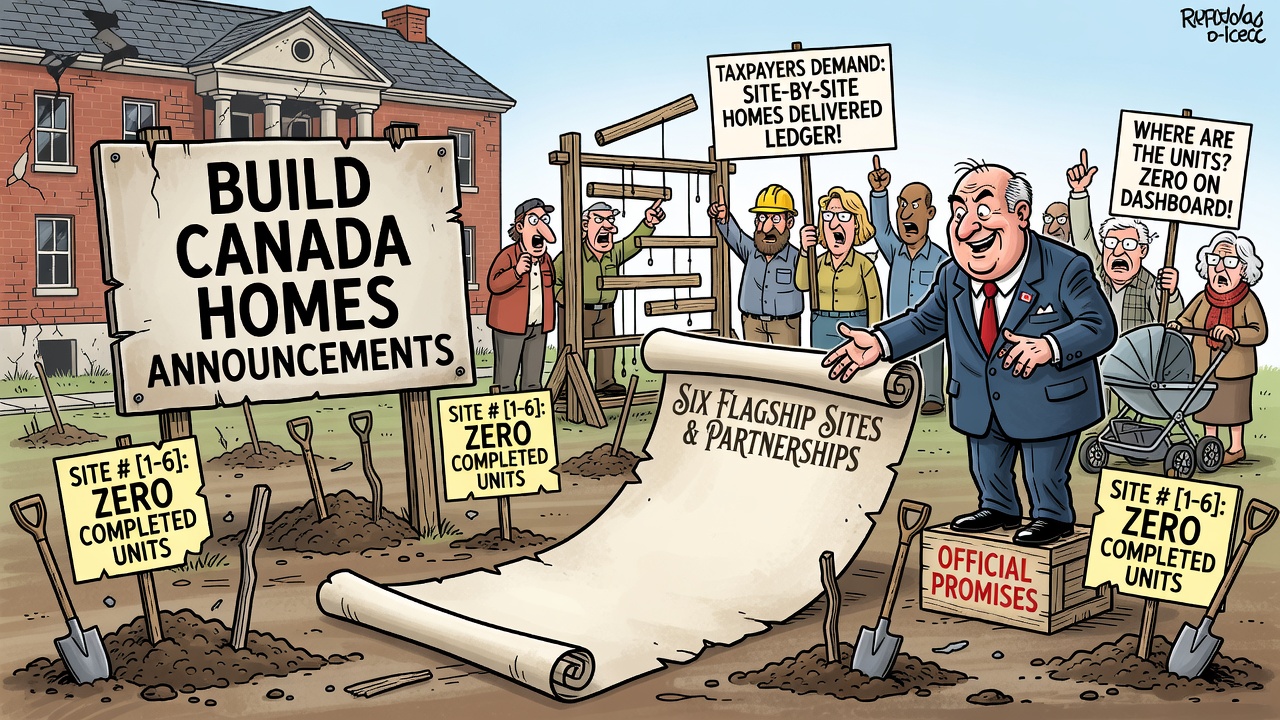
Build Canada Homes was sold as the federal machine that would turn Ottawa’s land, financing and buying power into affordable homes. Nearly a year in, the public still cannot see the most basic scoreboard: how many homes are finished, what they cost, who can afford them and when residents move in.
The latest warning comes through a House of Commons written question from Conservative MP Jacob Mantle. He asked whether the government had established internal performance indicators for Build Canada Homes, including completed units, affordability outcomes, project timelines, cost per home, private capital leveraged and modern construction methods. Those are not partisan luxuries. They are the minimum controls any serious housing agency should have before billions in public commitments become political talking points.
Rebel News reported that the Department of Housing, Infrastructure and Communities responded on September 21 that it was still developing a comprehensive results and performance measurement framework. The report says the response did not provide finalized annual completed-unit targets, cost-per-unit benchmarks, affordability benchmarks or construction-timeline targets. If accurate, that means Ottawa has launched the brand but not the public dashboard needed to judge whether the brand is delivering.
The six flagship federal sites make the problem concrete. Government background material says Build Canada Homes is advancing sites in Dartmouth, Longueuil, Toronto, Ottawa, Winnipeg and Edmonton with the potential for up to 4,000 homes. Those may become useful projects. But “potential” is not occupancy. Rebel reported that the Order Paper response described the six sites as still in site servicing and design-builder selection, with zero units delivered so far.
Ottawa can point to motion: funding streams, partnerships and pipeline numbers. The same report says the department cited 17 signed partnerships expected to represent nearly 20,000 homes, while the government has also attached Build Canada Homes to supportive housing, Indigenous housing and a $1.5-billion rental protection fund. Some of that may be defensible policy. But a partnership is not a front door key, and preserving an existing rental is not the same as building a net new home.
Canada’s housing crisis does not need another announcement architecture. It needs delivery discipline. Conservatives should insist on a monthly Build Canada Homes ledger: each site, land status, procurement stage, permit status, expected start date, expected occupancy date, completed units, affordable units, rents or prices against local incomes, taxpayer cost per unit, private capital leveraged, delays and the named official responsible.
If the Carney government’s housing plan is working, that ledger will prove it. If the plan is mostly press releases, pipeline math and shifting definitions, the ledger will expose it. Either way, families locked out of the market deserve more than a ribbon-cutting promise. They deserve homes — and taxpayers deserve receipts.
- House of Commons: Q-1401 — Written question on Build Canada Homes performance targets
- House of Commons: Response from September 21, 2026 for Q-1401
- Rebel News: Carney’s Build Canada Homes: six sites, zero homes delivered and no finalized performance targets
- Housing, Infrastructure and Communities Canada: Parliamentary backgrounder on Build Canada Homes
This article distinguishes government-stated site and partnership ambitions from reported completed-unit and performance-target gaps, and argues for a public delivery dashboard Parliament can test.