The $1.9B Asylum-Housing Ledger Ottawa Still Won’t Publish
Taxpayers funded asylum housing. Ottawa still owes taxpayers the bed counts, agreements and property rules.
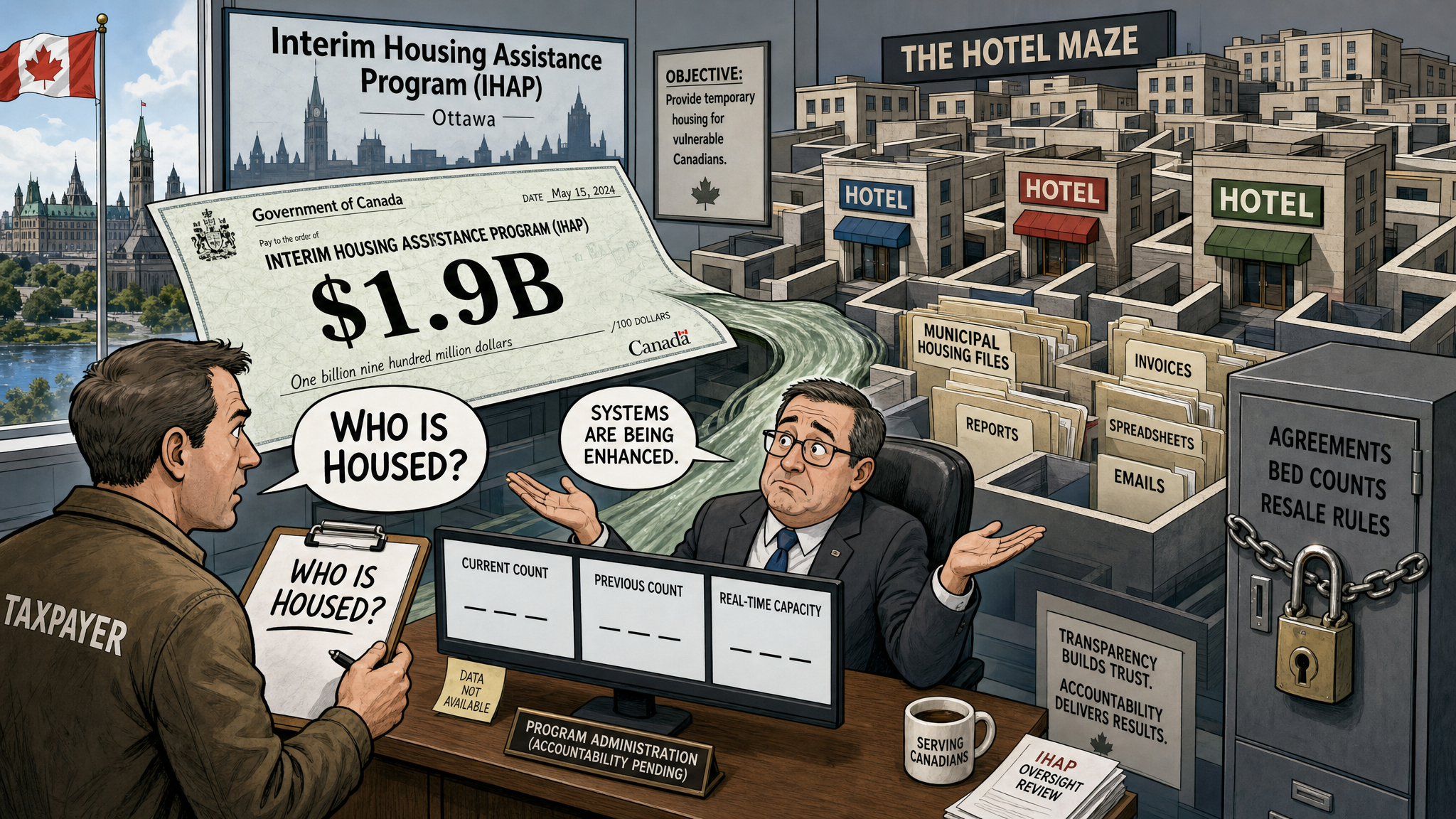
Ottawa’s asylum-housing program has become another Liberal spending file where the cheque cleared faster than the accountability system.
A September 21 House of Commons response to Q-1239 shows what Conservative MP Fred Davies asked for: the total funding under the Interim Housing Assistance Program, the details of contribution agreements, performance metrics, reporting requirements, data on transitions from hotels to municipally controlled or purchased real estate, and current, previous and projected housed counts by location. That is not a gotcha question. It is basic stewardship.
Juno News reports that Immigration, Refugees and Citizenship Canada said about $1.9 billion has been allocated to provinces and municipalities under IHAP since 2017. The program’s stated purpose is to help provinces and municipalities expand interim housing capacity for asylum claimants while claims are processed. A federal grants record for Halton, for example, describes IHAP funding as support for more sustainable and cost-effective approaches to asylum-claimant housing, including intake, referral, interim spaces and access to supports.
The accountability failure is what came next. According to Juno’s report on the Order Paper response, IRCC said it was unable to confirm how many individuals are currently housed, or how many were previously housed but are no longer housed, because data fluctuates day to day and Ottawa lacks real-time information on site capacity from local operators.
That answer is not good enough after $1.9 billion. A program can involve local delivery and still require federal visibility. If Ottawa can transfer public money, Ottawa can require basic reporting: occupied beds, vacant beds, hotel rooms, leases, operating costs, property purchases, resale rules and clawback terms. Twice-yearly reporting may satisfy paperwork. It does not satisfy real-time accountability when shelters, hotels, municipalities and taxpayers are all carrying costs.
The numbers reported by Juno make the gap sharper. IRCC estimated about 15,000 claimants receiving housing support as of May 2026, while jurisdictions projected roughly 40,000 by March 2027. Juno listed location examples including Toronto at 7,030, Ottawa at 3,490 and Peel Region at 3,170. If those figures can be assembled for an answer, Canadians should not be told the system cannot publish a current dashboard.
This is a sensitive immigration file, which is exactly why the receipts matter. The issue is not whether asylum claimants should sleep outdoors. The issue is whether the Carney government can spend nearly $2 billion and still fail to provide Parliament a clean occupancy ledger.
Before another dollar flows, Ottawa should publish recipient-by-recipient agreements, bed counts, hotel spending, municipal-property purchases, twice-yearly reports, resale and clawback rules, and a monthly public occupancy dashboard. Compassion without controls becomes a blank cheque. Conservatives should not let Ottawa hide behind complexity when the ask is simple: show who got the money, what it bought, and who is housed today.
- House of Commons: Q-1239 — Written question on Interim Housing Assistance Program funding
- House of Commons: Response from September 21, 2026 for Q-1239
- Government of Canada: IHAP grants-and-contributions record — City of Halton
- Juno News: Ottawa allocates $1.9B for asylum housing — can’t say how many are housed
This article distinguishes official House and grants records from the reported IRCC figures quoted by Juno News, and calls for a public ledger Parliament can test.