StatCan’s Immigration Revision Tests Carney’s “Control” Claim
A falling temporary-resident count is not the same thing as a controlled system. Publish the exits, extensions, housing and screening dashboard.
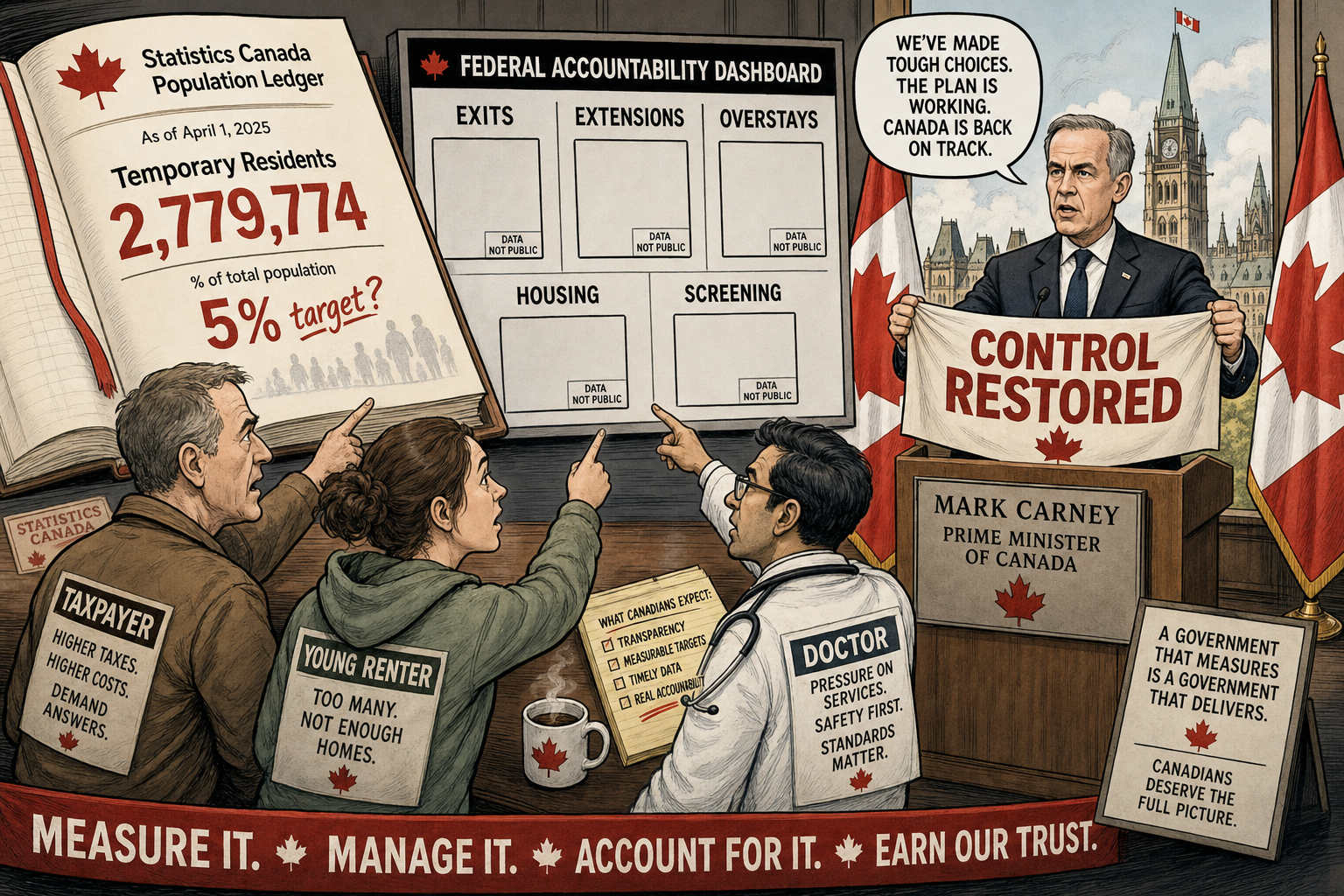
Statistics Canada’s September 23 population release gives Mark Carney’s government one useful talking point and one much harder accountability problem. The talking point is that population growth has slowed. Canada’s population was estimated at 41,798,407 on July 1, 2026, up 80,343 people, or 0.2%, during the second quarter.
The accountability problem is the temporary-resident stock. StatCan estimated 2,779,774 non-permanent residents in Canada on July 1. Global News, summarizing the release, reported that this was down 154,614 from July 2025 and equal to 6.7% of the population. That is movement in the right direction. It is not mission accomplished.
Ottawa’s own March 2026 IRCC briefing said the 2026-2028 levels plan is supposed to reduce the total temporary-resident population to under 5% by the end of 2027. Five per cent of StatCan’s July 1 population estimate is about 2.09 million people. On that simple benchmark, the July count remains roughly 690,000 above the threshold. If the government believes the path is on track, it should show the month-by-month math.
That matters because StatCan also reminds readers that these estimates are preliminary and will be revised. The agency says updated estimates from the third quarter of 2021 to the first quarter of 2026 are now available, and it explains that permit-expiry gaps, late vital-event registrations and fuller data sources can change the numbers later. In plain English: the public number is important, but it is not a full operating dashboard.
A serious conservative position is not anti-immigrant. It is pro-capacity, pro-rule-of-law and pro-honest accounting. Canada can welcome newcomers through a system that Canadians can verify. What it cannot keep doing is announcing “control” while leaving the public to guess how many people left, how many extended permits, how many shifted categories, how many asylum and protected-person files remain in inventory, and how those figures map onto housing, health care, schools and jobs.
Carney should publish a monthly temporary-resident control ledger: total NPR stock by category, new arrivals, permit expiries, extensions, confirmed exits, removals, asylum/protected-person inventories, provincial distribution, housing-market assumptions, service-capacity assumptions and screening outcomes in aggregate. Put the 5% target on the first page and show the remaining gap every month.
Control is not a press-line percentage drop. Control is a system with receipts. StatCan has supplied the baseline. Ottawa should publish the dashboard.
- Statistics Canada: Canada's population estimates, second quarter 2026
- Statistics Canada: Canada's population estimates: Age and gender, 2026
- Global News: Canada’s population growth continues its decline, StatCan says
- Immigration, Refugees and Citizenship Canada: CIMM – Immigration Levels Plan – March 23, 2026
This article uses official population and immigration-planning sources and argues for aggregate transparency, lawful screening and capacity-based immigration management without targeting law-abiding immigrants or communities.