Before Ottawa Opened the Door to Chinese EVs, Who Had Access?
The reported pre-deal lobbying around Canada’s China EV tariff reversal deserves a public access ledger.
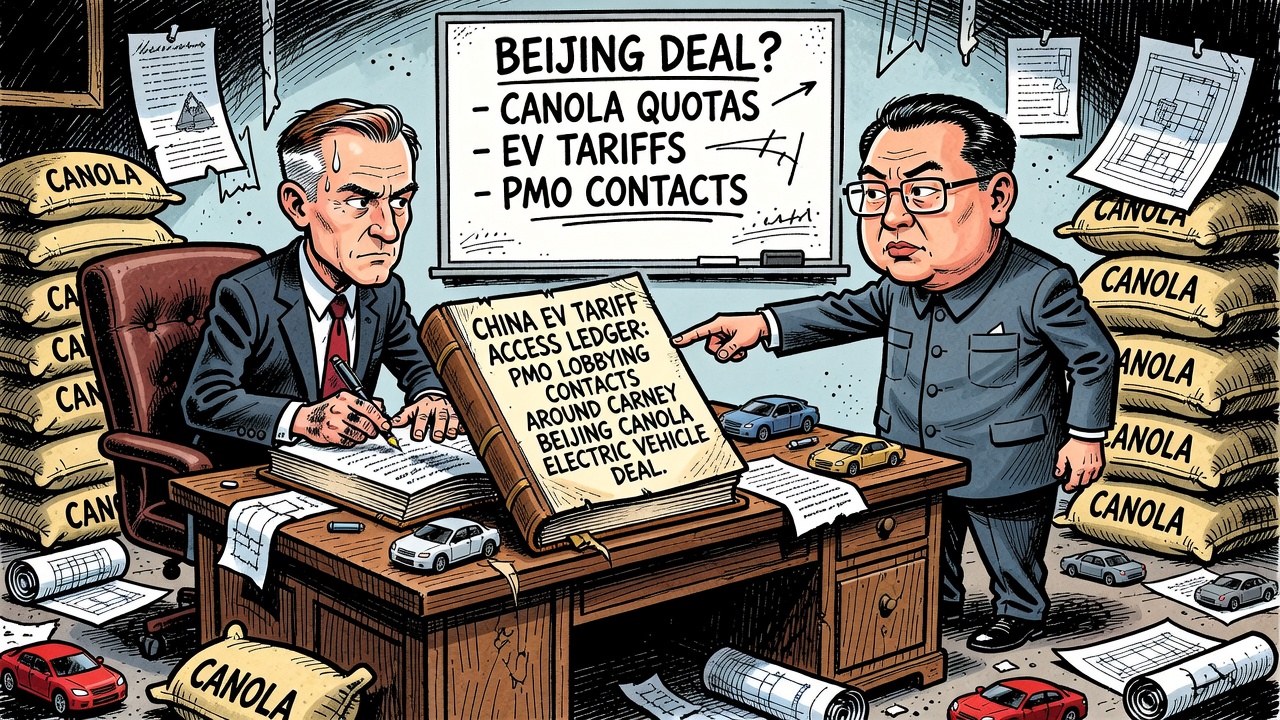
The Bureau has added a sharp new accountability question to Prime Minister Mark Carney’s China reset: before Ottawa agreed to let thousands of Chinese electric vehicles enter Canada at a far lower tariff, who was pressing the government for that result?
Its September 23 report says a Toronto-area Chinese business association, SinoCann, with reported United Front ties, urged the Prime Minister’s Office, MPs and senators to remove Canada’s 100% surtax on Chinese EVs shortly before Carney announced his Beijing agreement. That is an allegation about access and timing. It is not proof that Beijing dictated Canadian policy. But it is more than enough to require receipts.
The policy shift itself is not in dispute. The PMO’s January 16 release says Canada would allow up to 49,000 Chinese EVs into the Canadian market at the most-favoured-nation tariff rate of 6.1%. The same release said Canada expected China to lower tariffs on Canadian canola seed to roughly 15% by March 1, while suspending certain tariffs on canola meal, lobsters, crabs and peas for a defined period.
Global News reported that this followed the 2024 trade fight in which Canada accused China of subsidizing and dumping EVs and imposed a 100% tariff, after which China retaliated against Canadian agricultural exports. Farmers needed relief. Consumers want affordable vehicles. Trade diversification can be legitimate. None of that excuses secrecy around how such a major reversal was developed.
A conservative accountability standard is simple: publish the access ledger. List the dated contacts with PMO, cabinet offices, MPs, senators and senior officials. Release the submissions received, subject only to narrow national-security redactions. Show whether the lobbying registry, foreign-influence registry, CSIS, Global Affairs, Public Safety and ethics screens were checked. Show who met whom, what was requested, and how the final tariff decision was documented.
That is especially necessary because the Carney government has wrapped the China deal in sweeping language about a “new strategic partnership.” When a government moves from calling China a security threat to opening a sensitive auto-market channel, Canadians deserve more than diplomatic adjectives. They deserve evidence that national-security warnings, supply-chain risks, worker impacts and foreign-influence concerns were tested before the press conference.
Ottawa does not need to smear Chinese Canadians or treat every community organization as suspect. It needs the opposite: a transparent, rules-based record that protects legitimate civic participation while exposing improper access if it occurred. Sunlight is fairer than rumour.
If the China EV deal was negotiated in Canada’s interest, the access ledger should strengthen the government’s case. If insiders or foreign-linked networks got privileged influence while taxpayers, auto workers and farmers got talking points, Canadians should know that too.
- The Bureau: Toronto Business Group With United Front Ties Reportedly Sought Chinese EV Tariff Cut Before Carney’s Beijing Deal
- Prime Minister of Canada: Prime Minister Carney forges new strategic partnership with the People’s Republic of China focused on energy, agri-food, and trade
- Prime Minister of Canada: Prime Minister Carney delivers remarks after forging a new strategic partnership with the People’s Republic of China
- Global News: Carney reaches ‘preliminary but landmark’ China deal on tariffs, quotas
This article distinguishes reported access concerns from proven causation. It argues for disclosure of aggregate government records, not suspicion toward any community.