Alto’s Torys Contract Needs a Public Recusal Ledger
When a Crown corporation’s chair is also chairman of a law firm working on the project, taxpayers deserve the paperwork before the spin.
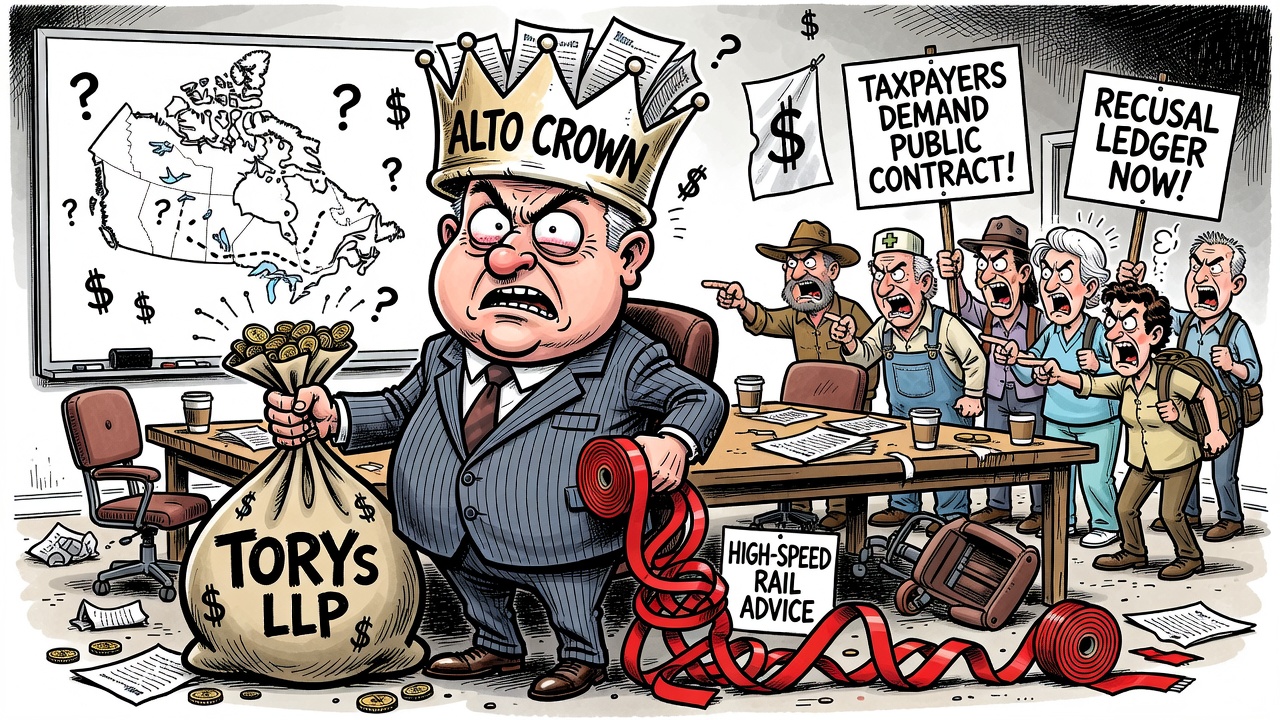
Alto is asking Canadians to trust a generational rail project. Trust starts with a basic public question: who is paid, how were they chosen, and who stepped out of the room when the decision was made?
Alto’s own team page lists J. Robert S. Prichard as chair of the board of directors. The same biography says he is the non-executive chairman of Torys LLP. Separately, Torys partner Valerie Helbronner’s public profile says her recent work includes advising Alto, formerly VIA HFR, on permitting and engagement with more than 40 Indigenous communities for the proposed high-speed rail network spanning almost 1,000 kilometres between Québec City and Toronto.
That does not prove wrongdoing. It does prove the public has enough information to require a clean conflict screen. A federal Crown corporation overseeing one of Canada’s largest infrastructure projects should not leave taxpayers guessing about whether the board chair’s firm was retained through competition, standing offer, sole source, extension, task authorization or some other procurement channel.
Lexpert’s July profile of Alto chief legal and real property assets officer Félix Turgeon adds more context. It describes Alto as developing the largest infrastructure project currently under way in Canada and says external counsel includes DLA Piper on deal-structure negotiations with Cadence, Torys on impact assessment and Indigenous matters, and Dentons Canada on procurement. That mix may be legitimate. It may even be prudent. But legitimacy in public infrastructure is not established by reputation. It is established by records.
The conservative accountability standard is simple: publish the Alto-Torys ledger. That means the contract value or ceiling, procurement method, evaluation criteria, start date, scope of work, amendments, task authorizations, invoices by category, conflict declarations, board minutes, recusal records and any legal opinion explaining why the arrangement was acceptable. If privacy or cabinet confidence requires redactions, identify the specific basis instead of hiding the whole file.
This matters most because Alto’s legal work is not peripheral. The project involves land acquisition across roughly 1,000 kilometres, federal impact assessment, Indigenous engagement and negotiations with a private consortium led by CDPQ Infra. Those are precisely the files where public confidence depends on visible independence, not insider assurance.
Ottawa’s Liberals keep telling Canadians that big projects can move quickly if everyone just trusts the process. No. Speed is not a substitute for governance. The faster government wants to move, the more disciplined the paper trail must be.
If Alto can show that Prichard had no role, Torys was retained properly and the safeguards were enforced, publication helps everyone. If it cannot show that, taxpayers have learned something important before the bill gets bigger. Either way, the answer is the same: release the ledger.
- Alto: The Alto team
- Torys LLP: Valerie Helbronner profile
- Lexpert: Alto’s Félix Turgeon on law, land, and Canada’s rail mega-project
This article argues for procurement and recusal transparency. It does not allege illegality or a proven conflict of interest.