Before Another $100M Leaves Ottawa, Publish the Palestine Aid Ledger
Humanitarian aid can be urgent. Accountability is urgent too: taxpayers deserve the recipients, safeguards, reform benchmarks and police-training scope.
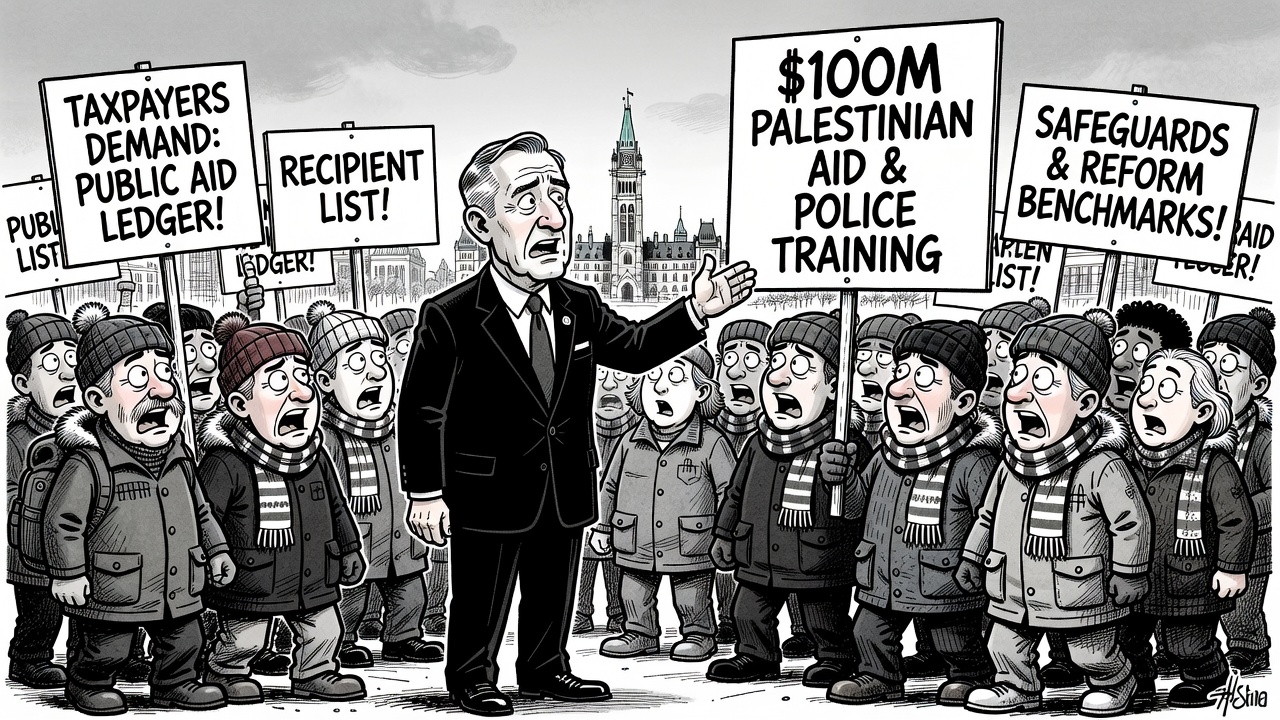
Prime Minister Mark Carney used the UN General Assembly week to announce another $100 million in Canadian international assistance for Palestinians. Reuters reported the split as $80 million for humanitarian aid and $20 million for peace and security capacity-building. Canadian Press reporting carried by CityNews added that Carney is open to expanding RCMP-linked Palestinian police training from the West Bank to Gaza when conditions permit.
That is not a small footnote. It is a live foreign-policy, public-safety and taxpayer-accountability file. In June, Global Affairs Canada had already announced another $100 million for Palestinians, saying that package brought Canada’s total international assistance efforts in Palestine to more than $500 million. The new September pledge now pushes the public figure higher, while the public ledger remains too thin.
Conservatives should be clear: emergency food, medical care, water, shelter and civilian protection can be legitimate humanitarian objectives. The argument is not that suffering civilians should be ignored. The argument is that Ottawa has a duty to prove where Canadian money goes, who receives it, what safeguards prevent diversion, and what measurable results taxpayers are buying.
The $20 million security-capacity portion needs special scrutiny. Police training in the Palestinian territories is not ordinary aid; it is security-sector assistance in one of the most volatile conflict zones in the world. If Canada is considering any Gaza role, even conditional and future-facing, the government should publish the legal authority, operational scope, risk assessment, partner list, vetting standards, end-use controls and the conditions that would have to exist before Canadian-supported training expands.
Ottawa also owes Canadians a clean new-versus-old-money table. The June announcement named UN, Red Cross and Red Crescent and NGO partners, and described food, medical, water, sanitation, shelter, protection, peacebuilding and stabilization work. The September announcement should now be separated line by line: how much is newly appropriated, how much is reprofiled, which organizations receive it, what administrative fees are charged, which projects are in Gaza or the West Bank, and what audits will be public.
Then there are reform benchmarks. Canada has tied its diplomacy to a two-state solution, Palestinian Authority reform, disarmament of Hamas and the safe flow of humanitarian aid. Fine. Publish the scoreboard. Which PA reforms are required? Which benchmarks have been met? Which have failed? What happens if funds are misused, blocked, taxed, seized or redirected? Vague assurances are not controls.
Canadians do not need another values speech from a podium in New York. They need receipts: recipient contracts, diversion safeguards, third-party monitors, project damage reports, quarterly outcomes, police-training limits and ministerial sign-offs. Before another $100 million leaves Ottawa, publish the Palestine aid and security-capacity ledger.
- Reuters via MarketScreener: Canada is giving C$100 million in international aid for Palestine, says Carney
- Canadian Press via CityNews: Carney pledges $100 million aid for Palestinians, mulls RCMP training in Gaza
- Global Affairs Canada: Minister Anand announces new funding for Palestinians amid crises in Gaza and the West Bank
- Prime Minister of Canada: Prime Minister Carney to attend the 81st Session of the United Nations General Assembly
This article argues for public disclosure and safeguards. It does not allege criminal conduct by any aid organization, public servant or recipient.