Before Carney Advances Bill C-34, Publish the Internet-ID Ledger
Online child safety is a real duty. It is not a permission slip for hidden age-check systems, regulator creep and vague speech controls.
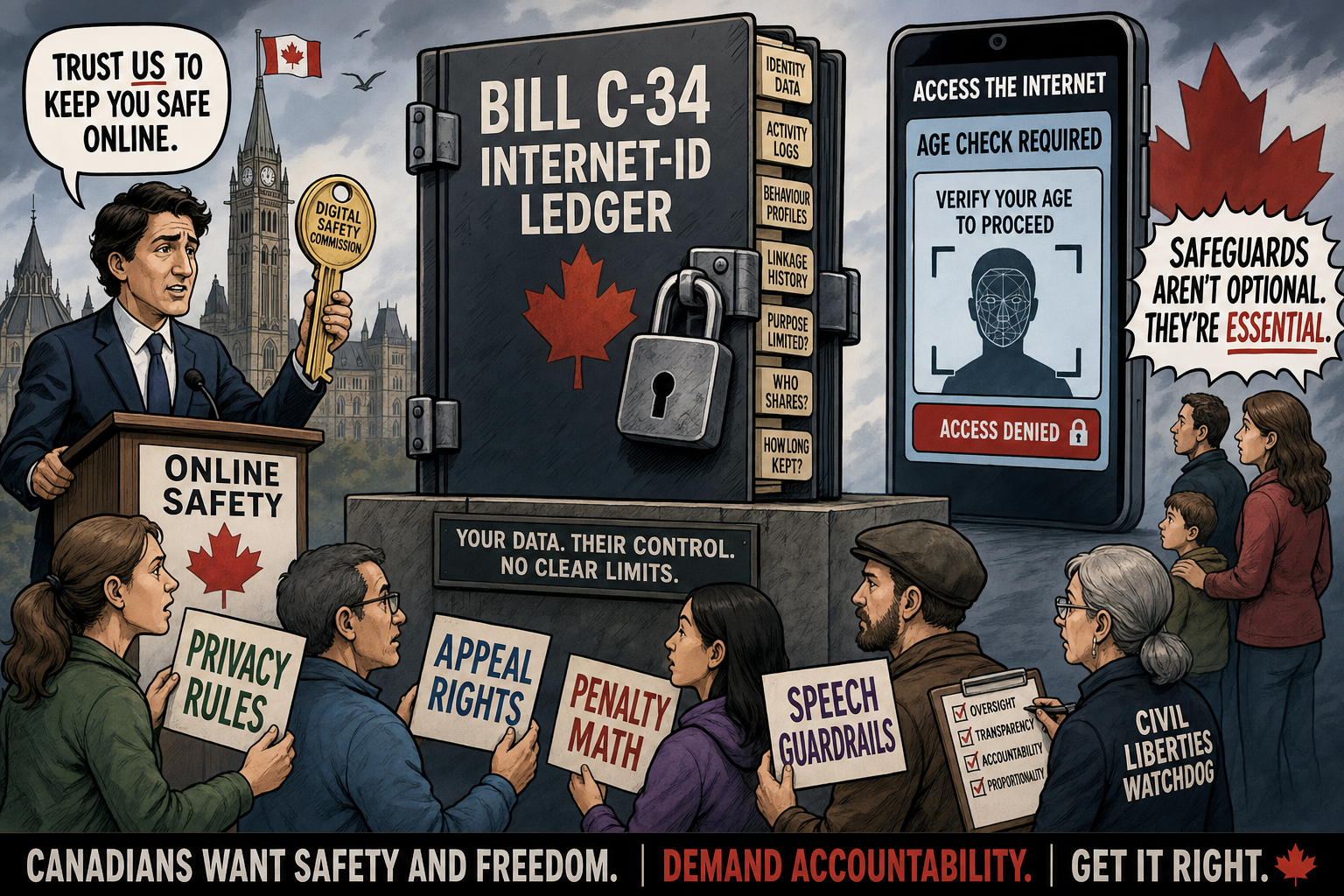
Bill C-34 is no longer just a June announcement gathering dust on Parliament’s shelf. Juno News and the Western Standard reported September 21 that Mark Carney told Liberal MPs his government intends to press ahead this fall with the online-safety legislation. That makes the accountability test immediate: before MPs move the bill, Ottawa should publish the internet-ID and regulator-power ledger.
Canadian Heritage says Bill C-34 was introduced June 10, 2026 and would enact the Digital Safety Act and the Digital Safety Commission of Canada Act. The official pitch is child protection: duties for regulated social-media and AI chatbot services, rules around harmful content, child-safety design, transparency reports and a new Digital Safety Commission to enforce compliance.
Child protection is legitimate. Conservatives should have no patience for platforms that enable exploitation, coercive bullying, predatory design or illegal material. But serious protection requires clear law, not a trust-us regulator. The bill text requires age-verification or age-estimation measures for regulated services with pornographic content and sets out measures designed to prevent people under 16 from holding accounts on specified regulated social-media services. That is an internet checkpoint unless the privacy model is written, published and independently audited.
The same bill gives regulated services duties to mitigate harmful-content exposure, provide reporting and blocking tools, publish guidelines, preserve certain violent-extremism or incitement material, keep compliance records and follow Commission orders. Those may sound technical. In practice, they decide what platforms must collect, what they must remove or restrict, what they must preserve, and how much discretion an unelected commission can apply after Parliament has gone home.
That is why the ledger matters. Ottawa should publish the age-check model, the personal-data minimization standard, the retention and destruction rules, the audit process, the Commission appointment plan, the order-and-appeal pathway, the penalty formula, the advisory minutes and the political-speech guardrails. If government officials insist the bill does not create a general internet-ID system or a censorship back door, they can prove it in writing before second reading advances.
Civil-liberties groups are already warning about the risk. The International Civil Liberties Monitoring Group says online-safety rules must not create undue fear of censorship for political, human-rights or academic debate, and flags concern that terrorism and violent-extremism language can expand through broad or controversial definitions.
The accountable standard is simple: protect children, punish illegal conduct, and keep Ottawa’s hands off lawful political debate. Bill C-34 may contain defensible tools. But no Parliament should hand a new internet regulator age-check powers, compliance orders and penalty machinery on the promise that the details will be reasonable later. Publish the receipts first. Then Canadians can judge whether this is child safety — or another Liberal power map wrapped in a sympathetic slogan.
- Juno News: Carney doubles down on internet regulation
- Western Standard: Carney vows to press ahead with Bill C-34 online safety law
- Canadian Heritage: Bill C-34, the Safe Social Media Act
- Parliament of Canada: Bill C-34 first-reading text
- International Civil Liberties Monitoring Group: Online-safety and civil-liberties concerns
This article supports targeted child-protection enforcement while demanding public privacy, appeal, speech and regulator-power safeguards before Bill C-34 advances.