Ottawa Financed the China Ferry Deal. Publish the Security Ledger.
If federal credit helped finance Chinese-built ferries after security concerns were known, Canadians deserve the full public risk ledger.
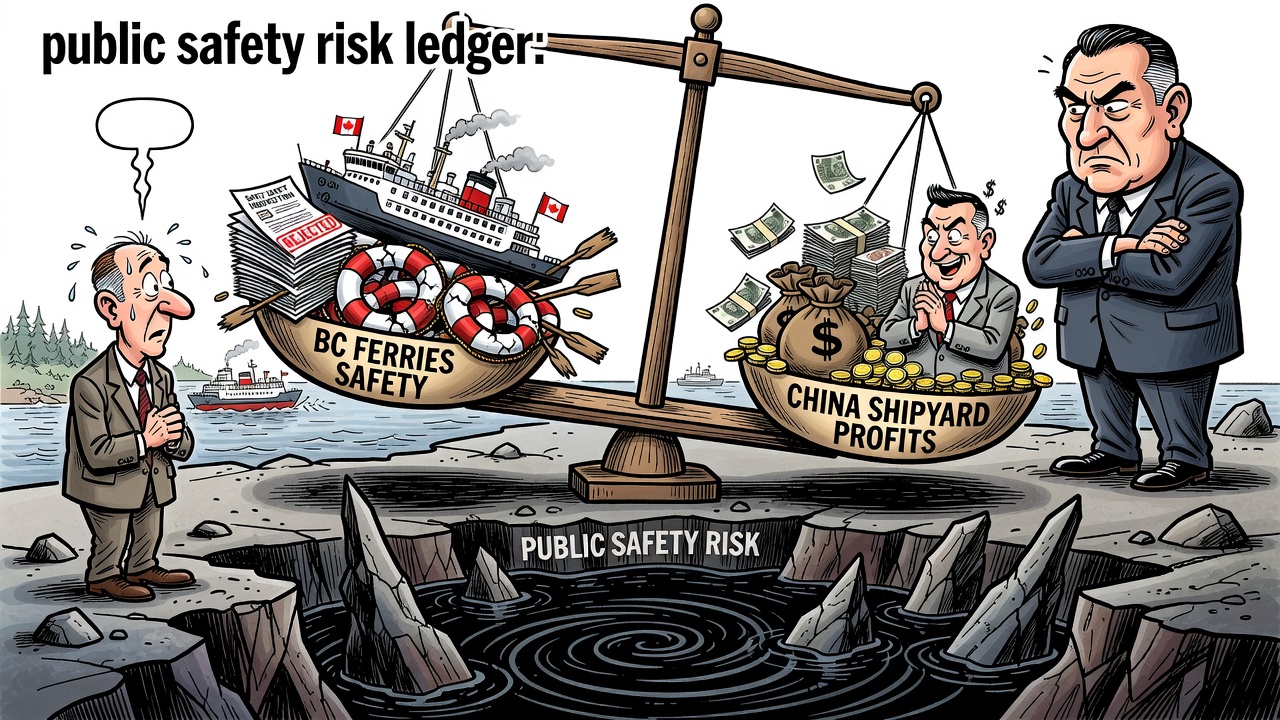
The BC Ferries China shipyard controversy is no longer just a procurement argument. It is now a national-security accountability test. The Bureau reports that Public Safety Canada records obtained through access to information identified potential supply-chain risks and flagged the proximity of ferry routes to sensitive Canadian military and intelligence assets in the deal with China Merchants Industry Weihai.
That matters because this was not a purely private, purely provincial, no-federal-stakes file. Federal briefing material says the Canada Infrastructure Bank and BC Ferries reached financial close on a $1 billion credit agreement on March 28, 2025, to support the New Major Vessels project. The same material says BC Ferries announced on June 10, 2025, that China Merchants Industry Weihai Shipyards had been selected to build four new major vessels after a global procurement process.
Public Safety’s own committee notes confirm the federal government knew the issue had moved beyond ordinary purchasing politics. The notes describe reports that BC Ferries had contracted a Chinese shipyard to construct four vessels, supported by $1 billion in low-interest CIB financing. They also say Public Safety withheld some information from documents produced to Parliament because releasing it could threaten Canada’s national security interests, including redactions recommended by CSIS.
The surviving text reported by The Bureau is specific enough to require answers. It says BC Ferries is the main connection between the mainland, Vancouver Island, the Sunshine Coast and the Gulf Islands, and that any disruption would have a major impact on logistics and daily life in island communities. It also reports that Route 11 between Prince Rupert and Skidegate passes within 100 kilometres of Masset, where Canada maintains a signals-intelligence facility, while routes to Swartz Bay pass within about 25 kilometres of CFB Esquimalt.
None of that proves wrongdoing by BC Ferries. It does not prove a vessel will be compromised. It does not mean every foreign-built asset is a spy device. Conservatives should not turn accountability into lazy panic. But it does mean Ottawa owes Canadians more than slogans about due diligence after federal financing is attached to critical coastal infrastructure.
The government’s current answer is a jurisdictional fog: Public Safety says it does not review provincial procurement decisions under the Investment Canada Act, and officials engaged after BC Ferries had already made its procurement decision. That may explain the bureaucratic gap. It does not excuse leaving taxpayers in the dark when a federal Crown financing vehicle is part of the architecture.
Publish the ledger: the CIB security due diligence, Transport Canada communications, Public Safety risk questions, CSIS redaction rationale, cabinet briefings, route-specific mitigation plan, software-and-systems audit requirements, contractor access limits, lifecycle maintenance safeguards and the decision record showing who accepted what risk, and when.
British Columbians need reliable ferries. Canadian workers deserve procurement honesty. Canadian taxpayers deserve to know why federal credit helped carry this deal forward despite security flags. If Ottawa wants trust, it can start by opening the file.
- The Bureau: Public Safety Documents Flag Intelligence, Military Base and Supply Chain Risks in BC Ferries’ China Deal
- Public Safety Canada: Parliamentary Committee Notes — Canada Infrastructure Bank’s financing of new vessels for BC Ferries
- Housing, Infrastructure and Communities Canada: Key Issues — BC Ferries and Canada Infrastructure Bank financing timeline
This article argues for public disclosure of the security and financing record. It does not allege sabotage, espionage or criminal conduct by any named company or official.