The Foreign-Influence Registry Needs a Failure Log
Ottawa promised Canadians a transparency tool. If one of the first China-linked disclosures can vanish from public view, the transparency system now needs its own audit trail.
Canada’s new foreign-influence registry was supposed to reduce guesswork. Public Safety Canada announced on August 4 that the Foreign Influence Transparency and Accountability Act and its regulations were in force, with an independent commissioner, a public registry and penalties that can reach $1 million for violations. The point was simple: Canadians should be able to see when someone is acting with a foreign principal to influence Canadian political or governmental processes.
That promise is now facing an early competence test. On September 16, Commissioner Anton Boegman said the first arrangements had been made public and that more would appear after validation. But the live registry checked today shows two visible public entries: Raquel Garbers with the U.S. Department of State, and Gerald Chipeur with the Republic of Korea. It does not show the reported Canada Files / CGTN Français filing.
The Bureau reported that one of the first three registry filings — the only initial disclosure involving a Chinese principal — disappeared from public view because of an unresolved technical failure. Juno News reported that the missing filing linked The Canada Files to CGTN Français, the French-language service of China Global Television Network, for roughly $823 tied to two sponsored productions. Juno also noted the important legal point: registration itself does not prove wrongdoing or foreign interference.
That caveat matters. This is not a call to treat every registrant as guilty, or to turn transparency into a blacklist. A registry is supposed to clarify facts, not manufacture allegations. But that is exactly why the system cannot be allowed to lose, hide or silently suppress entries. If the public sees only two records while reporting says there were three, Canadians need an official explanation that is as public as the registry itself.
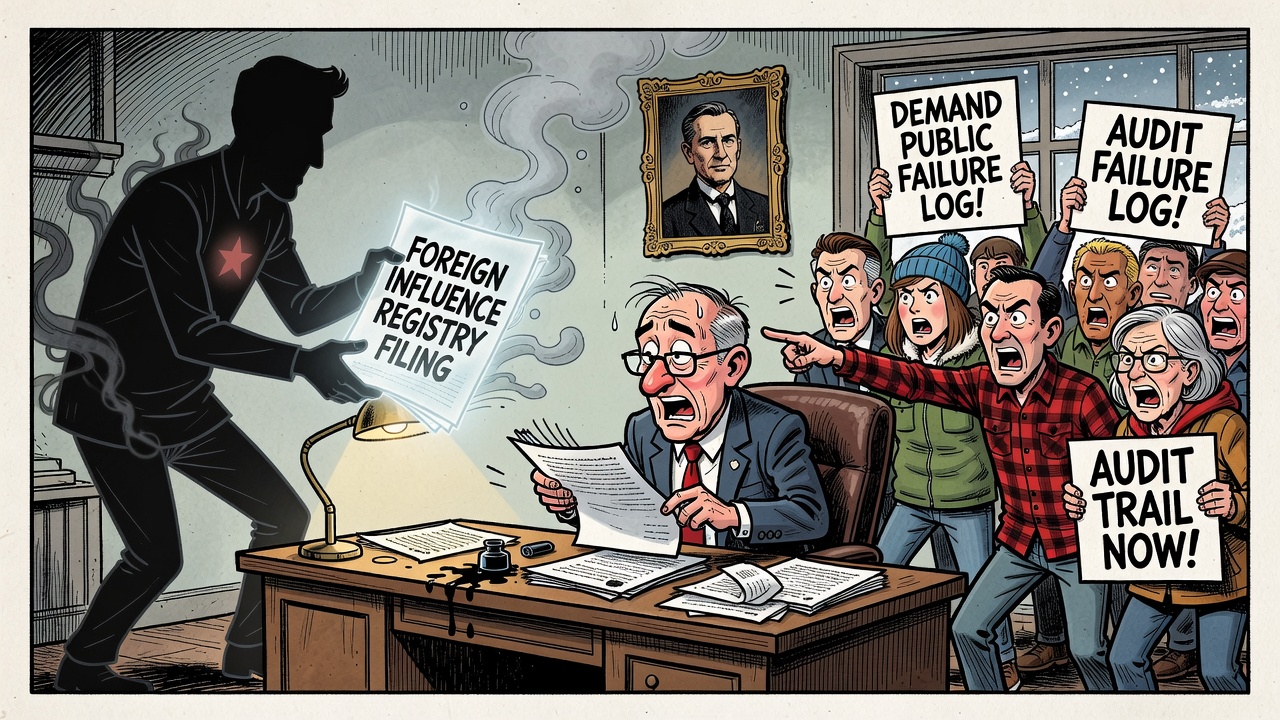
A conservative accountability standard is straightforward: when government builds a database to police trust, the database must be trustworthy. Ottawa should publish a foreign-influence registry failure log with the original three filing IDs, publication timestamps, validation status, outage timeline, cause of the data-transfer failure, restoration steps, responsible vendor or system owner, privacy breach assessment, and the date the missing entry will return. If an entry is temporarily unavailable, the registry page should say so in plain language rather than leaving citizens to wonder whether it never existed.
The Liberals spent years promising tougher action on foreign interference, especially after public concern over China. Now the first public test is not a spy thriller. It is basic administration: preserve the record, show the timestamps, explain the error, and restore the file. Transparency that vanishes on contact is not transparency. It is another Ottawa black box with a search bar.
- Office of the Foreign Influence Commissioner: Registry of foreign influence activities
- Office of the Foreign Influence Commissioner: Statement from Commissioner Boegman on the foreign influence registry
- Public Safety Canada: Government of Canada establishes foreign influence registry
- The Bureau: Technical Failure Removes China-Linked Filing From Canada’s New Foreign-Influence Registry
- Juno News: China-linked filing vanishes from Canada’s new foreign influence registry
This article argues for an audit trail and public incident report. It does not allege that any registrant, media outlet, official or foreign principal violated the Act or engaged in unlawful foreign interference.