Carney’s Fall Agenda Needs an Override Ledger Before MPs Vote
A government that just turned a shaky minority into a House majority does not get to sell a sweeping fall agenda on slogans. Publish the bill-by-bill ledger before the votes are whipped.
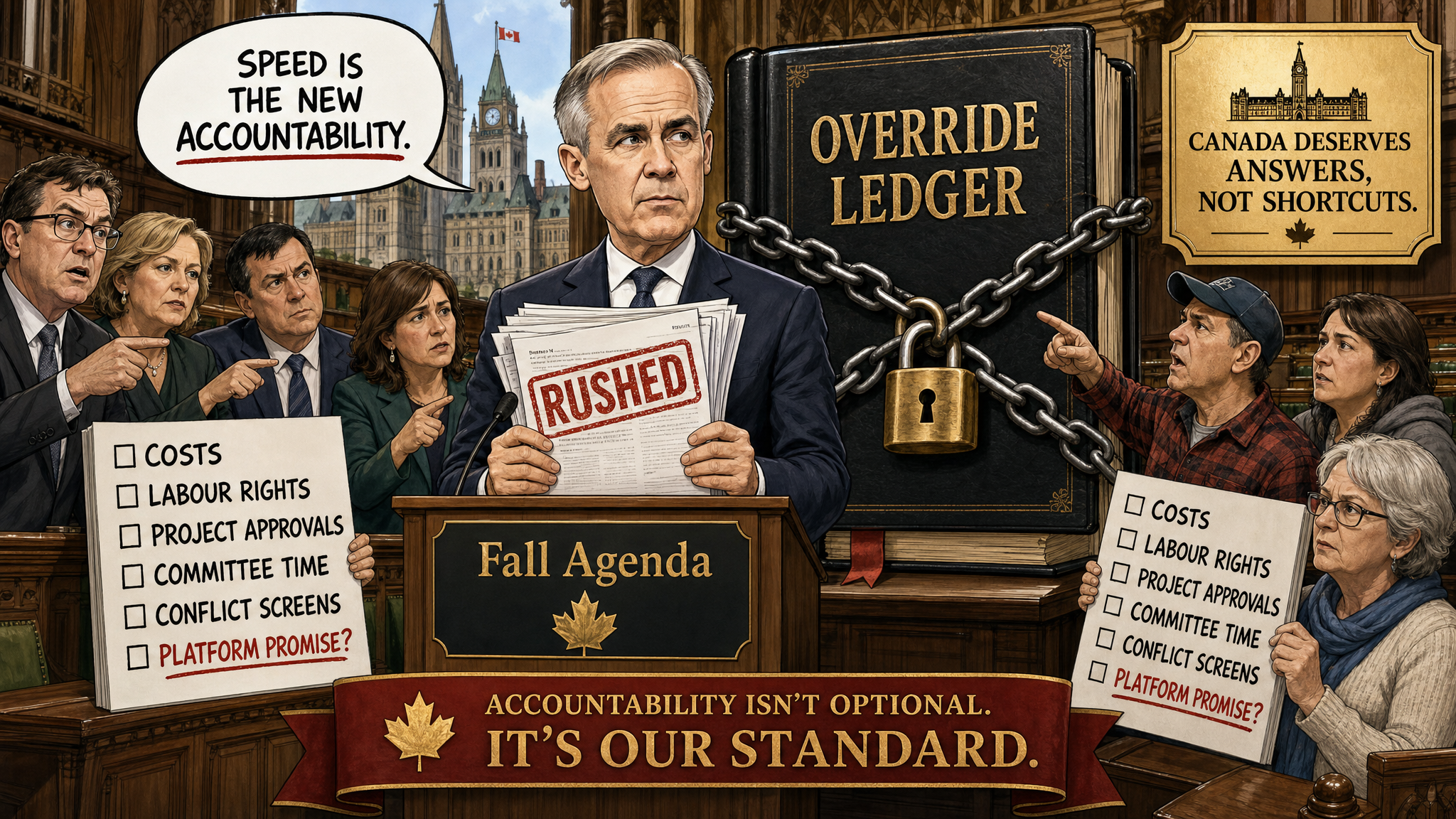
Parliament returned on September 21 with Prime Minister Mark Carney promising what Canadian Press, via Global News, described as some of the most consequential legislation in decades. Government House Leader Steven MacKinnon has promised “significant” economic legislation as the centrepiece of the fall sitting. That is exactly when Parliament should slow down and demand receipts.
The political arithmetic has changed since the spring. The Liberals are no longer merely managing a shaky minority. Global’s Canadian Press report says floor-crossers and byelections have pushed the government into a thin 173-seat majority, leaving opposition parties with less control over the House agenda. That may be legal. It is not a blank cheque.
The first test is labour power. The same reporting says critics are already warning that new legislation could affect the right to strike, while MacKinnon and ministers are preparing a bill they say will make agreements easier to reach. If the government wants to alter the bargaining balance in federally regulated sectors, Canadians need more than ministerial reassurance. They need the text, the Charter analysis, the list of affected sectors, the criteria for intervention, and the evidence showing why existing law is not enough.
The second test is project fast-tracking. iPolitics reported that Team Carney’s fall push is tied to the “Build Canada Strong” agenda, with major labour-law changes and measures aimed at accelerating approvals. Conservatives should support faster approvals when the rules are clear, property rights are respected, Indigenous consultation is real, and taxpayers know the cost. But fast approval cannot mean hidden exemptions, compressed committee study, or backroom carveouts for politically connected firms.
The third test is democratic honesty. Canadian Press reported that nine MPs stepped down after the House rose in June, three byelections have already been held, and six seats remain vacant. Carney is also headed to New York for United Nations meetings this week while the House resumes. A government can travel and legislate at the same time, but a new majority created after voters cast their ballots owes extra transparency when it starts moving major files through Parliament.
Here is the standard: before second reading on each major fall bill, publish a public Fall Agenda Override Ledger. It should show the bill title, every law amended, every regulatory power created, fiscal cost, committee timetable, time-allocation plan, Charter statement, Indigenous consultation plan, labour-rights analysis, public-asset implications, conflict screens, lobbyist-contact summary, and whether the promise appeared in the election platform.
If Carney’s agenda is as strong as advertised, it can survive daylight. If it depends on majority muscle, rushed committees and vague “build” branding, Canadians deserve to know before the votes are locked in.
- Global News / Canadian Press: House of Commons is back as Liberals vow ‘significant’ legislation coming
- iPolitics: House of Commons set to reopen for business as Team Carney launches fresh bid to build Canada strong
- Canadian Press via meadowlakeNOW: Parliament returns with some new MPs, more vacant seats and a major economic bill
- House of Commons: Party Standings in the House of Commons
This article argues for disclosure before major fall legislation proceeds. It does not claim any bill is unlawful; it demands public costs, powers, timelines and rights analysis before Parliament votes.