Balanced Operating Budget Is Not a Balanced Budget
Carney can claim progress on an operating-budget target. That is not the same thing as showing Canadians the whole deficit, borrowing and debt-interest bill.
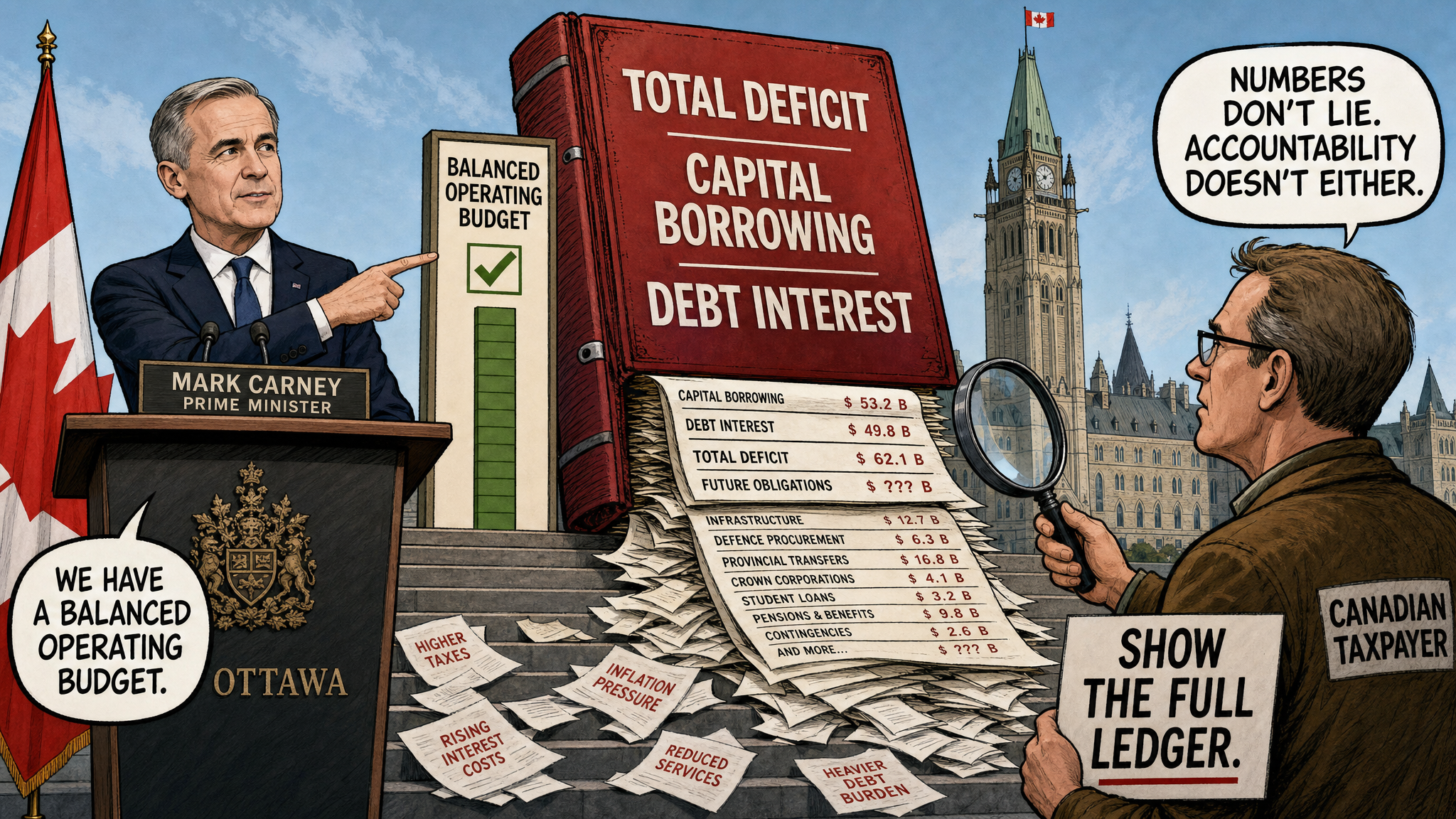
Prime Minister Mark Carney told investors at the Canada Investment Summit on September 15 that Ottawa is now “on track to balance the operating budget next year,” one year ahead of schedule. In the same speech, he said the government is distinguishing between operating and capital expenditures, reducing civil-service size by 10 per cent, cutting consultant spending by 20 per cent, and keeping what he called the lowest overall deficit in the G7.
That sounds disciplined. It is also incomplete. A balanced operating budget is not a balanced federal budget. Canadian Press reporting on September 19 said the Liberals have outlined $60 billion in planned trims over five years, partly through public-service downsizing, while Carney’s framework still permits borrowing for items classified as capital formation. The same report noted that stronger-than-expected revenues, consumer spending, corporate profits and higher oil prices have helped Ottawa’s fiscal position, offsetting a spring and summer spending burst.
The accountability problem is the column Canadians are not seeing in the headline. If Ottawa moves costs into a capital bucket, launches tax expenditures meant to stimulate private investment, or borrows for major projects, the total deficit can remain very real even while the operating side is declared balanced. Desjardins economist Randall Bartlett told Canadian Press that the new productivity mega-deduction should be treated as program spending and that Ottawa’s operating-expense definition is not taken seriously outside Ottawa. That is a warning worth taking seriously before the fall budget lands.
The Parliamentary Budget Officer has already explained why this distinction needs scrutiny. In August 2025, the PBO said the government had created a new “Operating Budget” fiscal anchor while the composition of that anchor had not yet been defined, and that Parliament would need better capital-spending monitoring to assess the new regime. The PBO also noted that capital spending is a well-defined accounting concept, but government may choose its own alternate definition.
Conservatives should not let the Liberals turn “operating balance” into a victory lap without the receipts. The fall budget should include a one-page total-deficit ledger: operating balance, capital deficit, total deficit, debt charges, asset sales, reclassified spending, tax expenditures counted as capital, department-by-department reductions, service impacts, headcount reductions, and every assumption tied to oil prices, GDP and revenue growth.
If Carney has found real discipline, the ledger will prove it. If the balance is mostly accounting labels and better-than-expected revenues, Canadians deserve to know that too. Fiscal credibility does not come from balancing the friendliest column. It comes from showing the whole book.
- Prime Minister of Canada: Prime Minister Carney delivers opening remarks at the Canada Investment Summit
- Canadian Press via paNOW: Ottawa’s summer spending flurry offset by stronger GDP, oil revenues
- Parliamentary Budget Officer: Forecasting Federal Capital Expenses
- Treasury Board of Canada Secretariat: Modernization of Budgeting Approach
- Fraser Institute: Reality check—the Carney government won’t actually reduce spending
This article distinguishes between an operating-budget claim and the broader fiscal position. It argues for disclosure of the total deficit ledger before Canadians accept any balanced-budget framing.