Building Canada Strong Needs Receipts Before Parliament Votes
Speed is not a blank cheque. If Ottawa wants one project, one review, one year, it should publish the rules before MPs vote.
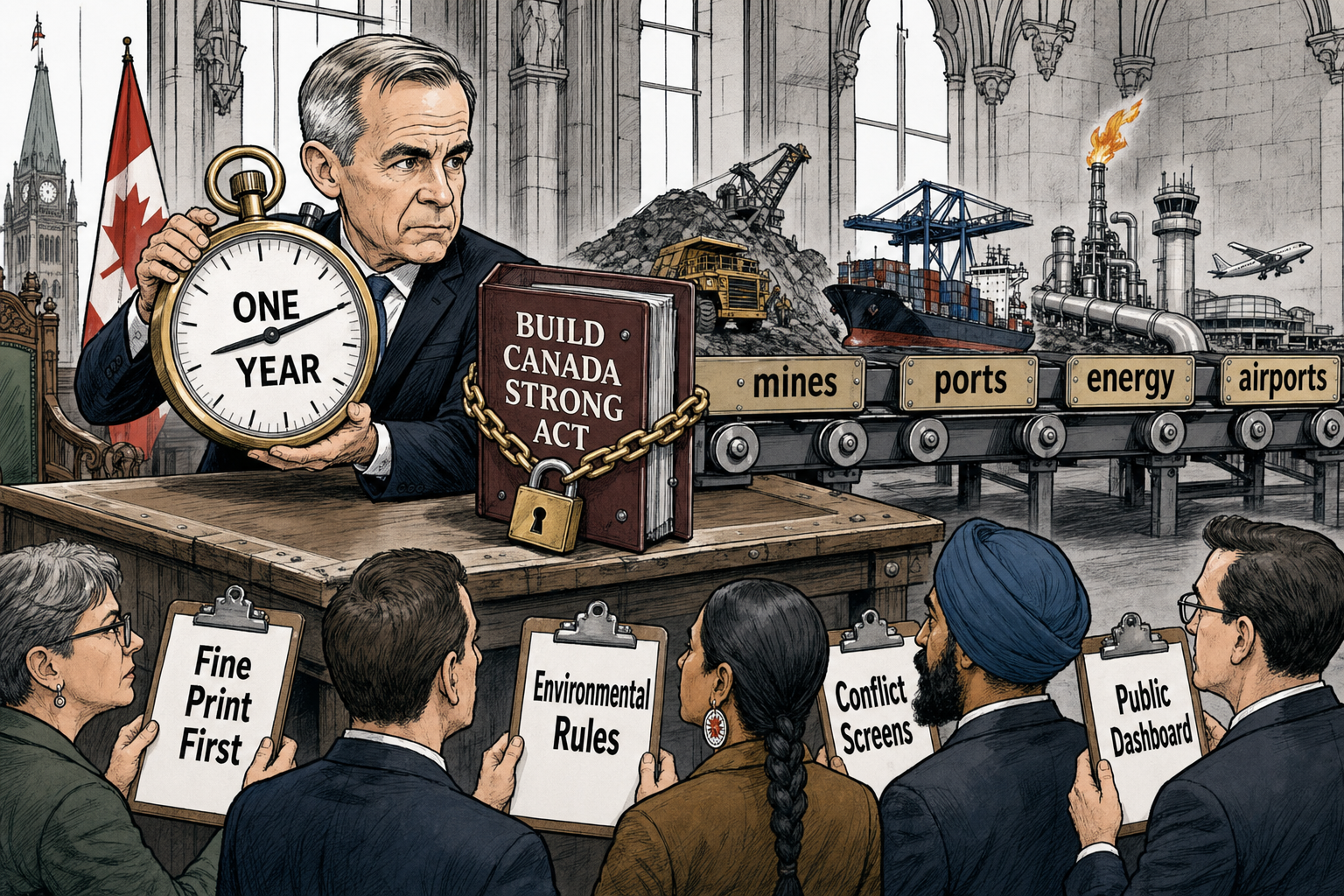
Prime Minister Mark Carney told Liberal MPs on September 18 that the coming House of Commons sitting is “crucial” and that his government will introduce project-review legislation known as the Building Canada Strong Act. Canadian Press reported through CityNews that Carney framed the standard this way: one project, one review, one year. If Ottawa is going to say no, he said, it should say no quickly; if it is going to say yes, it should say yes on time.
That sounds efficient. It is also the kind of slogan that can hide the real power transfer until after Parliament has already voted.
Canada does need faster decisions. Investors, workers, provinces and Indigenous communities should not be trapped for years in duplicated federal processes. The government’s own One Canadian Economy material says the Building Canada Act and the Major Projects Office are meant to streamline approvals and financing while respecting Indigenous rights and safeguarding the environment. Ottawa has already initiated a process to consider major projects under that framework, including northern road, port and nuclear-waste repository files.
But a one-year clock raises basic questions that cannot be answered by applause lines at a caucus retreat. When does the year start? When does it pause? Which projects qualify? Which federal laws, permits and authorizations are consolidated? What happens when a project crosses provincial, treaty, environmental, fisheries, navigation or nuclear-safety boundaries? Who decides that consultation has been adequate? What records will prove that Indigenous rights were respected rather than rushed past?
Government House Leader Steven MacKinnon reportedly called very significant economic legislation the centrepiece of the fall sitting and pointed to project reviews, Canada Labour Code changes and supply-chain planning. That means this is not a narrow administrative tune-up. It is a governing package touching infrastructure, trade corridors, labour, private capital and regulatory discretion.
The accountability test is simple: publish the fine print before the vote. Canadians should see the draft bill, a clause-by-clause table of every law being amended, the eligible project categories, the start-and-stop rules for the one-year clock, the public-submission process, the Indigenous consultation and accommodation plan, any environmental exemptions, the judicial-review risk memo, and conflict-screen rules for investors and project proponents.
Global News reported that the same caucus speech tied the fall agenda to U.S. tariffs, sovereignty and Canada’s turn toward Europe. Western Standard framed the package as pairing a one-year federal review promise with tariff aid and tax-writeoff commitments. In other words, this file is about more than speed. It is about who gets access, who gets financing, who gets fast-tracked, and who is left challenging the decision afterward.
Carney can argue that Canada must build again. Fine. Then build the accountability dashboard too: quarterly reports to Parliament listing applications, timelines, approvals, rejections, conditions, consultation milestones, litigation, public money committed and whether projects actually broke ground.
A serious government can move quickly and still show its work. If Building Canada Strong is as strong as advertised, Ottawa should have no fear of publishing the receipts before MPs are asked to hand cabinet the stopwatch.
- CityNews / The Canadian Press: Prime Minister Carney rallies Liberal MPs ahead of Parliament's return
- Global News / The Canadian Press: Trump’s new tariffs against Canada a ‘miscalculation,’ Carney says
- Government of Canada: Canada initiates process to list major projects under the Building Canada Act
- Government of Canada: Simplifying Canada’s process for all major projects
- Western Standard: Carney adds $7.5 billion onto tariff aid after halting U.S. trade talks
This article argues for public transparency around proposed project-review legislation. It does not allege unlawful conduct by any named official or oppose lawful project development.