Carney’s Strike-Power Bill Needs a Section 107 Ledger
If Ottawa says strike-ending power is only a last-resort stability tool, it should publish the rules before Parliament votes.
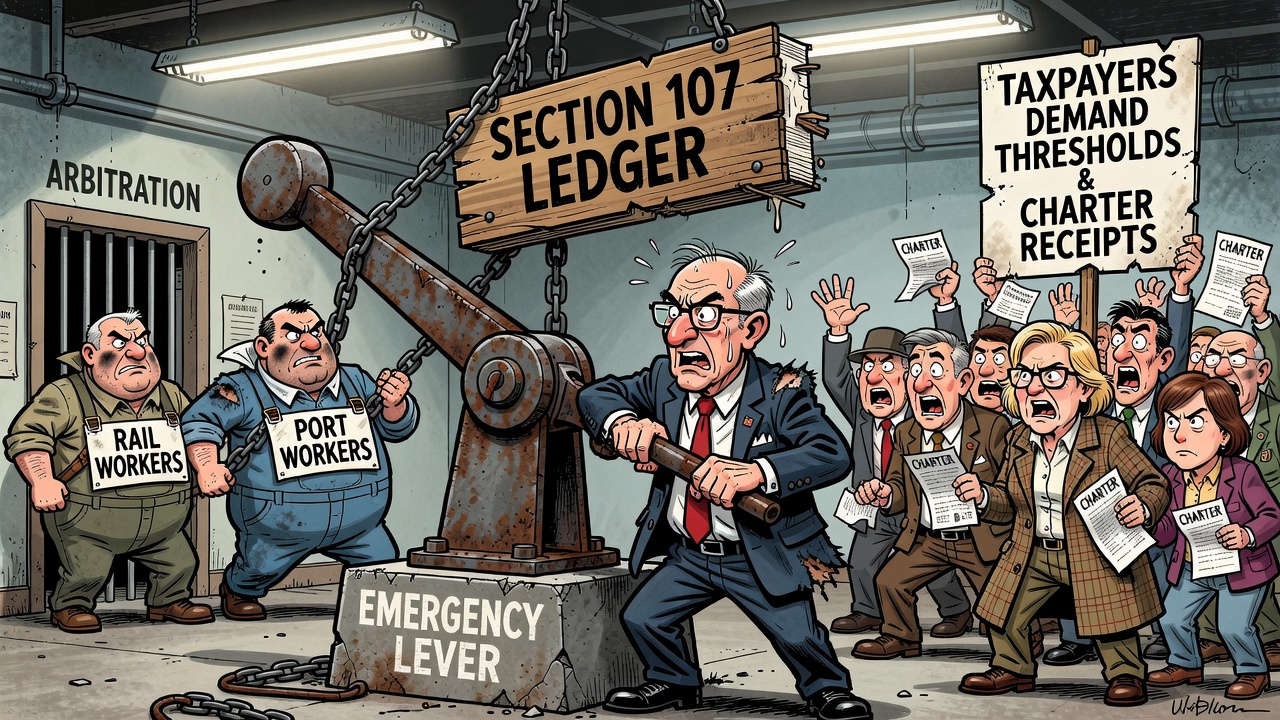
The Carney government is reportedly preparing to turn a controversial emergency-style labour workaround into explicit law. CBC reporting, syndicated by Yahoo News and mirrored by The1News, says Ottawa plans to amend Section 107 of the Canada Labour Code so the responsible minister can direct the Canada Industrial Relations Board to end work stoppages and order arbitration in federally regulated disputes.
That is not a small administrative tweak. Section 107 already lets the minister direct the board to take action considered useful to maintain industrial peace. Recent governments have leaned on that authority in high-stakes transportation disputes. Now, according to the report, the fall Building Canada Strong Act would spell out a clearer ministerial power focused on “high-potential disruptive labour issues” in export-critical sectors such as ports and rail.
Jobs and Families Minister Patty Hajdu told CBC’s Power & Politics the bill will not limit unions’ ability to strike and will focus on only a fraction of disputes that create major disruption. That may be the government’s intent. But conservative accountability starts with a basic rule: when Cabinet asks Parliament for coercive power, Cabinet owes Parliament the operating manual.
Canadians do not have to pick between chaos at the ports and blank-cheque ministerial intervention. Supply chains matter. Grain, energy, lumber, potash, auto parts and consumer goods all move through systems where a prolonged shutdown can hit workers far from the bargaining table. But the constitutional right to meaningful collective bargaining also matters, and the Supreme Court of Canada has recognized strike activity as part of that framework. A government that wants to override work stoppages should have to show more than a press-line promise that it will be careful.
Before this bill moves, Ottawa should publish a Section 107 ledger: the sectors covered, the disruption threshold, the evidence test, the mediator’s role, the Cabinet sign-off process, the Charter analysis, the appeal route, the arbitration criteria and every prior use of Section 107 that the government says justifies making the power explicit. It should also disclose whether employers in covered sectors receive any new incentive to wait for Ottawa instead of bargaining seriously.
The danger is moral hazard. If railways, ports or other federally regulated employers know the minister can end a strike quickly, the bargaining table changes. Workers may see their legal leverage weakened. Employers may see delay rewarded. Taxpayers may see Ottawa claim “stability” while hiding the political judgment calls inside a minister’s office.
If the Carney government believes the power is narrow, necessary and Charter-safe, it should welcome daylight. Publish the thresholds. Publish the sectors. Publish the intervention history. Publish the legal risk. Emergency powers should not become routine simply because Ottawa gives them a cleaner statutory label.
- Yahoo News / CBC: Liberals looking to give minister explicit authority to end strikes: sources
- The1News / CBC mirror: Liberals looking to give minister explicit authority to end strikes: sources
- Justice Laws Website: Canada Labour Code, Section 107
- Supreme Court of Canada: Saskatchewan Federation of Labour v. Saskatchewan
- LabourStart Canada: Canadian labour news roundup
This article argues for transparent rules and parliamentary disclosure. It does not claim every federal labour dispute should continue indefinitely or that critical infrastructure disruptions have no public cost.