Ottawa Wants Private Airport Operators. Publish the Contract Ledger First.
If Ottawa keeps the land but hands the operations to private players, Canadians deserve the terms before the boarding pass gets more expensive.
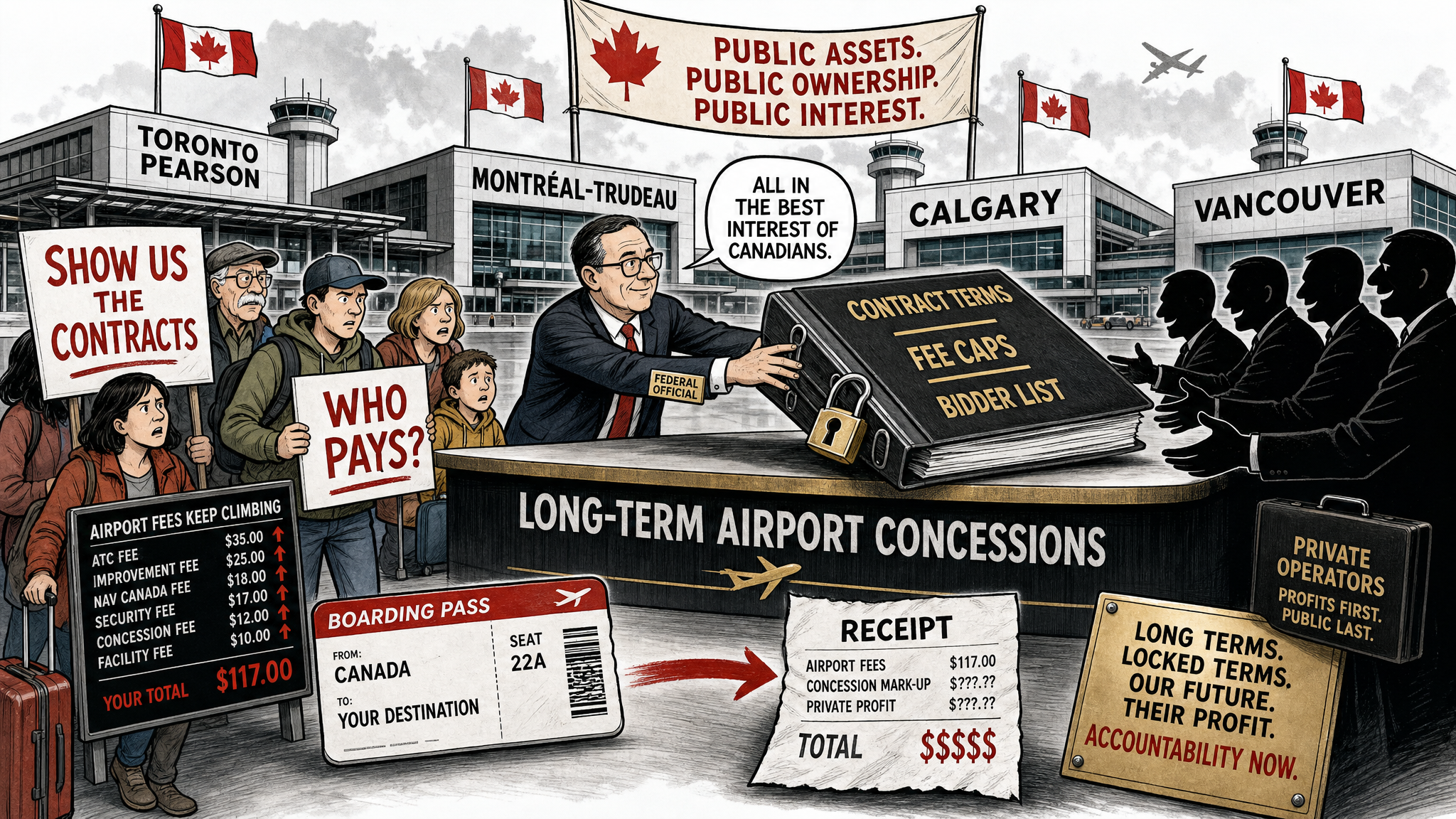
Prime Minister Mark Carney’s airport plan is being sold as a way to bring private capital and operating expertise into Canada’s biggest airports. The basic facts are clear enough to start asking harder questions. Canadian Press reporting says the government is looking at private operation of the four largest airports: Toronto Pearson, Montréal-Trudeau, Calgary International and Vancouver International. Carney says the federal government would keep ownership of airport land and assets, while private investors could operate the airports under long-term concession-style arrangements.
That is not a small housekeeping change. CityNews reported that Canada’s major airports are now run by private, not-for-profit airport authorities that lease from the federal government, set their own fees and cover their operating costs. Under the proposed model, private investors could manage the airports for set lease periods, while Transport Canada would keep regulatory oversight. A business-law expert quoted by CityNews said the concession agreement would need to spell out service levels, performance, public safety, passenger costs and employee management.
Exactly. That is why the contract ledger matters more than the press-release language. Ottawa can say it will retain ownership. Travellers still need to know whether the operating agreement lets a private concessionaire recover its investment through higher airport improvement fees, parking charges, lease payments, airline charges or other costs that eventually land on passengers.
The warning signs are not theoretical. CityNews noted that Australia’s competition watchdog has tracked privatized airports and said passengers face price increases when airports become privatized local monopolies. It also cited a University of Alberta study finding privately operated airports can perform better on some service measures but may come with higher fees — about $20 more per passenger. That does not prove Canada’s plan will fail. It proves Ottawa has no excuse to hide the fee-impact analysis.
Conservatives should not reject every private-dollar proposal on instinct. Better terminals, more capacity and faster upgrades matter. So does fiscal discipline. But public assets should not become opaque toll booths for well-connected operators while ministers claim victory for the capital they attracted.
Before any concession is signed, the Carney government should publish the valuation method, draft lease length, expected upfront payment, annual revenue-sharing terms, fee caps, service standards, labour protections, bidder list, conflict screens, pension-fund exposure and termination clauses. It should also release the traveller-cost model airport by airport, including the effect on airlines, tenants, parking, security flows and regional connections.
If this plan is truly better for travellers, the numbers should survive daylight. If it is mainly a way to book private capital now while burying passenger costs later, Canadians deserve to know before Ottawa signs away operational control for decades. The test is simple: no airport concession without the contract ledger.
- CityNews / The Canadian Press: What you need to know about Carney’s pitch for private investment in airports
- Global News: Canada seeks private investment in airports but feds to keep land, assets
- Prime Minister of Canada: The first Canada Investment Summit unleashes nearly $500 billion of new investment in Canada
This article argues for disclosure of public contract terms and aggregate cost analysis, not for release of confidential personal traveller data.