Canada Already Had an Investment Agency. Publish the Summit Bypass Ledger.
A summit advertised as nearly $500 billion in commitments deserves more than applause. It deserves records.
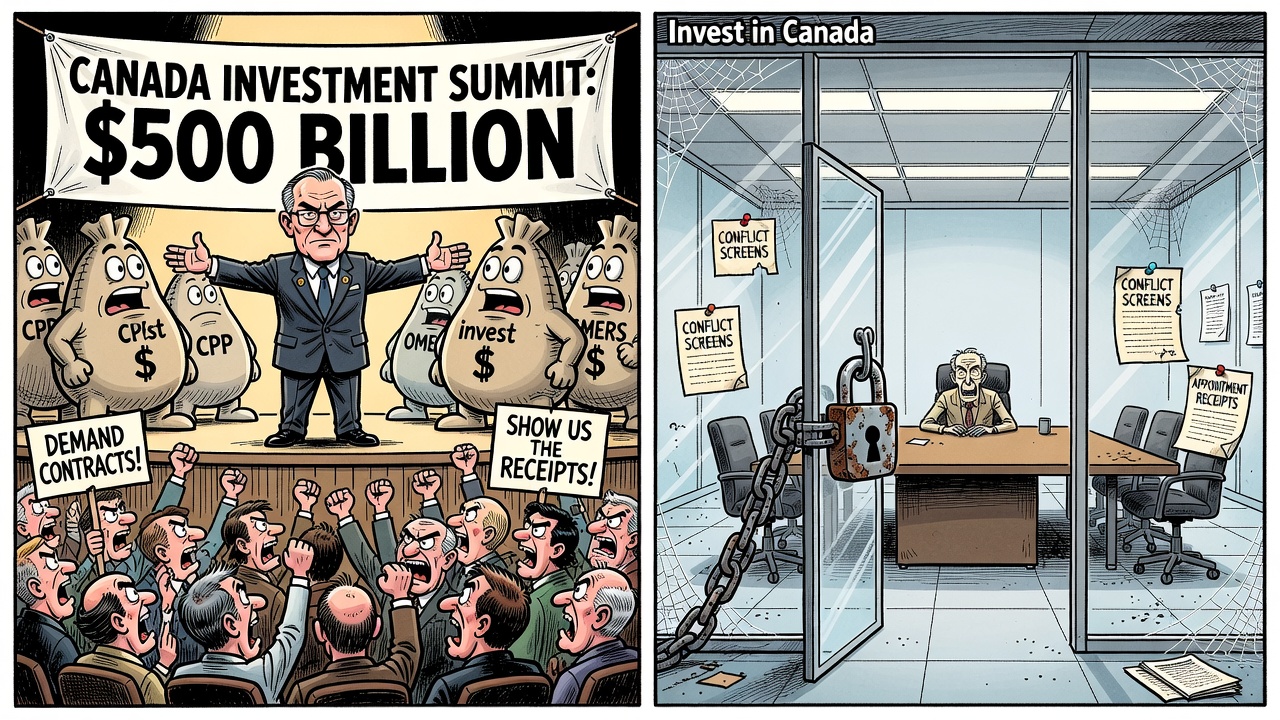
Prime Minister Mark Carney’s office says the first Canada Investment Summit in Toronto produced nearly $500 billion in new investment commitments. That is a big headline. It included a $50 billion CPP Investments-Brookfield Maple Fund, higher Canadian allocations from PSP Investments, new pension and insurer commitments, bank financing pledges, and project support in energy, critical minerals, AI, infrastructure and defence-adjacent sectors.
Fine. Conservatives should want capital built in Canada. But serious conservatives also ask the boring questions before the victory lap becomes the cheque. Who selected the projects? Who screened conflicts? Which commitments are binding, which are financing envelopes, and which depend on future taxpayer incentives, regulatory favours or public guarantees?
The odd part is that Parliament already created a federal body for this job. The Invest in Canada Act gives Invest in Canada a mandate to coordinate federal foreign-investment efforts and lists event and conference promotion among its functions. Yet the government’s public summit page described the event as hosted by the Prime Minister in partnership with CPP Investments and PSP Investments. Invest in Canada appeared publicly in the media-inquiries list, not as host, partner or producer.
The Receipts went further, reporting that the summit was produced by a California events firm and that, as of September 15, the Governor in Council appointments database still listed ten of eleven Invest in Canada positions as vacant, with neither Dominic Barton’s chair appointment nor Gurinder Grewal’s CEO appointment yet reflected there. The same outlet emphasized that every step may have been lawful; the issue is what the published architecture shows — and does not show.
That matters because Global News reported Carney had just overhauled the agency’s leadership weeks before the summit, naming Barton as chair and Grewal as CEO. Barton’s résumé includes McKinsey, Rio Tinto, LeapFrog, the Trudeau economic advisory council and service as ambassador to China. None of that disqualifies him. It does, however, make conflict screens and recusal rules essential, especially after the Auditor General found frequent disregard for procurement rules across federal McKinsey contracts worth $209 million, with $200 million spent.
The pension-fund role also needs daylight. CPP Investments and PSP Investments are supposed to manage retirement assets, not become a shadow delivery arm for the Prime Minister’s industrial strategy. If they were simply conveners and investors, publish the boundary memo. If they controlled delegate data, instructed vendors, selected projects or helped shape commitments, publish the authority, privacy, procurement and fiduciary records.
This is not an anti-investment argument. It is the pro-accountability argument. If Carney’s summit is as strong as advertised, the receipts should strengthen it: the summit production contract, vendor-selection record, agency-role memo, ministerial directions, board quorum records, appointment instruments, conflict screens, project list, investor follow-up plan, and taxpayer-risk terms.
Canada needs investment. It does not need another Liberal machine where public agencies are ornamental, pension funds are political stage props, insiders rotate through the same doors, and taxpayers are told to clap before they are allowed to read the fine print.
- The Receipts: Canada Already Has an Investment Agency. An American Firm Produced the Investment Summit Instead.
- Government of Canada: Canada Investment Summit 2026
- Justice Laws Website: Invest in Canada Act — Functions
- Prime Minister of Canada: The first Canada Investment Summit unleashes nearly $500 billion of new investment in Canada
- Global News / Canadian Press: Carney names Dominic Barton as chair of Invest in Canada
- Office of the Auditor General of Canada: Report 5—Professional Services Contracts
This article distinguishes between official summit claims, public-record gaps reported by The Receipts, and accountability questions that should be answered with documents.