IRCC Is Cutting Advanced Language Training. Publish the Settlement Cuts Ledger.
Ottawa cannot invite newcomers, promise productivity, then quietly shrink the integration pipeline without showing the receipts.
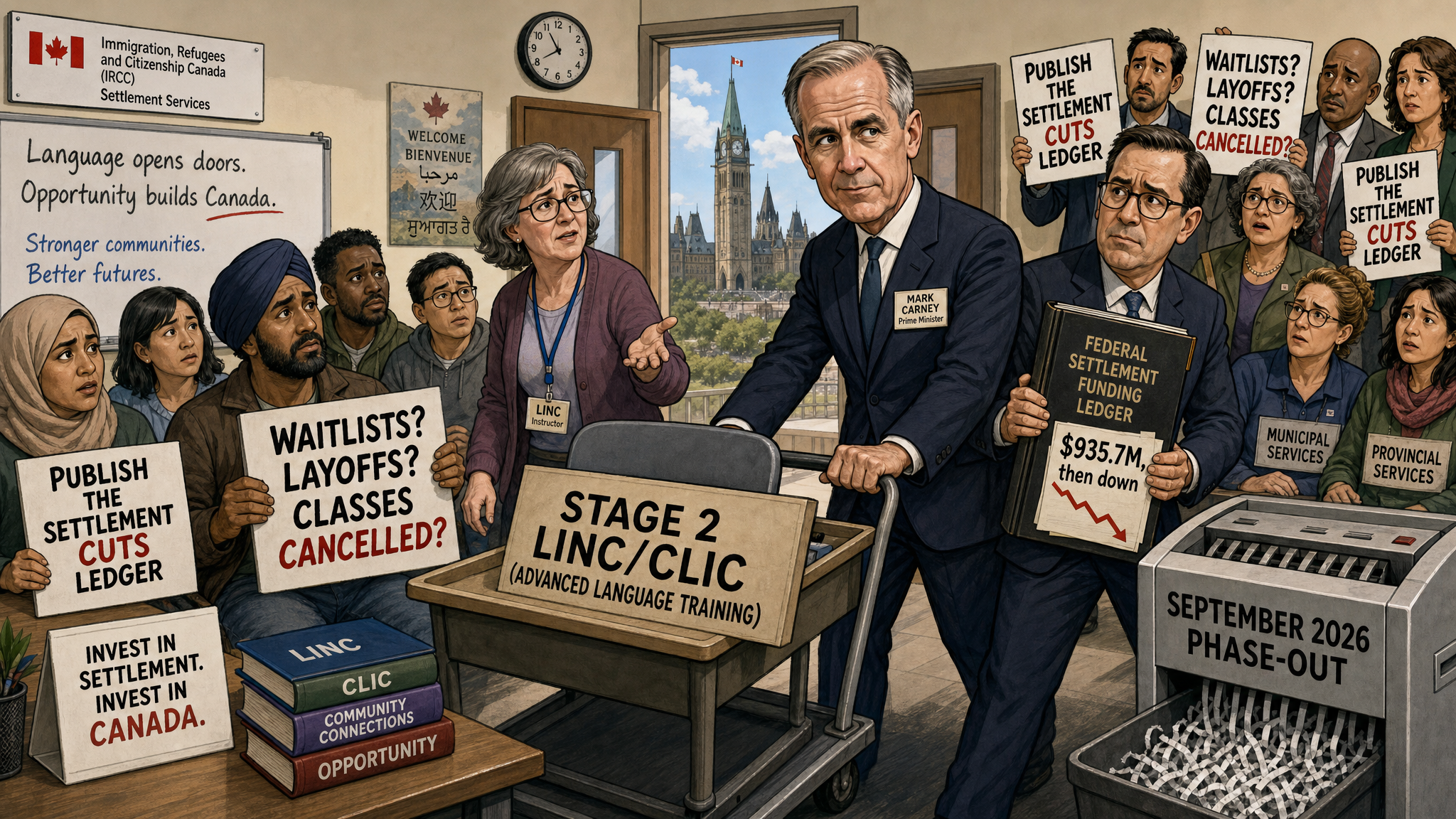
IRCC’s own 2026 transition binder lays out the problem in plain numbers. The department says Ottawa is investing $1.125 billion in 2025–26 for settlement needs outside Quebec, delivered by more than 530 third-party service provider organizations. Then the same document says the envelope is being cut because immigration levels are lower, the 2026–2028 Levels Plan changed the mix of admissions, and Budget 2025 expenditure-review savings are being taken from the Settlement Program.
The cliff is specific. IRCC anticipates $935.7 million for settlement needs outside Quebec in 2026–27 — a 9.5 per cent decrease, or about $98.1 million, compared with prior notional allocations used to negotiate existing agreements. The department says funding is expected to fall again to $895.0 million in 2027–28 and $783.7 million in 2028–29.
That is not just an accounting note. IRCC says it is re-negotiating existing agreements for downward amendments. It is reducing settlement-service eligibility for economic-class permanent residents to six years starting in April 2026 and five years starting in April 2027. Most directly for workers and employers, it says Stage 2 Language Instruction — advanced LINC and CLIC language training — will be phased out by September 2026 so funding can be prioritized for basic language services.
Conservatives should support disciplined immigration targets and disciplined spending. But discipline means matching intake, housing, jobs, language training and credential recognition — not dumping the integration bill on provinces, municipalities, charities, employers and newcomers after the federal announcement fades.
IRCC’s June 2025 committee note said nearly 686,000 newcomers accessed settlement services in 2024–25, one of the program’s highest client-volume years. Its 2026 binder also admits settlement services support both new and past arrivals, meaning demand can remain high even as immigration levels start decreasing.
The ground-level warnings are already visible. Canadian Press reported in February that a GTA survey of 48 newcomer-service agencies found 44 per cent expected program closures, 56 per cent expected disruptions, and 68 per cent anticipated layoffs by 2028. The same report connected many cuts to higher-level language training and warned of employment and housing consequences when newcomers cannot access the training they need.
So publish the settlement cuts ledger. List every provider reduction, class cancellation, waitlist, affected CLB/NCLC level, region, layoff estimate and alternative capacity plan. Show which provinces, colleges or employers are expected to absorb advanced-language demand. Show the labour-market modelling. Show the refugee and high-needs safeguards.
If Ottawa believes these cuts are responsible, it should defend them line by line. If not, it should stop pretending integration happens by press release.
- IRCC Deputy Minister Transition Binder 2026: Canada’s approach to settlement and integration of immigrants and refugees
- IRCC committee material: COW — Settlement Services — June 9, 2025
- Open Government Question Period note: Update on how IRCC supports settlement services for immigrants
- Canadian Press via CityNews: Almost half of Toronto-area immigrant settlement services expect program closures
This article argues for transparent settlement-service budgeting and accountable implementation. It does not argue for unlimited immigration levels or for bypassing normal program-integrity controls.