Finance Canada’s Fiscal Monitor: Spending Still Climbs Behind the Smaller Deficit
Revenue improved the first-quarter headline. Spending discipline did not.
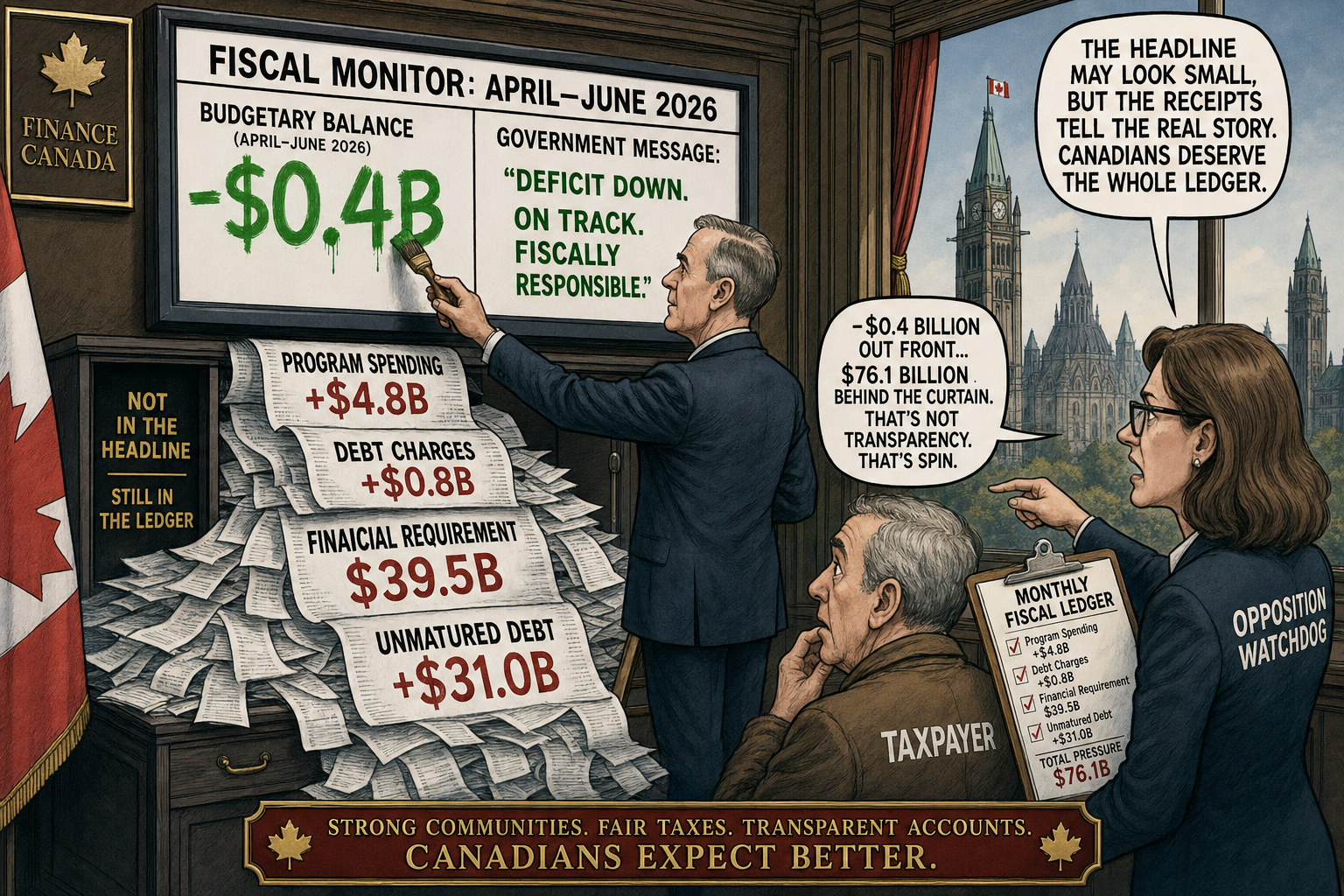
Finance Canada’s June 2026 Fiscal Monitor gives the Liberal government one number it will want repeated: for April to June 2026, Ottawa posted a $0.4 billion budgetary deficit, down from $6.3 billion in the same period a year earlier. That improvement is real. It is also incomplete.
The first-quarter deficit shrank because revenues jumped. Finance reports revenues of $132.6 billion for April to June, up $11.8 billion, or 9.8 per cent, largely from higher personal and corporate income-tax, GST and other revenues. If taxpayers are sending Ottawa more money, the deficit line should improve.
But that is not proof the government got smaller. Program expenses excluding net actuarial losses rose $4.8 billion, or 4.3 per cent, to $117.2 billion. Finance points to higher direct program expenses and major transfers to persons, with direct program expenses alone up $6.4 billion, or 13.6 per cent. Operating expenses rose $3.1 billion, or 10.8 per cent, largely reflecting higher personnel costs and accounting changes for bad-debt expense.
Then comes the debt bill. Public debt charges increased $0.8 billion, or 6.1 per cent, to $14.6 billion in just three months. Finance says the increase largely reflected higher average effective interest rates on an increased stock of marketable bonds and higher CPI adjustments on Real Return Bonds, partly offset by lower short-term treasury-bill rates. That is the cost of years of borrowing showing up as a monthly invoice.
The cash side is even less flattering. Finance explains that the accrual budgetary balance is not the same as cash coming in and out. For April to June 2026, the government had a $39.5 billion financial requirement. It financed that by increasing unmatured debt by $31.0 billion and drawing down cash balances by $8.4 billion.
Carney’s government also cannot hide behind the idea that a better quarter settles the year. Its own Spring Economic Update projected deficits of about $65 billion in 2026–27, $63 billion in 2027–28, $58 billion in 2028–29, $56 billion in 2029–30 and $53 billion in 2030–31.
So publish the monthly fiscal ledger. Separate revenue windfalls from real spending restraint. Show the drivers of direct program expenses, personnel costs, transfer timing, professional services, debt issuance, cash drawdowns and interest-rate sensitivity. Canadians do not need a victory lap over a smaller early-year deficit. They need proof that Ottawa can control spending before the next debt-charge bill arrives.
- Department of Finance Canada: The Fiscal Monitor — June 2026
- Open Government Portal: The Fiscal Monitor: 2026 dataset
- Department of Finance Canada: Spring Economic Update 2026 — Economic and fiscal overview
- Department of Finance Canada: Publications and reports
This article relies primarily on Finance Canada’s monthly Fiscal Monitor and Spring Economic Update. Fiscal Monitor results are monthly and can be affected by timing within the fiscal year.