Carney’s $36B Mega Deduction Needs a Receipt Ledger
If Ottawa wants permanent broad corporate expensing, Canadians deserve to know who benefits, what jobs are created, and when taxpayers get paid back through real productivity gains.
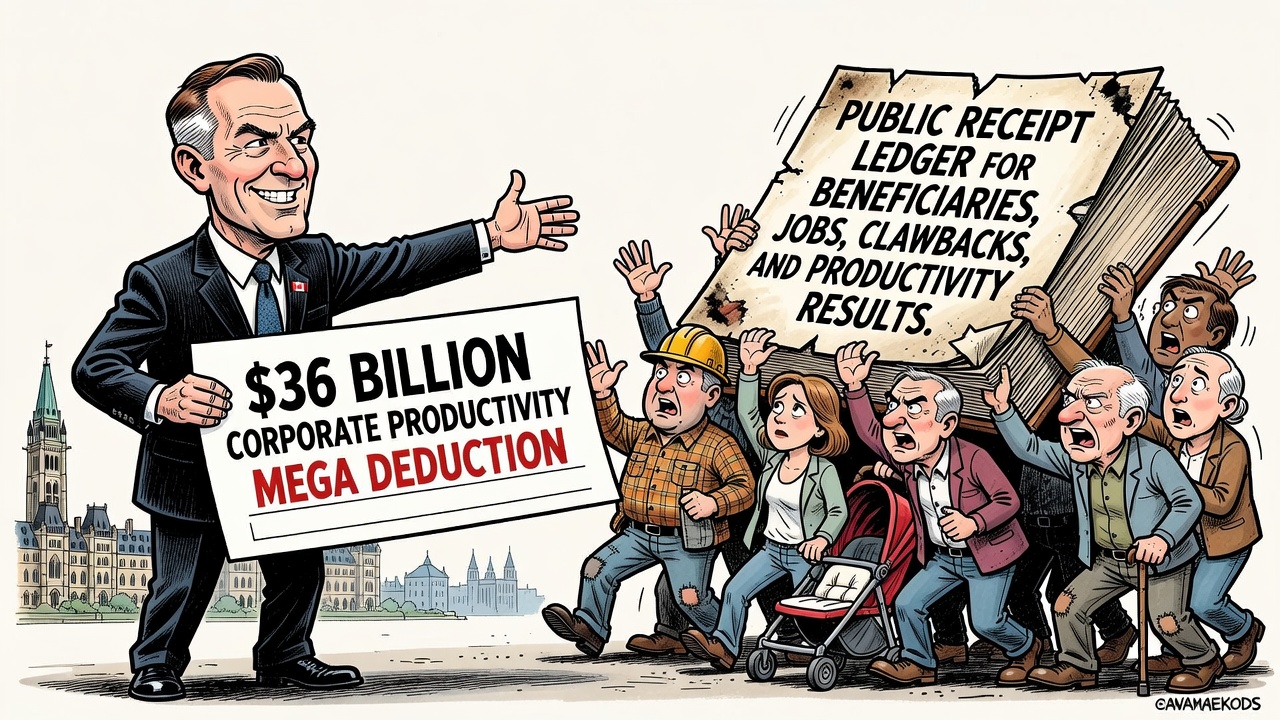
The Carney government is selling its new Productivity Mega Deduction as a competitiveness plan. Finance Canada says it would permanently allow immediate expensing for a broad range of depreciable property and expand eligibility from roughly 15 per cent of capital-asset investment under the 2025 Productivity Super-Deduction to about two-thirds of capital-asset investment.
That is not a minor accounting tweak. Finance Canada estimates the incremental fiscal cost at $36 billion over five years beginning in 2026-27. The department also says the average annual investment support would be $8.5 billion over a ten-year horizon, while lowering Canada’s marginal effective tax rate on new business investment from 13.0 per cent to 6.4 per cent.
Conservatives should support faster writeoffs when they are simple, broad, pro-investment and tied to real growth. Canada needs machinery, software, patents, research and development, fibre, rail, pipelines and productive infrastructure. Carney’s own investment-summit remarks pointed to exactly those categories. The problem is not that Ottawa wants businesses to invest. The problem is that Ottawa is booking a very large tax expenditure today while asking Canadians to trust that tomorrow’s productivity gains will appear.
That trust has to be earned with receipts. Before Parliament makes this permanent, Ottawa should publish a mega-deduction ledger: expected tax expenditure by sector, firm size, province and ownership; the split between Canadian-controlled firms and foreign-owned multinationals; anti-windfall rules for investments already planned; restrictions on buybacks, executive bonuses and paper reshuffling; and audit triggers for companies that claim the deduction without adding capacity, jobs or measurable output.
The government’s case is that lower tax friction will attract capital and help Canada compete with the United States and other OECD economies. That may be true in some sectors. But a $36 billion fiscal cost cannot be treated as free money. Every dollar Ottawa forgoes is a dollar that must be made up through higher growth, lower spending, more borrowing or taxes elsewhere. If the result is genuine new factories, technology adoption, transportation capacity and productivity, show the public the targets. If the result is accelerated deductions for balance-sheet moves that would have happened anyway, taxpayers are financing a corporate timing benefit.
Independent critics have already framed the package as another version of trickle-down economics. The government does not have to accept that label, but it does have to disprove it. The way to do that is not with summit-stage slogans. It is with quarterly disclosure, sector-level results, clawback rules, job and wage metrics, and a sunset review that can cancel or redesign the measure if promised investment fails to materialize.
Carney says Canada needs investment. Fine. Start by investing in transparency. Publish the beneficiary ledger before the tax break becomes permanent.
- Department of Finance Canada: Government of Canada introduces new Productivity Mega Deduction
- Prime Minister of Canada: Prime Minister Carney delivers opening remarks at the Canada Investment Summit
- Canadian Dimension: Trickle-down hasn’t worked for the last 40 years. Why does Carney want to try it again?
This article argues for public tax-expenditure disclosure, audit metrics and clawback rules. It does not allege unlawful conduct by taxpayers, investors, public servants or ministers.