Before Carney Leases Airport Operations, Publish the Ledger
Airport concessions may raise capital. They can also lock travellers, airlines, workers and taxpayers into decades of private toll-taking unless Ottawa publishes the receipts first.
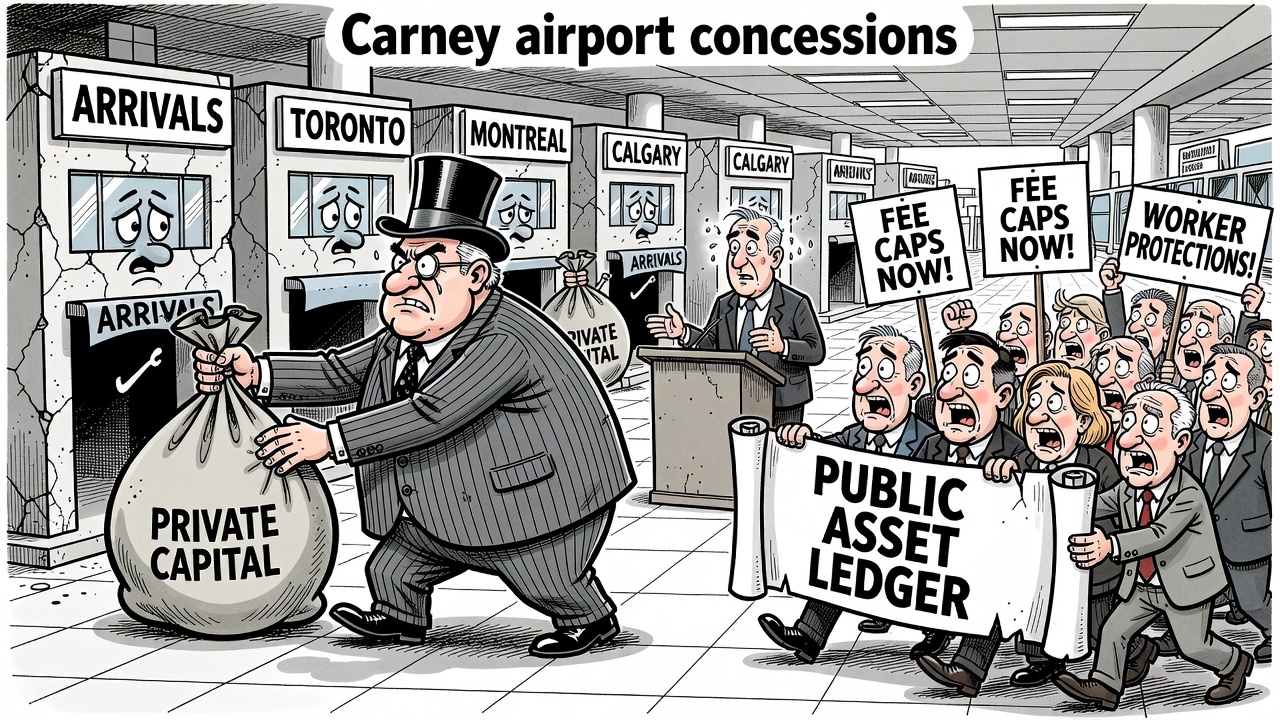
Prime Minister Mark Carney says Ottawa will seek private investment through long-term concessions to operate Canada’s four largest airports. Global News identified those airports as Toronto Pearson, Vancouver International, Montréal-Trudeau and Calgary International, citing Transport Canada data. Carney also says the federal government will keep ownership of the underlying land and assets while bringing in new capital and operating expertise.
That distinction matters. Selling land is one thing; selling control of future cash flows is another. A long-term concession can still transfer enormous practical power over fees, service standards, construction priorities and labour conditions. If the contract is badly priced, too long, too generous or too weakly regulated, Canadians will not get a do-over for a generation.
Conservatives do not need to oppose every private-capital model on reflex. Pension funds and infrastructure investors can help build terminals, expand capacity and modernize operations. But the public test is not whether bankers and consultants like the structure. The test is whether travellers pay less or more, whether airlines face higher charges, whether workers are protected, whether regional airports actually benefit, and whether the public receives fair value for assets built under a national transport system.
That is why Carney’s airport plan needs a public-asset ledger before any concession is signed. Publish the airport-by-airport valuation. Publish the proposed concession length. Publish the bidder list, beneficial ownership, foreign ownership exposure and any role for pension funds. Publish the expected proceeds and the formula that directs money to regional airports or other infrastructure. Publish the regulator’s powers, fee caps, service standards, security safeguards, labour protections, executive-compensation rules and penalties for missed investment targets.
The risk is obvious. Global News reported labour criticism warning that the plan could mean higher costs for passengers and airlines, more pressure on workers and more airport revenue flowing to private investors. The same report noted research suggesting private-equity airport ownership can increase traffic and capacity, while airport fees charged to airlines may rise after privatization. That is exactly the tradeoff Canadians deserve to see in plain numbers, not after the deal is already politically irreversible.
Carney framed the summit as proof that Canada can attract global capital. Fine. But public assets are not trophies for an investment-stage announcement. They are strategic infrastructure. If Ottawa wants to “unlock” their value, it must first prove it is not merely unlocking a private rent stream backed by captive travellers.
Before the Prime Minister asks Canadians to trust another complex insider deal, publish the concession ledger. If the airport plan is as good as advertised, the receipts should strengthen it. If the receipts are too sensitive to show, the deal is too risky to sign.
- Global News: Canada seeks ‘private investment’ in airports but feds to keep land, assets
- Prime Minister of Canada: Prime Minister Carney delivers remarks to media at the 2026 Canada Investment Summit
- Associated Press / Canadian Press: Carney, Trump and the Canada Investment Summit report
This article argues for public valuation, contract and performance disclosure. It does not allege unlawful conduct by airport authorities, investors, public servants or ministers.