At Carney’s Banff Retreat, Publish the Media-Access Ledger
If a reporter was removed from a federal media setting, Ottawa should disclose the rule, the authority and the decision-maker.
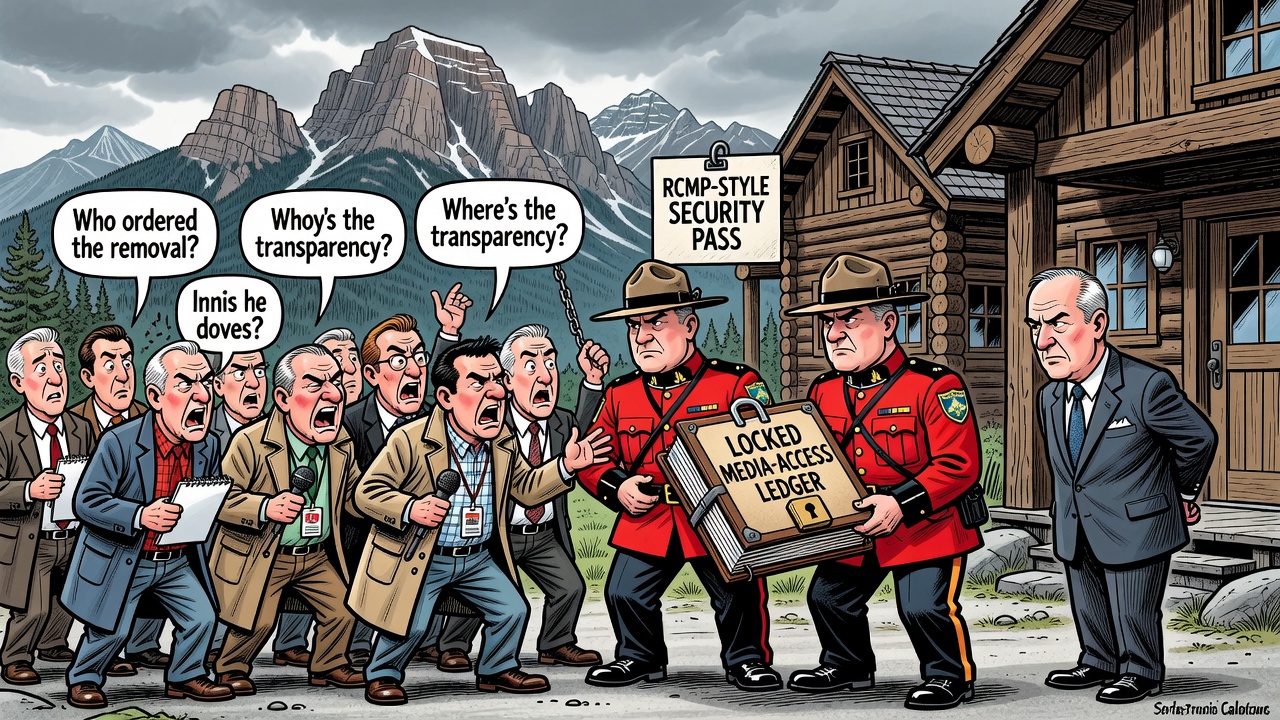
Prime Minister Mark Carney’s government held its fall Cabinet Planning Forum in Banff from September 10 to 11, bringing ministers and secretaries of state together behind closed doors before Parliament’s return. Canadian Press described the retreat as a two-day cabinet meeting in Alberta, and the Prime Minister’s Office said cabinet would hear from outside experts on the economy, Indigenous partnerships and global affairs.
Closed cabinet meetings are not the problem. Governments need private deliberation. The accountability problem starts when a federal political event has media access, security screening and visiting-leader logistics, but the public is left guessing who gets in, who gets removed and under what authority.
Juno News says its co-founder and reporter Keean Bexte was forcibly removed from a press conference or media availability at the Banff retreat before Carney was set to appear with Ukrainian President Volodymyr Zelenskyy. Rebel News reported Bexte’s account that he had questioned ministers earlier that day without incident, and that video appeared to show a person involved carrying identification marked RCMP/GRC for the Cabinet Planning Forum. Rebel also reported that, at publication time, the RCMP, PMO and Banff Centre had not publicly explained why Bexte was removed or who ordered it.
Those are claims from independent outlets, and they deserve careful wording. The government may have a safety explanation. Accredited-media rules may have been communicated. Foreign-leader security may have created a perimeter change. A reporter may have been standing in the wrong place. But none of those possibilities justifies silence after the fact.
The PMO’s own itinerary for September 10 advertised open coverage for accredited media at Carney’s Calgary events with Zelenskyy, then listed the Banff cabinet forum later that afternoon. A PMO statement also said Zelenskyy would address cabinet members at the Banff forum during his September 9 to 11 visit. That overlap makes the access rules more important, not less. When domestic cabinet business, foreign security and political media availability meet in one venue, the rules need to be transparent enough that they cannot be used selectively.
A conservative accountability standard is simple: equal rules, published in advance, applied neutrally and reviewable afterward. Ottawa should release the media-access ledger for the Banff forum: accreditation criteria, credentialed outlets, excluded outlets, security zones, who had removal authority, whether RCMP, PMO, Ukrainian security or the venue made the call, what safety rationale applied, and whether any appeal or correction process existed.
Supporting Ukraine does not require weakening Canadian press freedom. Protecting a visiting president does not require leaving Canadians in the dark. If the removal was justified, publish the rule and stand behind it. If it was arbitrary, admit it and fix the process before the next cabinet retreat.
- Prime Minister of Canada: Prime Minister Carney to hold fall Cabinet Planning Forum
- CityNews / Canadian Press: Carney’s cabinet enters final day of closed-door meetings in Banff
- Prime Minister of Canada: Thursday, September 10, 2026 itinerary
- Prime Minister of Canada: Statement on President Zelenskyy’s visit to Canada
- Juno News: Independent Press Gallery condemns Liberals after Bexte booted
- Rebel News: Juno News forcibly removed from Carney cabinet retreat
This article argues for transparent, viewpoint-neutral media-access rules. It does not claim to know the undisclosed security rationale or final decision-maker.