CMHC’s August Housing Starts Scoreboard Still Flashes Red
The monthly starts data is a delivery scoreboard, not a backdrop for another promise. If Ottawa says it can fix housing, publish the monthly receipts.
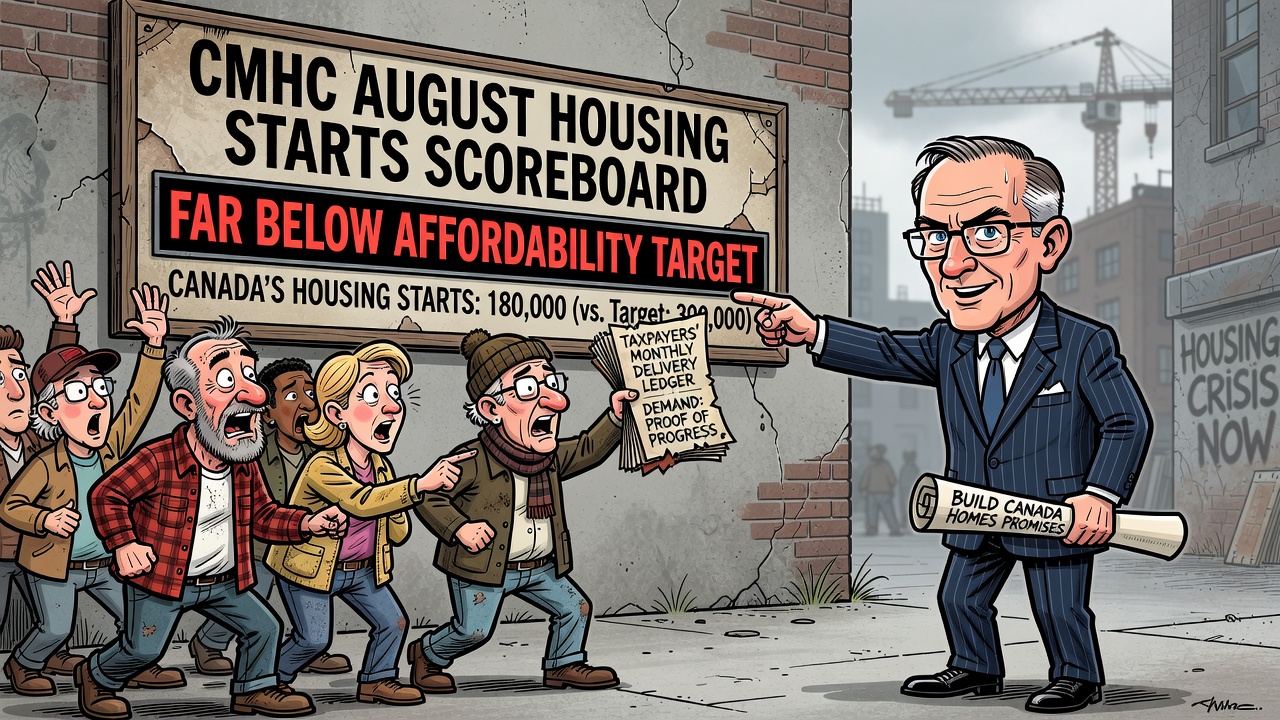
CMHC’s August numbers should make every housing announcement in Ottawa answer one question: where are the actual homes? The agency reported that the six-month trend in housing starts fell 1.3% from July to August, landing at 244,149 units. Actual monthly starts in urban centres of 10,000 people or more were also down 2% from August 2025, at 17,691 units compared with 18,112 a year earlier.
The year-to-date urban total is not a victory lap either. CMHC says starts in those centres reached 149,542 units through August, down 4% from the same period in 2025. The total monthly seasonally adjusted annual rate for all areas was basically flat: 229,046 in August versus 229,360 in July. In plain English, the scoreboard is not accelerating.
That matters because CMHC’s own supply report, released September 10, says Canada needs annual housing starts in the range of 417,000 to 469,000 to restore pre-pandemic affordability by 2036. August’s national SAAR is barely over half the low end of that range. The trend measure is better, but still nowhere near the run-rate CMHC says is required.
This is where conservative accountability has to cut through Liberal branding. Prime Minister Mark Carney can rename programs, centralize approvals and promise Build Canada Homes will move faster. But families do not live in mandate letters. Renters cannot sleep inside a podium graphic. Young workers trying to buy a first home need completions, serviced lots, permits converted into shovels, and homes priced at incomes people actually earn.
Ottawa should publish a monthly Build Canada Homes delivery ledger beside CMHC’s starts data. It should show starts, completions, cancellations, permit-to-start timelines, public land released, units by tenure, average supported rent or sale price, federal dollars committed per unit, private leverage claimed, labour bottlenecks, infrastructure constraints and the affordability gap against CMHC’s 417,000-to-469,000 target.
The point is not to blame builders for responding to costs, rates and weak demand. CMHC has warned that slowing construction threatens recent affordability gains. The point is to hold government to the metric it keeps using to justify intervention. If taxpayers are underwriting new agencies, financing tools and land deals, they deserve a visible scoreboard showing whether those tools are producing homes faster than the old announcements did.
That scoreboard should also separate announcements from occupancy. A project can be announced, financed and celebrated long before anyone gets keys. Canadians need to see the lag between promise, permit, start, completion and affordable move-in.
Housing policy has had enough slogans. August’s CMHC data says Canada is still short of the pace required. Before Ottawa asks for more money, more authority or more patience, publish the delivery ledger — and let Canadians judge the results in units built, not speeches delivered.
- CMHC: Housing starts and construction data for August 2026
- CMHC: Slowing home construction threatens recent affordability gains
- CMHC: Fall 2026 Housing Supply Report
This article argues for transparent delivery metrics. It does not allege unlawful conduct by CMHC, builders, public servants or ministers.