Publish the Saint-Pierre Strategic-Sectors Ledger Before Carney Meets Macron
A prime-ministerial meeting about energy, defence, critical minerals, satellites, quantum and supercomputing needs more than a photo-op. It needs public receipts.
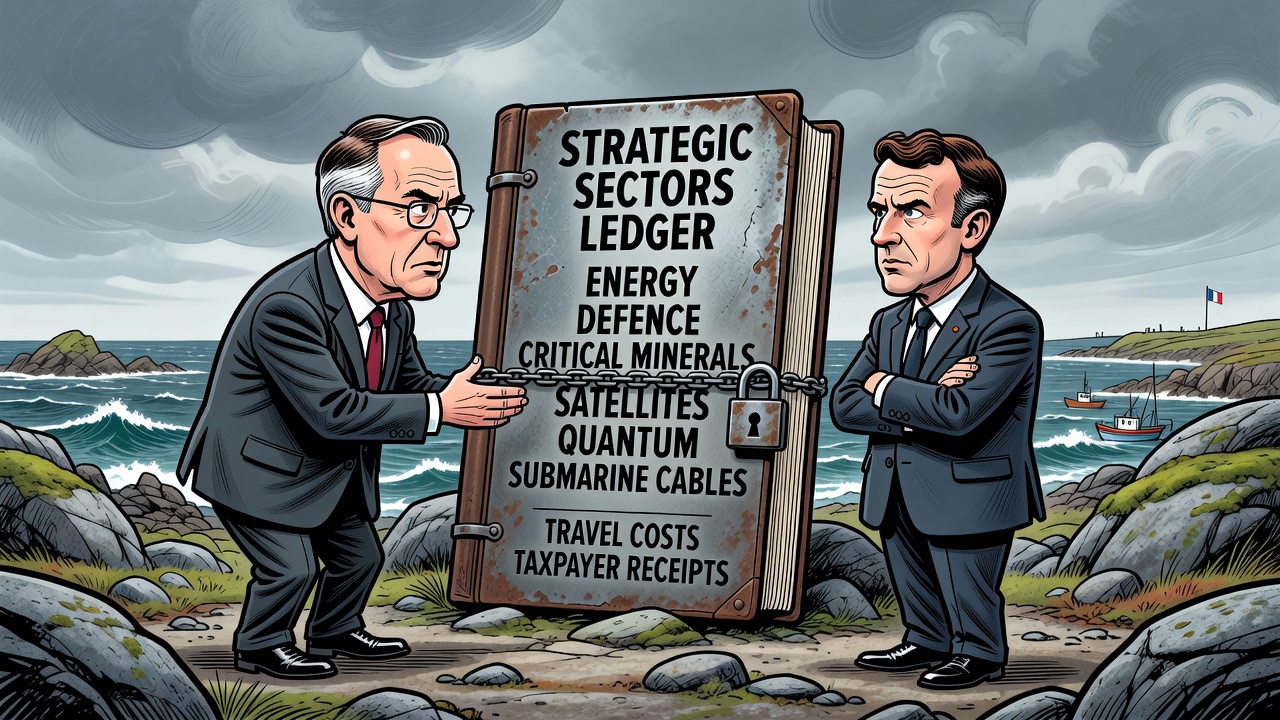
Prime Minister Mark Carney is headed to Saint-Pierre-et-Miquelon on September 20 to meet French President Emmanuel Macron. The PMO says the agenda includes Canada-France co-operation in aerospace, energy, critical minerals, quantum, satellites and supercomputing, with defence and security ties also part of the official context.
That is not a routine diplomatic coffee. It is a strategic-sector meeting on Canadian doorstep territory, involving industries where government decisions can shape billion-dollar contracts, resource access, procurement priorities, data infrastructure and taxpayer exposure. Canadians do not need to assume misconduct to demand transparency. They only need to remember how often Ottawa turns “partnership” into a fog bank.
The geography matters. Saint-Pierre-et-Miquelon is a French overseas collectivity about 25 kilometres off Newfoundland and Labrador, and Canada and France share a maritime border there. PMO quick facts say merchandise trade between the two countries reached $15.2 billion in 2025, with $5 billion in Canadian exports and $10.2 billion in imports. The same release notes that France is now Canada’s third-largest export market in the European Union.
Local reporting from Outremers360 adds another layer. Before the PMO announcement, it reported that Macron and Carney were expected to discuss issues directly tied to the islands, including fishing, telecommunications, submarine cables and climate change. Those are not abstract diplomatic themes. They touch Atlantic communities, coastal economies, digital infrastructure, energy security and sovereignty in the North Atlantic.
So publish the ledger before the meeting, not months later through access-to-information scraps. Canadians should see which departments are attending, which companies or advisers briefed the government, what procurement files are connected to the discussion, and whether any commitments are being explored on energy, critical minerals, aerospace, satellites, quantum, supercomputing or defence supply chains.
Carney’s government likes the language of “strategic sectors.” Fine. Then apply a strategic standard of disclosure. If taxpayer-backed financing, federal land, export support, defence procurement, research subsidies, critical-mineral concessions or data-centre infrastructure are anywhere near the table, the public deserves to know the boundaries before the handshakes happen.
A conservative accountability approach is straightforward: diplomacy can be serious without being secretive about costs, participants and public-risk exposure. Publish the travel and security cost estimate. Publish the agenda headings. Publish the list of ministers, departments and senior officials. Publish the post-meeting deliverables. Publish conflict screens for outside advisers and any industry-linked participants. Publish what Canada asked for, what France asked for, and what files were explicitly ruled out.
If the Saint-Pierre meeting produces real benefits for Canadian workers, Atlantic communities and national security, a public ledger will strengthen the case. If it produces another round of elite photo diplomacy with strategic-sector buzzwords and no measurable deliverables, Canadians should know that too.
- Prime Minister of Canada: Prime Minister Carney to visit Saint-Pierre-et-Miquelon to strengthen ties with France in energy and defence
- Outremers360: Le Premier ministre canadien Mark Carney rejoindra Emmanuel Macron à Saint-Pierre et Miquelon
- Government of Canada: Canada-France relations
This article argues for public disclosure around a planned diplomatic and strategic-sector meeting. It does not allege unlawful conduct by any public official, foreign leader, company or adviser.