Parks Canada’s Learn-to-Camp Program Needs a Tent-City Reality Check
Ottawa funded low-cost urban camping outreach while real tent cities became too visible to ignore.
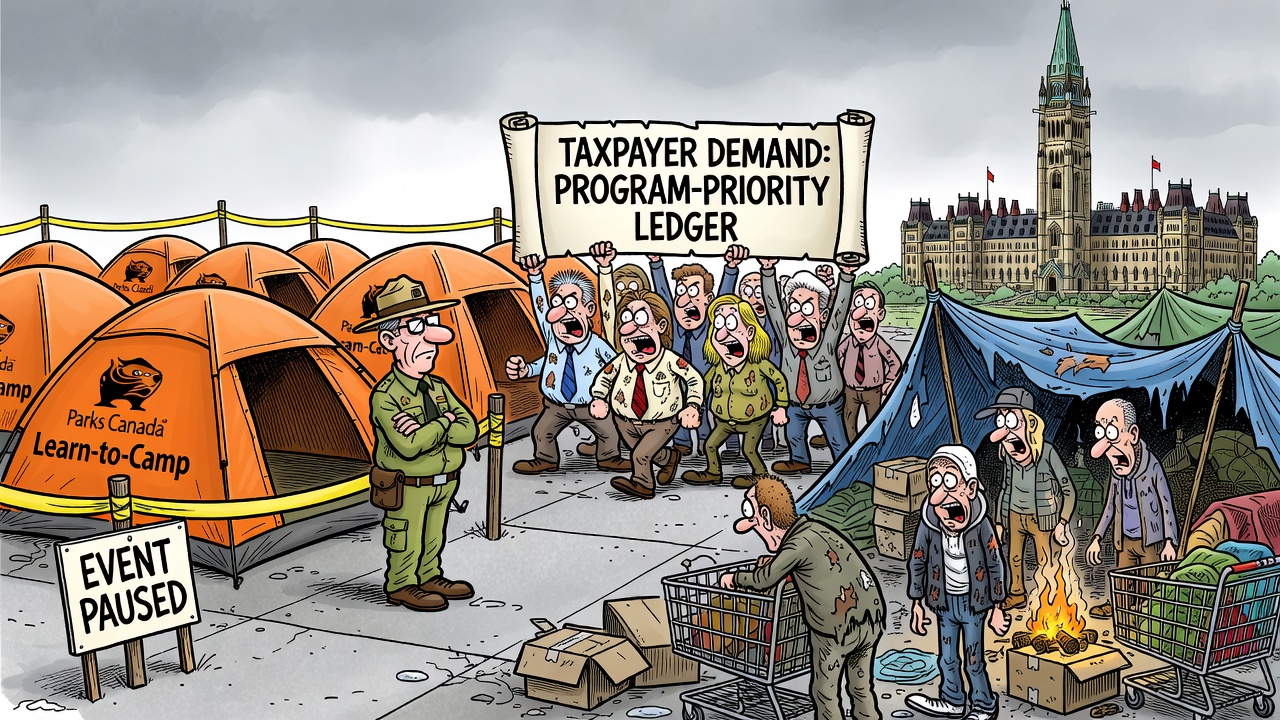
Parks Canada’s own evaluation has produced one of the most Ottawa stories imaginable: a federally funded Learn-to-Camp program, designed partly for urban families and other target audiences, had some urban overnight events paused because Canada’s real tent-city crisis had become impossible to ignore.
The program itself is not sinister. Parks Canada says Learn-to-Camp began in 2011 to reduce barriers to camping and outdoor recreation. It initially targeted new Canadians and families with young children in urban centres, expanded in 2017 into urban hubs, and later added workshops, virtual programming and other “Learn-to” activities. Ottawa put $6.3 million into the expansion for 2016-17 to 2020-21, then approved another $5.95 million for 2022-23 through 2026-27.
But the evaluation also says the urban model prioritized transit-accessible places: national historic sites, heritage canals, schools, libraries, parks and community centres. Then reality arrived. Parks Canada states that communities across Canada reported more homeless encampments over the past five years, intensified by the pandemic and by housing and cost-of-living pressures. It says heightened public awareness of encampments, and criticism of holding recreational camping events in or near places where unhoused people had been displaced, led some hubs to pause overnight events and shift toward workshops or other activities such as Montreal’s Learn-to-Paddle program.
That is not a small optics problem. It is a priorities problem.
Housing, Infrastructure and Communities Canada’s 2025 Point-in-Time enumeration counted more than 65,000 people experiencing homelessness on a single night in 75 communities. The federal count included 36,716 people in shelters, 10,747 in transitional housing, and 17,620 in unsheltered locations, including 4,763 in encampments. Against that backdrop, taxpayers are entitled to ask why Ottawa was subsidizing recreational urban camping without a published collision plan for cities where people were already sleeping outside.
The answer should not be to mock families learning outdoor skills. Nor should anyone pretend Parks Canada caused homelessness. The accountability question is narrower and fairer: when federal departments build feel-good outreach programs inside cities, do they check whether those same cities are facing federal policy failures visible in tents, shelters and sidewalks?
Publish the ledger. Canadians should see which hubs paused overnight events, which sites were affected, how much each event cost, what fees participants paid, what costs were absorbed by taxpayers, what partners were involved, and whether Parks Canada coordinated with municipal homelessness teams before staging recreational camping near encampment-sensitive locations.
Ottawa loves programming language: inclusion, access, awareness, barriers. Fine. But the most urgent barrier to “camping” in Canada is not a lack of marshmallow-roasting workshops. It is that thousands of people are living outside because housing has failed. A government serious about compassion should be able to teach camping and confront homelessness — but it should never confuse the two, and it should never hide the receipts.
- Parks Canada: Evaluation of the Learn-to-Camp Program
- Housing, Infrastructure and Communities Canada: Everyone Counts 2025 — Point-in-Time Enumeration
- Rebel News: Tent cities force Parks Canada to cancel urban camping events
This article argues for disclosure about federal program design, site selection and spending priorities. It does not claim Parks Canada caused homelessness or that every Learn-to-Camp participant was an immigrant.