The 33-Month Citizenship Proof Backlog Needs a Public Ledger
Ottawa expanded citizenship-by-descent rules. The people now trying to prove their status deserve service standards, not a three-year holding pen.
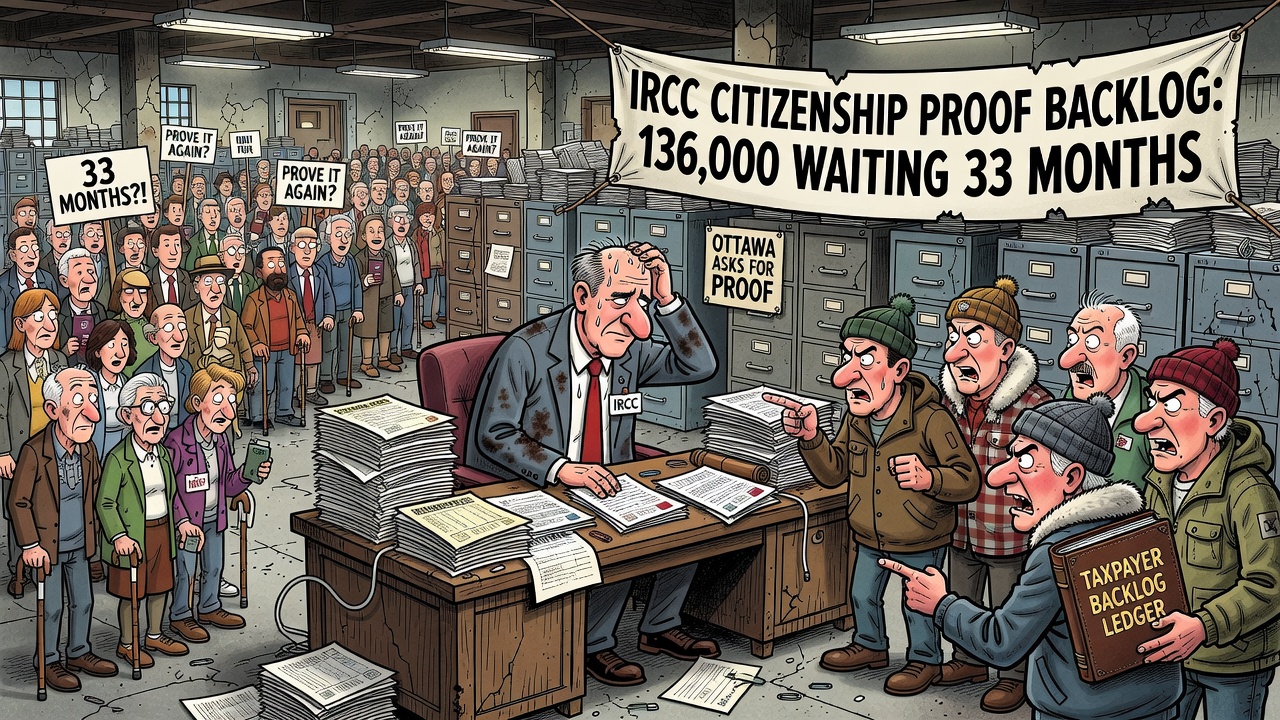
IRCC’s own September update is brutal: proof-of-citizenship applications are now listed at about 33 months, with about 136,000 people waiting. This is not an opposition talking point or a social-media rumour. It is the department’s published processing-time data, stamped September 3, 2026.
The queue is moving the wrong way. IRCC’s monthly snapshot says a September 2026 proof-of-citizenship applicant has about 136,000 people ahead of them, up from about 134,000 in August and about 132,200 in July. CIC News reported the quoted wait was 25 months in August and 33 months in September. A CBC-syndicated report carried by Atnito News said the delay has jumped sharply since Bill C-3 and quoted IRCC saying it is triaging applications, improving intake, training staff and refining workload management.
Those are process words. Canadians need output numbers.
On December 15, 2025, Canada passed Bill C-3, changing the first-generation limit on citizenship by descent. Canada.ca says that before the bill, citizenship by descent was limited to the first generation born outside Canada; the new law removed that limit in some situations. It also tells people who believe they became citizens because of the change that they must apply for a citizenship certificate to find out for sure and to prove their status for passports or border delays.
That creates a basic accountability problem. Ottawa changed the law, invited a new class of people into the certificate system, and then left applicants facing a timeline that can stretch into 2029. Some files will be complex. Some will require old records, name-change proof or fraud checks. Nobody serious should demand rubber-stamp approvals. But competence means planning capacity before opening the gate, not discovering afterward that the line is nearly three years long.
The conservative answer is not mass approval. It is a public ledger: applications received by month, certificates issued by month, refusals, withdrawals, average age of files, staffing assigned to proof cases, urgent-processing approvals and denials, error rates, returned incomplete files, document-verification bottlenecks, fraud referrals and weekly backlog-reduction targets. If IRCC is triaging, publish the criteria. If it is onboarding staff, publish how many and where. If complexity is the excuse, publish the categories driving delay.
Citizenship is not a customer-service perk. It affects passports, work, study, family relocation and the ability to plan a life. A government that writes the rules has a duty to administer them honestly, securely and on time. The 33-month ledger should be public before another update quietly pushes the line even farther out.
- IRCC: Forward-looking processing-time JSON, updated September 3, 2026
- IRCC: Change to citizenship rules in 2025
- CIC News: Processing times for proof of Canadian citizenship applications jumps in September
- Atnito News / Canadian Press: Canadian citizenship certificate applications now facing nearly 3-year delays
This article argues for administrative transparency and timely processing. It does not argue for bypassing document verification, security screening or lawful eligibility rules.