Carney’s Summit Prospectus Needs a Public Ledger
A prime-ministerial deal book may help attract capital. It also creates a duty to disclose who got selected, what was promised and what taxpayers could be asked to underwrite.
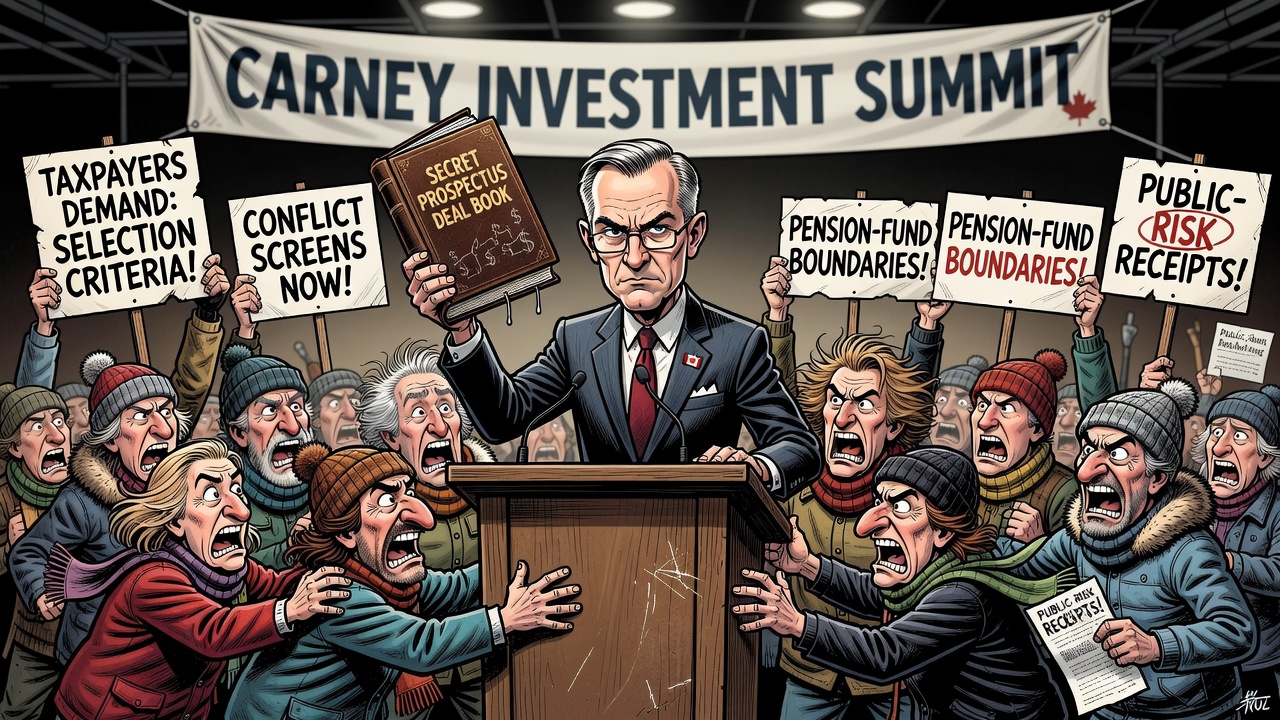
Prime Minister Mark Carney’s Canada Investment Summit is no longer just a growth slogan. It now has a prospectus problem.
The official summit page says the Toronto event runs September 14 and 15, 2026, is hosted by the Prime Minister in partnership with CPP Investments and PSP Investments, and is part of a plan to catalyse $1 trillion in total investment over five years. The April PMO announcement said the summit would convene major global investors, CEOs, entrepreneurs and business leaders to attract investment into major projects, critical minerals, energy, new technologies and artificial intelligence.
Those goals are not automatically wrong. Canada badly needs productive private capital. The accountability problem begins when a government-hosted, pension-partnered, invitation-only room becomes a curated pipeline between selected projects and the world’s largest pools of money.
A Bloomberg-republished report at EnergyNow says a document seen by Bloomberg contains 167 projects intended for large institutional investors, including BlackRock and Saudi Arabia’s Public Investment Fund, at the Toronto summit. The reported pitchbook spans data centres, advanced manufacturing, LNG, ports, dozens of mines, defence-focused technology, a Nova Scotia space launchpad, a Canada-Norway fibre-optic line, quantum computing and large Alberta data-centre proposals.
Company releases make the prospectus concrete. Critical Elements Lithium said its Rose Lithium-Tantalum Project was selected for inclusion and that its CEO was invited to a September 13 welcome reception. LithiumBank said its Boardwalk Lithium Brine Project in Alberta was included. Canagold also announced that its New Polaris gold-antimony project was included. Project proponents are already able to tout federal-prospectus visibility before the summit even opens.
That is precisely why the ledger must be public. Selection into a prime-ministerial prospectus is not a neutral brochure placement. It can shape investor attention, market perception, lobbying leverage, permitting expectations and future demands for tax credits, loans, infrastructure spending or regulatory fast tracks. If public pension organizations are partners in convening the room, Canadians also need written boundaries proving pension beneficiaries’ money is governed by commercial duty, not political choreography.
The government should publish the full 167-project list, invitation list, selection criteria, scoring process, lobbying and contact logs, conflict declarations, public-pension role limits, foreign-investor due-diligence rules and any federal subsidy, loan, guarantee, tax-credit, land, procurement or permitting support attached to each project.
None of this is anti-investment. It is anti-insiderism. Good projects can survive daylight. If Carney’s summit is about national prosperity rather than preferential access, the government should prove it with a project-by-project public benefits ledger: Canadian jobs, ownership, Indigenous consultation status, environmental review status, taxpayer exposure and expected public return.
Growth is not a substitute for receipts. When Ottawa curates the deal book, Ottawa owes Canadians the ledger.
- Government of Canada: Canada Investment Summit 2026
- Prime Minister of Canada: Prime Minister Carney announces first-ever Canada Investment Summit
- EnergyNow / Bloomberg: PM Carney to woo investors with data centers, mines and LNG deals
- Critical Elements Lithium: Critical Elements selected for Canada Investment Summit Prospectus
- Newsfile / LithiumBank: LithiumBank Resources selected for inclusion in the prospectus
- Newsfile / Canagold: Canagold’s New Polaris project included in Canada Investment Summit Prospectus
This article argues for public disclosure around a government-hosted investment prospectus and summit access. It does not allege that any named company, investor, pension organization or public official has acted unlawfully.