The 100-Year Ukraine Partnership Needs Today’s Public Ledger
Century-long promises require present-day receipts: costs, suppliers, guarantees, readiness and review triggers.
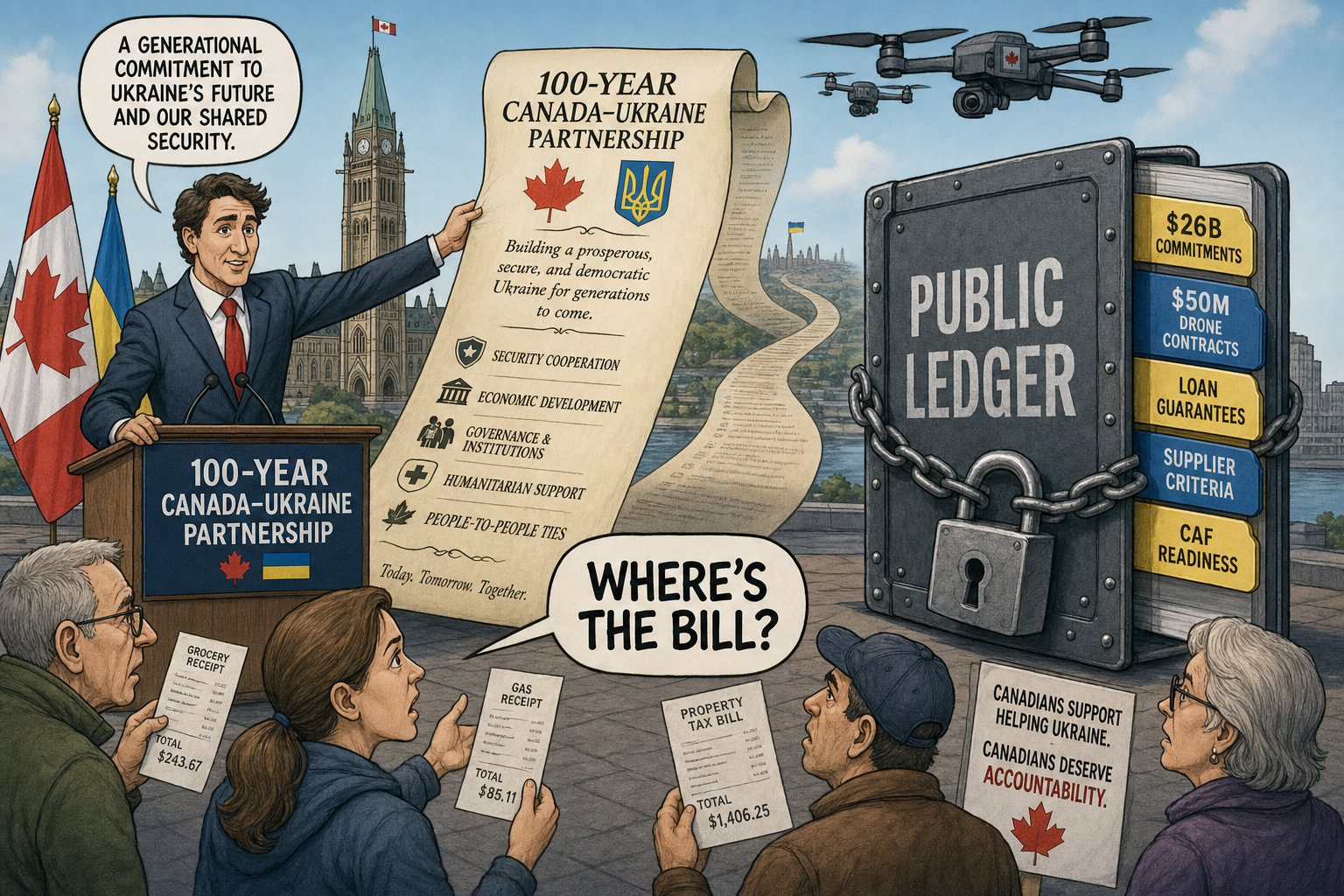
Prime Minister Mark Carney and Ukrainian President Volodymyr Zelenskyy met in Calgary on September 10 and signed what Ottawa calls a Canada-Ukraine Declaration for a 100-Year Partnership. The Prime Minister’s Office says the new roadmap is built around defence innovation and cooperation, economic growth and reconstruction, and people-to-people ties, with the goal of elevating the relationship into a Comprehensive Strategic Partnership.
That is a major foreign-policy commitment. It may also be a defensible one. Ukraine is fighting Russian aggression, and Canada has real security interests in a Europe that is not redrawn by force. But serious support does not excuse unserious bookkeeping. When a government attaches a century-long label to defence, reconstruction, energy and migration cooperation, taxpayers deserve a public ledger before the political glow hardens into permanent obligation.
The numbers announced by Ottawa are not small. PMO says Canada is creating a Defence Drone Initiative Marketplace supply arrangement, with nearly 400 trusted Canadian suppliers having access to the system and initial contracts worth up to $50 million. The government says those first contracts are intended to increase the number of drones deployed by the Canadian Armed Forces tenfold, and it names suppliers including Beonyx, AVSS, Volatus Aerospace, Twenty20 Insight, Draganfly and Objexis AI.
That is exactly where Conservative accountability should start. Publish the supplier scoring, contract ceilings, Canadian-content tests, conflict screens, sustainment obligations, intellectual-property terms, delivery milestones and military acceptance criteria. “Build Canadian” is a slogan unless Canadians can see what was bought, why those vendors were selected, and whether the Canadian Armed Forces are receiving capability on time at a fair price.
Ottawa also announced approximately $350 million for critical air-defence interceptors through JUMPSTART, nearly $23 million for Ukraine’s security architecture and hybrid-threat response, nearly $435 million in loan guarantees through the European Bank for Reconstruction and Development, $200 million in concessional Export Development Canada loans for reconstruction, another $10 million for the Ukraine Energy Support Fund, up to $40.1 million for veterans and up to $6 million for the return and reintegration of unlawfully deported children. PMO says Canada’s total Ukraine commitments have now reached more than $26 billion since 2022.
Canadians can support Ukraine and still ask who carries the risk. Loan guarantees are not magic. Concessional loans are not press-release confetti. Drone procurement is not automatically good procurement because the technology is urgent. Ottawa should disclose the repayment assumptions, guarantee exposure, fiscal guardrails, parliamentary approval path, sunset clauses and annual review triggers.
Global News, carrying Canadian Press reporting before the meeting, noted the visit was focused on defence, economic and energy co-operation. That framing is useful because it shows the issue is broader than one aid cheque. This is now industrial policy, foreign policy, military procurement and public finance bundled together.
If the Carney government believes this partnership is in Canada’s interest, it should be able to defend it with receipts. Publish the 100-year ledger: binding clauses, annual cost ceilings, supplier records, loan exposure, CAF readiness impacts, Canadian jobs actually created, and the date Parliament gets to review the deal.
- Prime Minister of Canada: Canada and Ukraine to scale up drone production, build up Canada’s defence industries, and achieve a just and lasting peace in Ukraine
- Prime Minister of Canada: Joint statement by Prime Minister Carney and President Zelenskyy
- Prime Minister of Canada: Prime Minister Carney meets with President of Ukraine Volodymyr Zelenskyy
- Global News / The Canadian Press: Zelenskyy arrives in Calgary ahead of Carney meeting
This article does not argue against supporting Ukraine. It argues that large, long-term commitments require public cost, procurement and risk disclosure.