IRCC’s Own Risk Binder Is the Receipt — Now Publish the Numbers
Identity fraud, inadmissibility, system abuse and human smuggling are not opposition talking points when IRCC lists them itself.
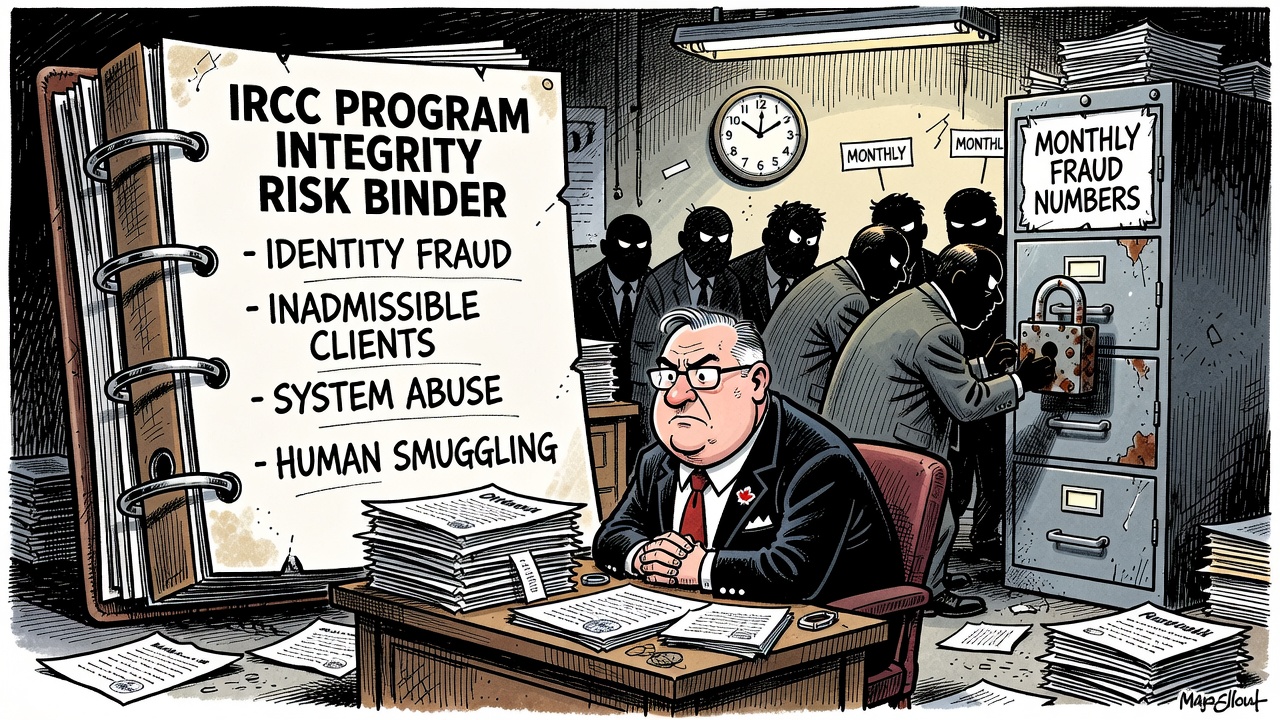
Ottawa does not need another immigration slogan. It needs a ledger. IRCC’s 2026 Deputy Minister transition binder says program integrity is foundational to public trust, national security and a sustainable immigration system. That is exactly right — and it is exactly why the Carney government should publish the numbers behind the risks it now acknowledges in its own briefing material.
The risk-management binder names the problem categories plainly. IRCC identifies high-level operational integrity risks including criminality, human smuggling, security, health and safety, fraud and abuse, volumes, and processing pressures. It then lists top issues: identity fraud, inadmissible clients, and system abuse involving fraudulent applications, supporting documents, relationships of convenience, unauthorized representatives and human smuggling.
Those are serious words. But serious words are not serious management unless Parliament and the public can see measurable outcomes. How many identity-fraud files were detected each month? How many applications were refused for misrepresentation? How many inadmissibility cases involved security, criminality or organized-abuse concerns? How many unauthorized representatives were referred for enforcement? How many human-smuggling indicators were found, disrupted or prosecuted?
This is not an argument against immigration. It is an argument for a system Canadians can trust. IRCC’s companion landscape binder says Canada is trying to return to sustainable levels after record temporary and permanent resident volumes, asylum pressures, humanitarian crises and a shifting security environment. It also says housing and health-care capacity are part of the context, and that asylum volumes create downstream cost implications for provinces and municipalities.
That is the accountability gap. The same government that admits volumes, processing pressure and integrity risks are connected still asks Canadians to accept broad assurances instead of monthly public reporting. A managed migration system cannot be managed by press release. It needs dashboards, targets, enforcement results and correction notices when targets are missed.
The binder also points to technological risk and technological promise. IRCC says integrity measures should be evidence-based, adaptive, data-driven and technologically enhanced. It refers to advanced analytics, automated functionality, digital credentials, regulatory changes for designated learning institutions, an early risk warning system and Bill C-12 information-sharing amendments. Fine — but every one of those tools needs guardrails. Canadians should know what data is used, what is audited, what is redacted for valid security reasons, and what aggregate results can still be disclosed.
The Conservative accountability standard should be simple: protect legitimate applicants by rooting out fraud, protect Canadians by enforcing admissibility rules, and protect public consent by publishing the evidence. If IRCC can name identity fraud and system abuse in a transition binder, it can publish aggregate counts, enforcement outcomes, DLI compliance actions, risk-tool audit results and province-by-province capacity impacts.
Public confidence is not rebuilt by telling Canadians not to worry. It is rebuilt when government opens the books. IRCC has provided the receipt for the risk. Now Ottawa should publish the ledger.
- Immigration, Refugees and Citizenship Canada: Deputy Minister Transition Binder 2026 — Risk Management and Program Integrity
- Immigration, Refugees and Citizenship Canada: Deputy Minister Transition Binder 2026 — IRCC Landscape
This article argues for aggregate public reporting on immigration program integrity. It does not claim every applicant is fraudulent or that protected operational details should be disclosed.