The GlobalEye Deal Needs a Requirements Ledger
Speed is not a procurement strategy if taxpayers inherit the modification bill and the military inherits the operational risk.
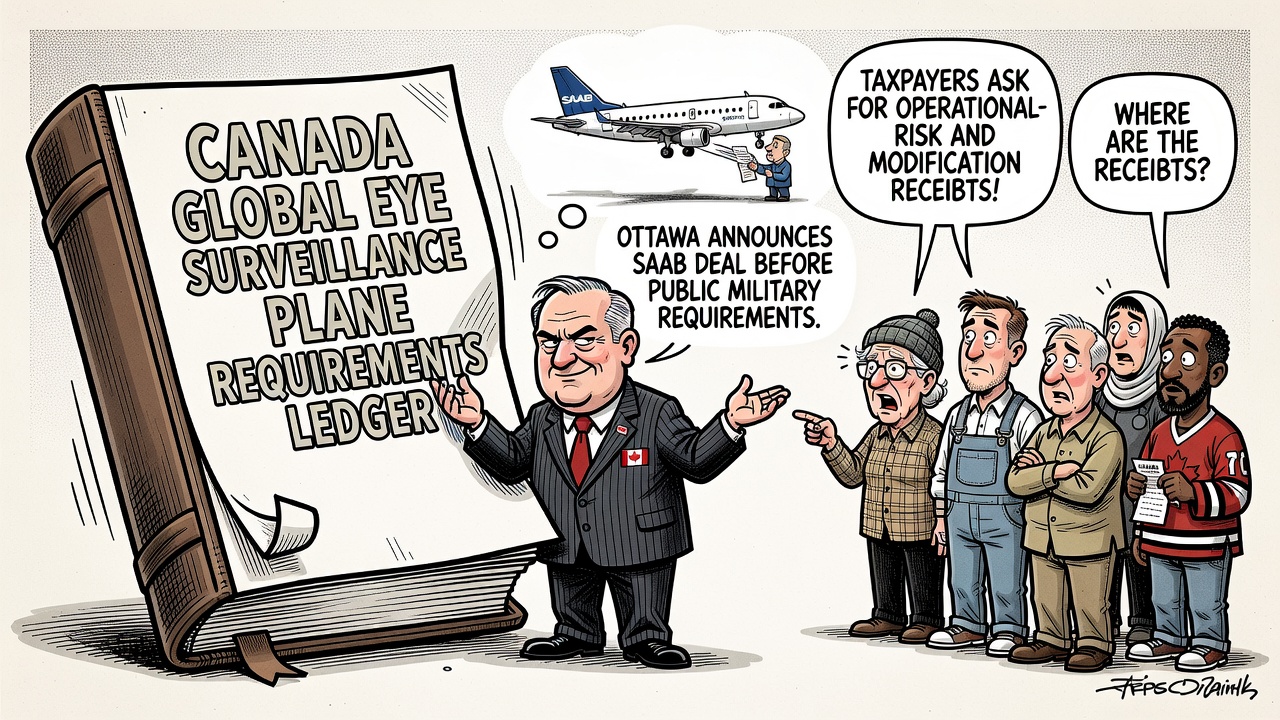
Ottawa’s GlobalEye announcement was sold as a two-for-one: defend the Arctic and build Canadian aerospace jobs. Both goals matter. But a defence purchase is not a ribbon-cutting exercise. Before the Carney government signs a deal for Saab’s airborne early warning and control aircraft, Canadians deserve the requirements ledger.
CBC News reported September 9 that Ottawa began negotiations for six GlobalEye aircraft without guarantees the platform met Canada’s military requirements, and that a later assessment found the aircraft met only part of those requirements and would need modifications to reach operational readiness. CBC also reported concerns involving radar coverage, radar range and frequency, crew stations, connectivity for NORAD operations and air-to-air refuelling.
The government’s own May 27 release shows why the accountability stakes are high. Prime Minister Mark Carney announced at CANSEC that Canada had entered negotiations to procure Saab’s GlobalEye platform, projected support for 3,000 Canadian aerospace and defence jobs, and a plan under which no less than one-third of a projected fleet would be manufactured in Canada over 15 years. Saab’s release said Canada had engaged Saab as preferred supplier and described GlobalEye as a Bombardier Global 6500-based system combining Erieye ER radar, sensors and multi-domain command and control.
Those industrial benefits may be real. They are not a substitute for the Royal Canadian Air Force’s operational requirements. If cabinet decided that jobs, supply chains and geopolitics justified an “85 per cent solution,” then cabinet should say so plainly and identify who accepted the remaining 15 per cent of risk. The public does not need classified tactics. It does need the unclassified shape of the trade-off.
The conservative standard here is simple: buy what the military needs, compete fairly where possible, and publish enough information for Parliament to judge whether taxpayers are funding capability or a political headline. That means the original AEW&C requirement set should be tabled in redacted form. So should the gap assessment, the required modifications, the estimated cost and schedule impact, the NORAD interoperability plan, and the record showing whether competing suppliers saw the same requirements at the same time.
Defence procurement is full of temptations. Ministers love job numbers. Companies love preferred-supplier status. Bureaucracies love speed when speed reduces scrutiny. But the aircraft will be flown by service members, integrated into allied command networks, and paid for by taxpayers long after the CANSEC applause fades.
If GlobalEye is the right answer, Ottawa should be able to prove it without hiding the math. Publish the requirements, publish the gaps, publish the modification bill, and publish the ministerial risk sign-off before Canada is locked in.
- CBC News via Yahoo News: GlobalEye gamble: Ottawa chose surveillance plane without knowing it met military needs
- Prime Minister of Canada: Prime Minister Carney announces major new defence partnership
- Saab: Canada engages Saab as preferred supplier of future AEW&C capability
This article does not claim GlobalEye is incapable or that classified operational details should be released. It argues for a public, redacted accountability record before final signature.