Now That Counter-Tariffs Are Here, Publish the Public Cost Ledger
Carney says the pivot away from the U.S. will come at a cost. Canadians should see the bill, line by line.
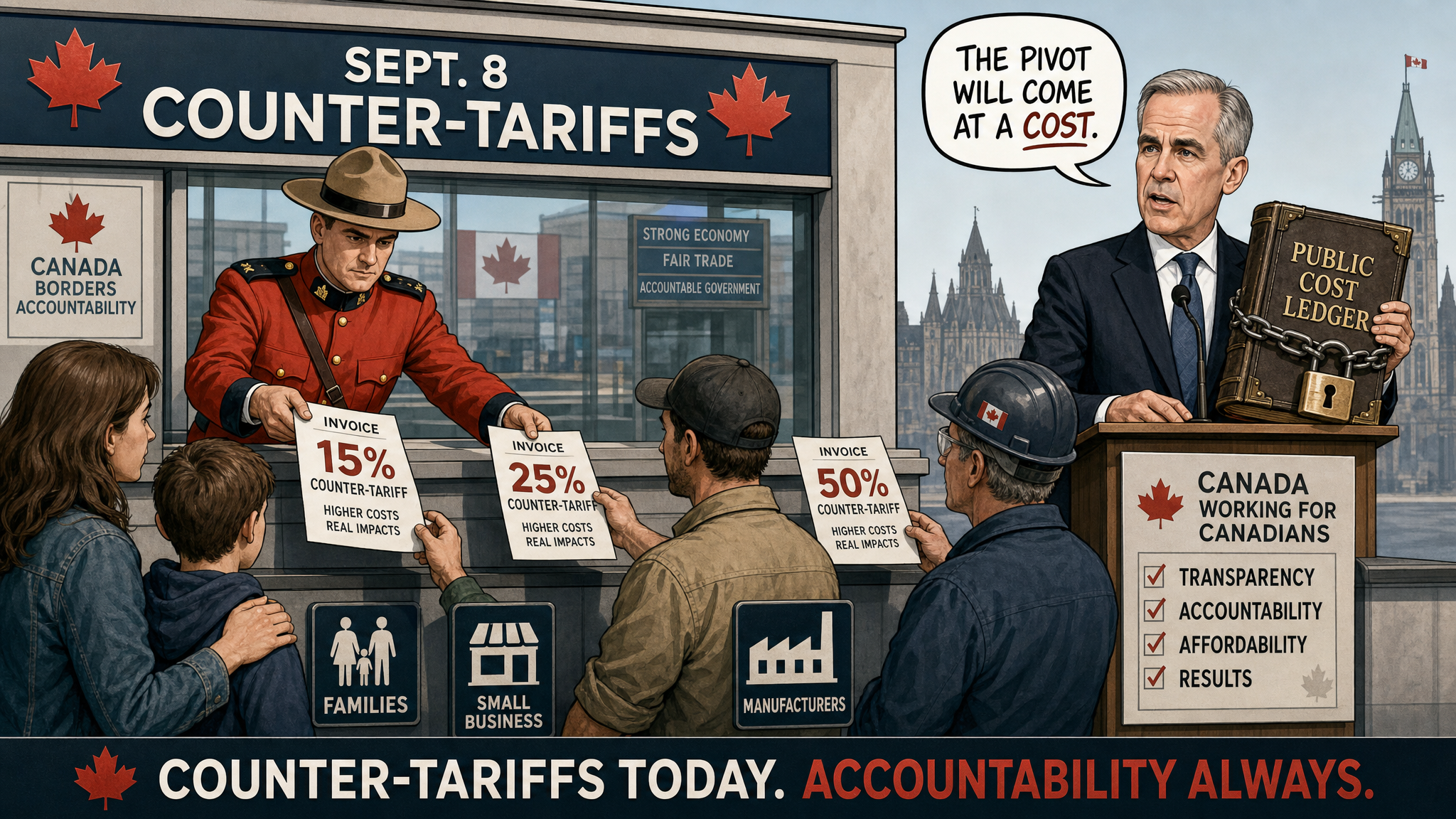
Canada’s counter-tariffs are no longer a coming threat. They are now live at the border, and the Carney government should stop treating the public cost as an internal talking point.
Finance Canada says the updated countermeasure list took effect at 12:01 a.m. on September 8, 2026, after the United States imposed 50 per cent tariffs on $27.6 billion of Canadian goods effective August 22. Ottawa’s response applies counter-tariffs to $27.6 billion in products imported from the United States, with targeted sectors including steel and aluminum, dairy, appliances, agricultural equipment, pulp and paper, plastics and electronics. Some existing steel and aluminum counter-tariffs rise from 25 per cent to 50 per cent.
That is not abstract policy. It is a border tax regime with real invoices attached. CBSA’s public guidance says that, as of September 8, U.S.-origin goods may face 15, 25 or 50 per cent surtaxes, depending on the product list. It also says the surtax does not replace ordinary duties or GST/HST. In other words, the counter-tariff is added to the customs value, and sales tax is then calculated on the duty-paid value.
Canadians can support standing up to punitive U.S. tariffs without accepting a blank cheque from Ottawa. If the government believes this response is necessary, it should publish the numbers that prove the policy is disciplined, targeted and temporary. That means a product-by-product public ledger: tariff rate, import value, expected revenue, expected consumer and business pass-through, affected regions, remission criteria, approved relief, denied relief, processing timelines and monthly review dates.
Carney’s own message makes that disclosure more urgent, not less. CityNews, carrying The Canadian Press, reported that the prime minister warned Canadians the pivot away from the U.S. “will come at a cost.” Fine. Then show the cost. A national address is not a spreadsheet. A tariff list is not an affordability analysis. A support-program headline is not proof that families, retailers, machine shops, farmers and exporters are being protected from avoidable damage.
The political accountability test is simple. Parliament should be recalled, the rejected U.S. deal text should be released, and the tariff-impact ledger should be tabled before Ottawa asks Canadians to absorb another round of higher prices and uncertainty. Conservatives are right to demand those receipts. The government chose this countermeasure package. It can also choose transparency.
Retaliation may be justified. Secrecy is not. If these tariffs are the right tool, the public ledger will strengthen the case. If the costs are being pushed quietly onto consumers and small businesses, Canadians deserve to know that now, not months later in a buried departmental update.
- Finance Canada: Complete list of U.S. products subject to counter-tariffs
- CBSA: Travellers — tariffs and counter-tariffs
- CityNews / The Canadian Press: Carney warns of tough times ahead in national address as retaliatory tariffs kick in
- battlefordsNOW / The Canadian Press: Canada’s retaliatory tariffs on $28B in U.S. goods take effect
- Global News: U.S.-Canada trade war: Carney releases forward-guidance message
This article argues for public cost disclosure around tariff retaliation. It does not claim the countermeasures are unlawful or that all costs will fall directly on consumers.