Before Bill C-34 Advances, Publish the Free-Speech and Privacy Ledger
Ottawa wants a new internet regulator over social media and AI chatbots. Canadians deserve the receipts before Parliament moves the bill.
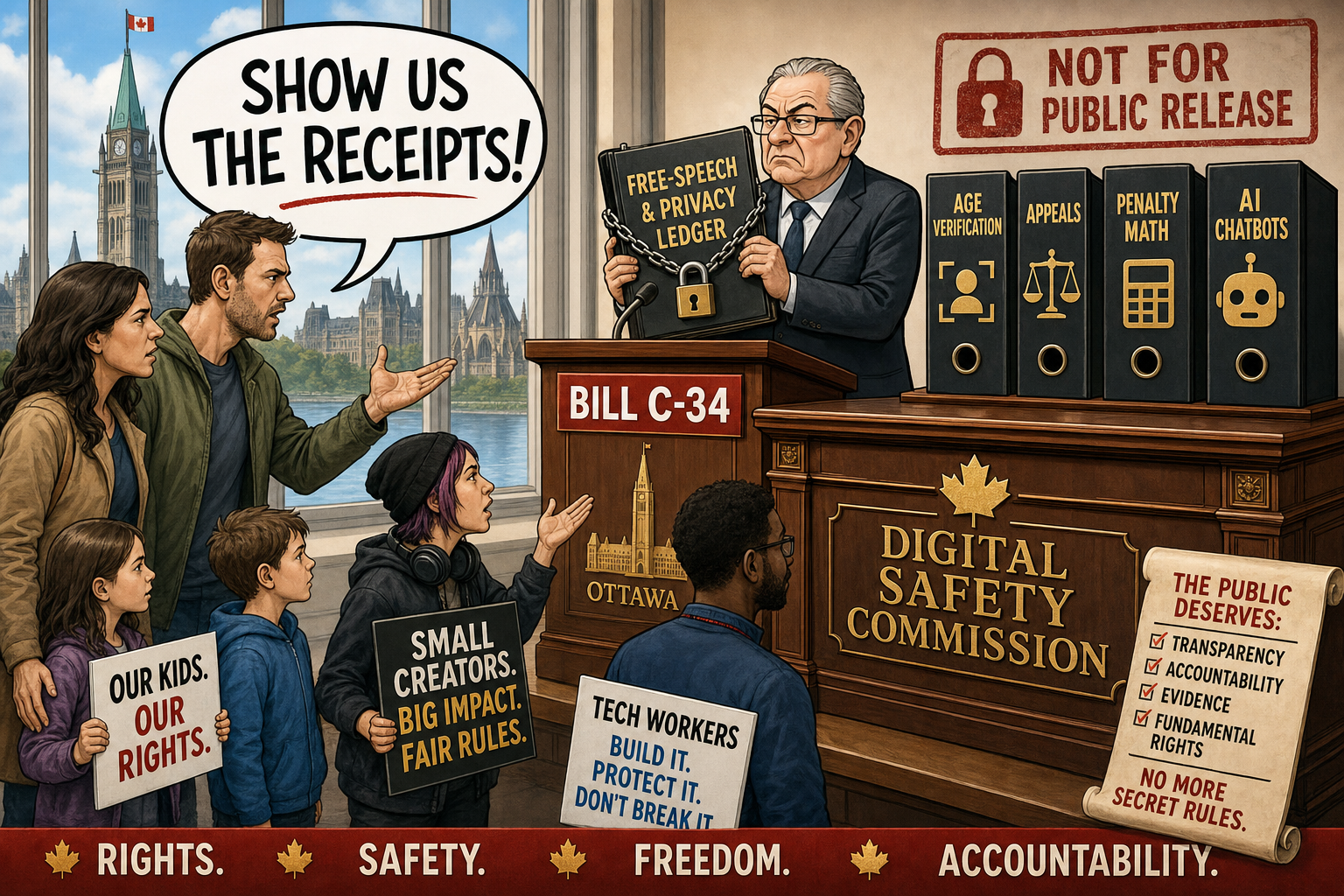
Bill C-34 is back on the public docket at exactly the moment Canadians should be demanding caution, not slogans. Canadian Heritage’s own Bill C-34 page was updated September 8, 2026. It says the Safe Social Media Act was introduced June 10 and would enact two new laws: the Digital Safety Act and the Digital Safety Commission of Canada Act.
Parliament’s LEGISinfo page lists C-34 as a House government bill at second reading in the House of Commons, with no recorded votes and no second-reading activity shown. That means MPs still have time to do the basic accountability work before Ottawa builds a permanent regulator for speech-adjacent online conduct.
The government’s child-safety objectives include real problems: child sexual exploitation, non-consensual intimate images, child self-harm content, bullying of children, incitement to violence, terrorism or violent extremism content, and content that foments hatred. Conservatives should not minimize those harms. Predators should be prosecuted. Criminal material should be removed. Parents should have stronger tools.
But the same official page also says regulated social-media services and AI chatbot services would face duties to protect children, act responsibly, make certain content inaccessible, publish Digital Safety Plans and transparency reports, and answer to a new Digital Safety Commission. The Commission would audit compliance, issue orders, penalize services, handle complaints and make regulations on age estimation, age verification and age-appropriate design. That is not a narrow press release. It is a machinery-of-government bill.
The bill text confirms why the public ledger matters. Operators must submit Digital Safety Plans containing risk assessments, mitigation measures, moderation volumes, flags, timelines, automated-decision resources and law-enforcement notification information. The bill also includes administrative penalties up to the greater of $10 million or 3% of gross global revenue for violations, and offence fines for operators up to 5% of gross global revenue or $20 million on indictment.
Independent scrutiny has already raised the obvious civil-liberties warning. Rebel News reported that private advisory-group minutes, obtained through access to information, show renewed discussion around government policing of platforms, lawful speech, memes and private messaging. Ottawa does not have to accept Rebel’s framing to answer the concern. It only has to release the records.
Before second reading advances, the Carney government should publish a plain-language C-34 ledger: the 2026 Expert Advisory Group minutes and attendance, conflict disclosures, exact content-removal thresholds, the age-verification privacy model, private-message boundaries, AI-chatbot obligations, appeal timelines, Commission appointment rules, inspection powers and penalty math. If the bill is truly targeted, the ledger will prove it. If the ledger stays locked, MPs should not hand Ottawa the keys.
- Canadian Heritage: Bill C-34, the Safe Social Media Act
- Parliament of Canada: Bill C-34 LEGISinfo status
- Parliament of Canada: First-reading text of Bill C-34
- Rebel News: Report on advisory-group minutes
- iVoteLiberal.com: Censorship tracker and duplicate check
This article supports serious child-protection enforcement while demanding public records, privacy safeguards, appeal rights and statutory limits before federal internet-regulation powers expand.