One St. John’s Groundbreaking Is Not a Housing Plan
A shovel photo is easy. A public delivery ledger is the real test.
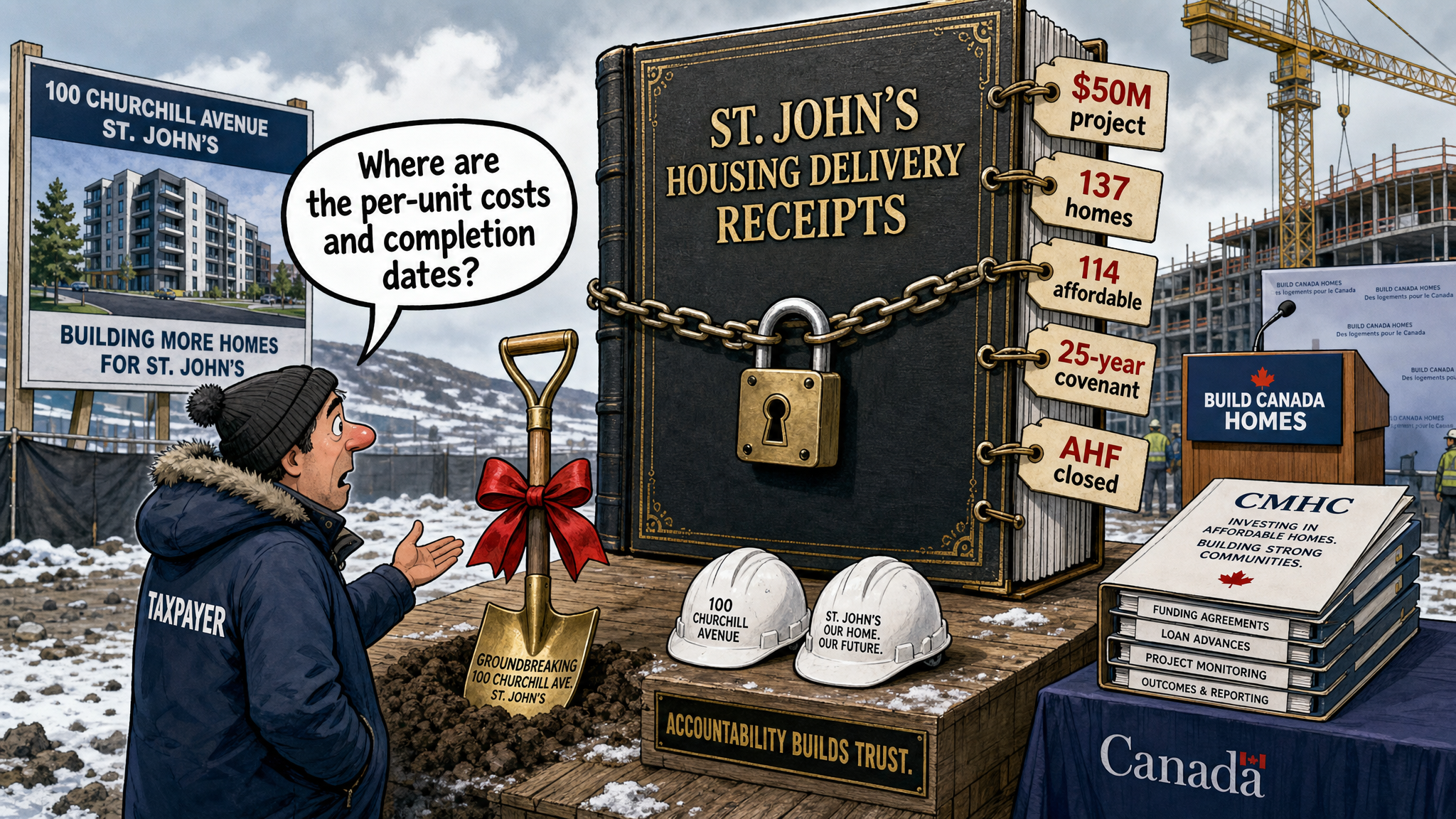
CMHC announced on September 8 that ground has been broken for the 100 Churchill Avenue project in St. John’s, calling it the largest community-housing project in Newfoundland and Labrador in more than 40 years. The release says the development will deliver 137 new homes, including 114 affordable homes that will remain affordable for at least 25 years.
Those homes may be badly needed. But conservatives should be clear about the difference between welcoming construction and suspending accountability. Ottawa does not get to convert one local groundbreaking into a national victory lap unless taxpayers can see what is being bought, when it will be delivered, who is responsible if milestones slip, and how affordability will be enforced after the cameras leave.
The dollar figures are specific enough to audit. CMHC describes an approximately $50 million project supported by up to $11.4 million from Build Canada Homes, $24.2 million through CMHC’s Affordable Housing Fund, up to $8.3 million from Newfoundland and Labrador, and more than $480,000 from the City of St. John’s. That is public money from several directions. It should come with a single public table showing land value, grants, loans, operating subsidies, recipient agreements, procurement status, contingency costs and the all-in public exposure per completed unit.
The affordability claim deserves the same scrutiny. “Affordable for at least 25 years” is not self-enforcing. Canadians should see the covenant, rent-setting formula, eligible-tenant rules, annual reporting requirements, breach remedies and what happens in year 26. If federal officials can put the affordability promise in a press release, they can publish the mechanism that makes the promise real.
This announcement also lands against a tougher national backdrop. CMHC’s 2026 outlook said new home construction is set to decline through 2028 as developers face high costs, weaker demand and unsold inventory. The Carney government’s Build Canada Homes launch promised to scale affordable housing supply, use public lands, deploy flexible financing, and help build faster. That promise cannot be measured by podiums. It has to be measured by starts, completions, per-unit costs and net-new capacity.
There is another reason for disclosure: CMHC’s St. John’s release says the Affordable Housing Fund application portal is closed because all funding has been committed. If the old program cupboard is closed while a new Build Canada Homes brand appears on the cheque, Canadians deserve to know whether Ottawa is adding new capacity or rebadging an existing pipeline.
The fix is straightforward. Publish the St. John’s unit ledger now: construction schedule, funding agreements, cost per unit, affordability covenant, operating-cost assumptions, federal exposure, inspection dates and completion deadlines. Then update it monthly until every promised home is occupied.
One groundbreaking is good news for one site. It is not proof of a working national housing plan. The proof is the receipt.
- CMHC: Ground broken on largest community housing project in Newfoundland and Labrador in over 40 years — September 8, 2026
- CMHC: Housing Market Outlook 2026
- Prime Minister of Canada: Prime Minister Carney launches Build Canada Homes — September 14, 2025
This article supports transparent housing delivery and value-for-money controls. It does not allege wrongdoing by Avalon Housing Trust, CMHC, Build Canada Homes, Newfoundland and Labrador, St. John’s or any public official.