Bill C-34’s Internet Regulator Needs the Missing Minutes
Ottawa wants a new internet regulator while key advisory, privacy and delegation records are still missing.
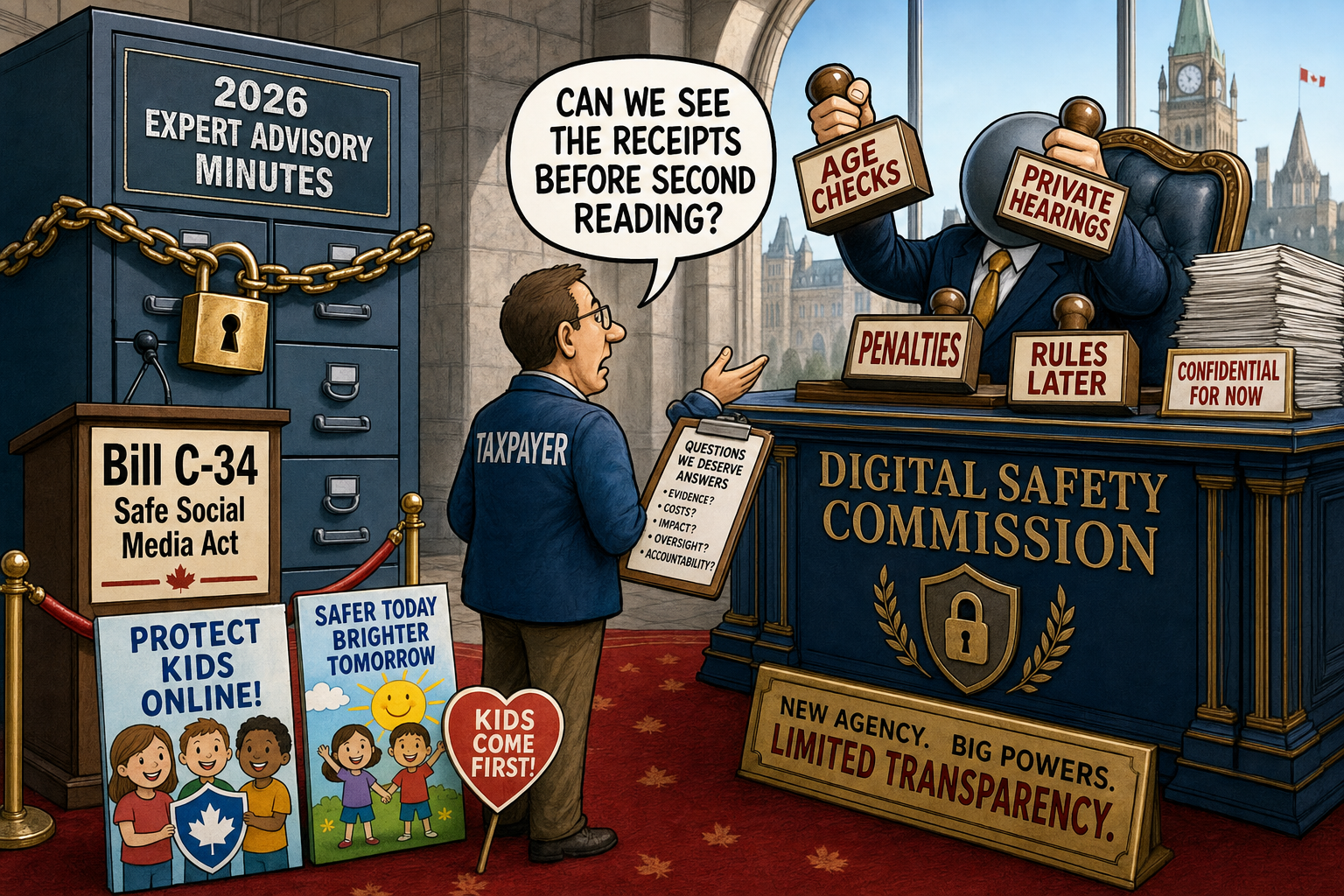
Bill C-34 is being sold as child safety. That is the strongest possible sales pitch for any internet bill. It is also exactly why Parliament should slow down and demand the receipts before handing Ottawa a new regulator for social media and AI chatbots.
Parliament’s LEGISinfo page lists Bill C-34, the Safe Social Media Act, as a government bill at second reading in the House of Commons, with first reading on June 10, 2026 and no recorded votes. The bill would enact the Digital Safety Act and the Digital Safety Commission of Canada Act. That is not a small housekeeping bill. It is a new federal online-safety architecture.
Canadian Heritage says regulated social media and AI chatbot services would have to identify risks, adopt measures, implement age-appropriate design features, provide user tools, and publish Digital Safety Plans. The department also says the new Digital Safety Commission would enforce obligations, audit compliance, issue compliance orders, impose penalties, handle complaints, and make regulations on matters such as age verification and age-appropriate design.
Here is the accountability problem: Canadian Heritage says Bill C-34 was informed by a reconvened Expert Advisory Group on Online Safety that met from March to May 2026, but its own page still says summaries of those 2026 sessions will be available soon. If the advice shaped the bill, Canadians should see the minutes, attendance, conflict disclosures, dissenting views and civil-liberty warnings before MPs move the bill forward.
Rebel News reported September 1 that private meeting minutes obtained through access to information show the previous online-harms advisory circle was brought back under the Carney government, with discussion touching government policing of platforms, lawful-but-awful content, memes and private messaging. Those are serious claims. The answer is not to ask Canadians to trust either the government or its critics. The answer is to publish the record.
Michael Geist’s analysis sharpens the same concern from a legal-policy angle. He argues the Commission would carry wide rule-making and enforcement powers, including age-verification standards, inspections, penalties, private hearings in some cases, and a transitional setup where a single appointed chair could initially exercise Commission powers. The government may dispute the warning. Fine. Then publish a plain-language powers ledger and let Canadians judge it clause by clause.
Conservatives should say this plainly: protect children online, prosecute predators, remove child sexual abuse material, and give families better tools. But do not hide a speech-and-privacy regime behind a child-safety slogan. Age checks can become identity checks. Safety plans can become compliance theatre. A regulator built first and explained later can become a permanent pressure point over lawful expression.
Before second reading advances, Ottawa should release the 2026 advisory-group minutes, the draft regulation list, the age-verification privacy standard, the Commission appointment criteria, limits on any one-chair transition, and a table showing every power delegated to cabinet or the Commission. If Bill C-34 is as narrow and careful as advertised, the receipts should prove it. If the receipts stay locked away, MPs should not reward the secrecy with more power.
- Parliament of Canada: Bill C-34 LEGISinfo status
- Canadian Heritage: Bill C-34, the Safe Social Media Act
- Canadian Heritage: Backgrounder on regulated services and the Digital Safety Commission
- Rebel News: Report on advisory-group minutes
- Michael Geist: Analysis of the Digital Safety Commission powers
This article supports child-protection enforcement while demanding public records, privacy safeguards and statutory limits before Parliament expands federal internet-regulation powers.